
AI Agent Audit Trails: Why Application Logs Are Not Evidence
Jun 11, 2026

Thomas Hepp
Jun 11, 2026

The Audit That Will Expose Your AI System Has Already Started
When a major European bank faced regulatory scrutiny in 2023 after its AI-driven credit-scoring system produced discriminatory outcomes, investigators discovered that the application logs had been overwritten during routine maintenance, leaving no verifiable record of what the model had actually decided or why. The bank could not prove its system had behaved lawfully. It could not prove it had misbehaved, either. It simply had no evidence.
That scenario is playing out across industries. An AI agent makes a credit decision. A patient triage recommendation. A procurement approval. Somewhere in your infrastructure, a log file records it. When a regulator, a judge, or a forensic auditor asks you to prove what happened, that log file will not be enough.
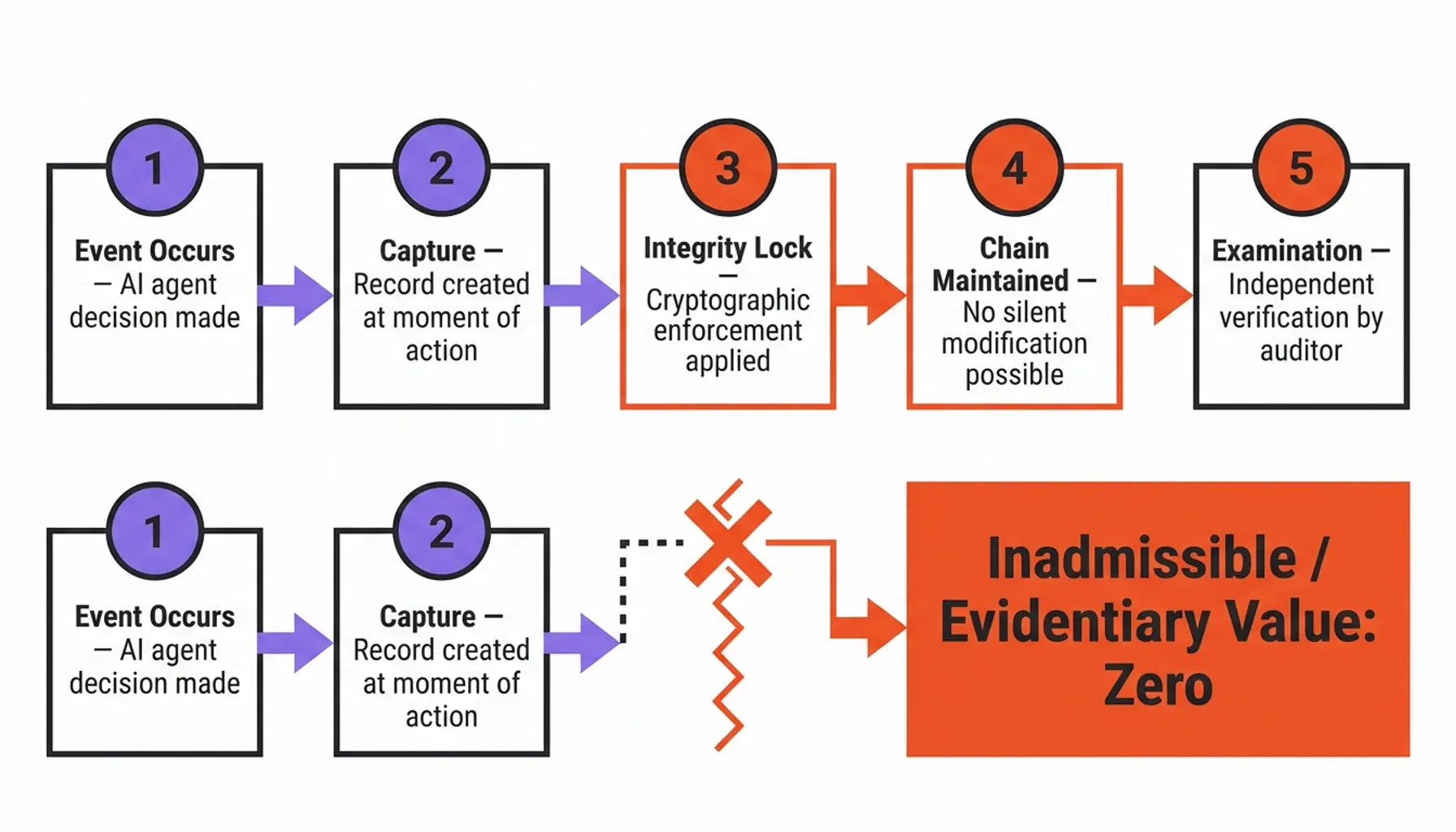
Think of it like chain of custody in criminal forensics. When physical evidence is collected at a crime scene, every person who handles it must sign for it, every transfer must be documented, and the integrity of the evidence must be provable from collection to courtroom. Break that chain anywhere, even once, and the evidence becomes inadmissible. Enterprise AI logs have no equivalent chain. Any administrator with sufficient privileges can alter them silently, and no one will know.
This is not a theoretical risk. As autonomous AI systems move from experimentation into production workflows, the gap between "we have logs" and "we have evidence" is becoming one of the most consequential blind spots in enterprise technology. Standard application logs were built for engineers, not courts. They answer "did the system crash?", not "who authorized this decision, and can you prove it was not altered?"
The regulatory environment is closing in fast. The EU AI Act's transparency and accountability requirements are not optional for high-risk AI deployments. The penalties for non-compliance are not abstract, they are existential. Understanding the difference between operational logging and forensically valid audit trails is no longer a DevOps concern. It is a board-level liability.
The AI Accountability Gap: When Logs Fail the Audit
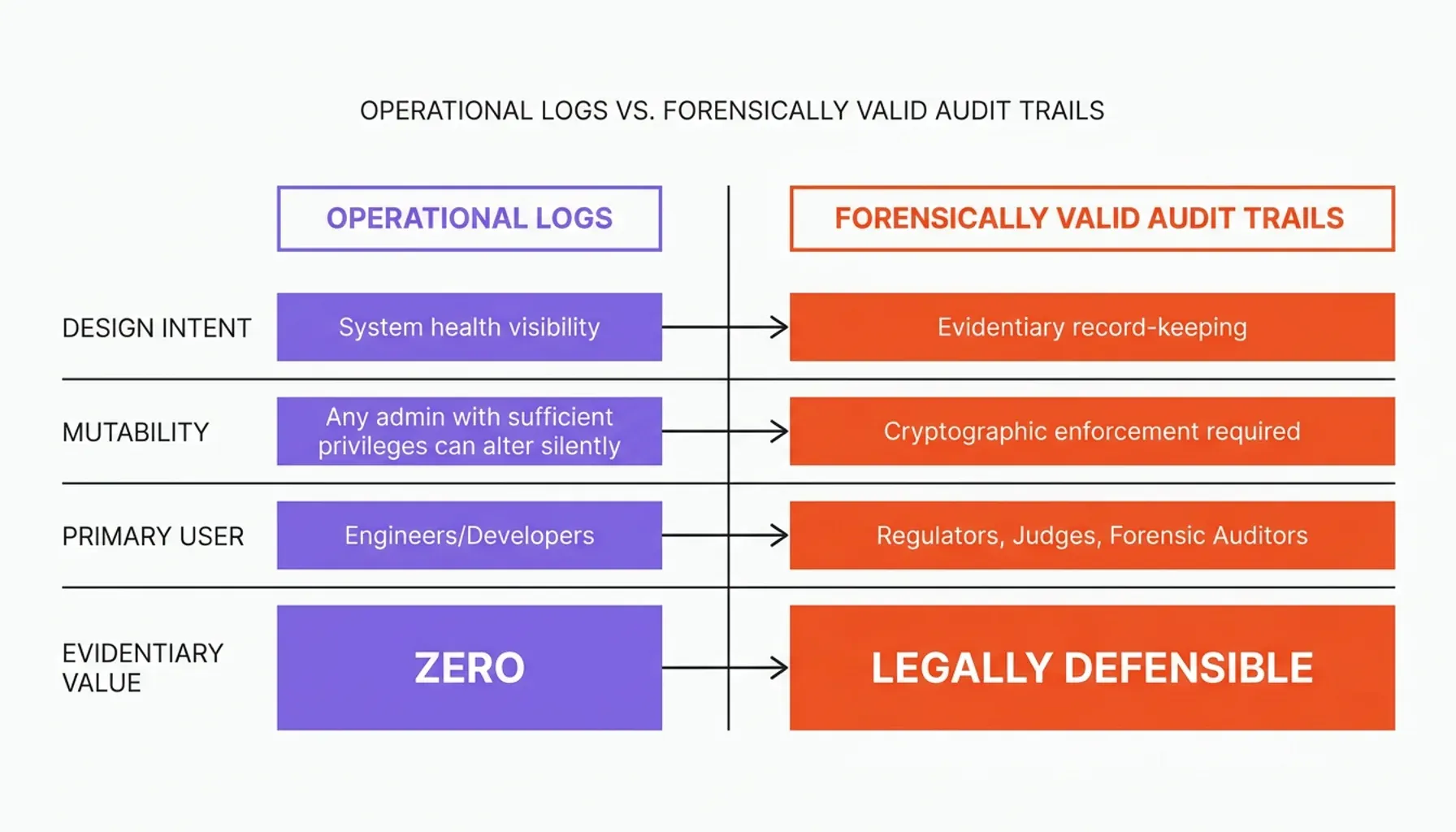
Most organizations miss a fundamental distinction until it is too late: the difference between operational monitoring and evidentiary record-keeping. Operational logs track system health, latency spikes, error rates, memory consumption. They help engineers diagnose problems and restore service. They were never designed to withstand cross-examination.
AI agents expose this gap dramatically. Unlike deterministic software, an AI agent does not follow a fixed code path. It reasons, infers, and acts, often in ways that cannot be predicted from the input alone. When an agent makes a consequential decision, the relevant question is not just what it did, but why, under whose authority, and can you prove the record of that decision has not been touched since it was created?
Traceability is a core requirement for trustworthy AI systems under the NIST AI Risk Management Framework. But traceability requires more than a text file with a timestamp. It requires proof that the record is authentic, that no administrator, malicious actor, or routine system update has silently modified it.
Here's the thing. Forensic auditors have a name for what a mutable log file provides: the "Evidentiary Value of Zero." A log that any admin with sufficient privileges can edit provides no legal or regulatory assurance whatsoever. It is a starting point for investigation, not a conclusion. When regulators ask for proof of what your AI agent decided at 14:37:22 on a specific date, a text file stored on your own servers does not answer the question. It raises more of them.
Just as a broken chain of custody renders physical evidence inadmissible, a mutable log renders a digital record legally worthless. The chain must be unbroken from the moment of capture to the moment of examination, and that requires cryptographic enforcement, not policy.
The shift in AI accountability frameworks is clear: the question is no longer "what happened?" but "who authorized this decision, and can that authorization be independently verified?" For C-level executives and compliance officers, this distinction carries direct personal liability.
The Anatomy of a Defensible Audit Trail vs. System Logs
Understanding what separates a forensically valid audit trail from a standard application log requires examining the design intent behind each.
Operational logs are built for developers. They are transient by nature, rotated, compressed, archived, or deleted based on storage constraints. Their primary function is system health visibility. They record events in human-readable or structured formats, but carry no inherent integrity guarantee. The timestamp on a log entry reflects the system clock at the time of writing: a clock that can be adjusted, a file that can be overwritten.
Audit trails are built for regulators, investigators, and courts. They are permanent, immutable, and focused on the chain of causality: who did what, when, under what authority, and what was the outcome. A true audit trail must answer these questions in a way that is independently verifiable, meaning the answer cannot change based on who controls the server.
The gold standard for forensic validity in regulated industries is the ALCOA+ framework, originally developed for pharmaceutical data integrity: Attributable, Legible, Contemporaneous, Original, and Accurate, with extensions for Complete, Consistent, Enduring, and Available. Every one of these criteria fails in a standard application log environment when an adversarial or negligent actor has administrative access.
This brings us to the most underappreciated security flaw in enterprise logging: admin access. In virtually every traditional logging architecture, a sufficiently privileged administrator can modify or delete log entries. This is not a bug. It is an architectural assumption baked into systems built before AI accountability was a regulatory requirement. ISO/IEC 27001 Annex A.12.4 mandates protection of log information, but technical enforcement requires more than access controls. It requires cryptographic proof that the log has not changed since it was written.
For AI agent environments specifically, the audit trail must capture not just the output of a decision, but the full decision context: the input prompt, the model version, the inference parameters, the retrieved data sources, and the resulting action. Without this chain of custody, that forensic thread running from input to output to consequence, the audit trail is incomplete. And an incomplete audit trail is legally equivalent to no audit trail.
For a deeper look at how autonomous decision-making creates new demands on AI governance frameworks, the architectural conclusion is consistent: immutability must be enforced at the infrastructure level, not the policy level.
The Failure Modes of Modern AI Logging
Most companies get this wrong. They deploy AI agents using logging architectures that were not designed for the threat model they now face. The failure modes are specific and serious.
Silent Alteration is the most dangerous. A rogue administrator, a compromised insider, or an attacker who has achieved privilege escalation can rewrite log history. In an AI context, this means an agent's hallucination, unauthorized action, or policy violation can be erased before a forensic investigation begins. No alarm sounds. No visible seam appears. The log simply reflects a different reality.
The Ordering Fallacy is a subtler problem. In high-frequency agent environments, where dozens of microservices generate events simultaneously, standard log timestamps do not guarantee sequence. System clocks drift. Network latency introduces ordering errors. An event logged at timestamp T2 may have actually occurred before an event at T1. In a forensic context, this means the causal chain of an AI agent's decision-making cannot be reliably reconstructed from timestamps alone.
Contextual Fragmentation compounds the problem in distributed architectures. When an AI agent operates across multiple microservices, a retrieval service, an inference engine, an action executor, a feedback loop, the prompt-to-output relationship is distributed across multiple log streams. Reconstructing a complete, coherent record of a single agent decision requires joining data from systems that may not share a common time reference, log format, or retention policy.
Regulatory non-compliance is the direct consequence. The EU AI Act's requirements for high-risk AI systems, particularly Article 12 on logging and traceability, are explicit: logs must be automatically generated, retained for a defined period, and sufficient to enable post-hoc reconstruction of the system's behavior. Standard application logs, with their mutability and fragmentation, do not meet this standard. The financial and operational consequences of AI Act non-compliance are severe enough to make this a strategic, not just technical, priority.
Insufficient logging and monitoring ranks as a primary vulnerability class for large language model applications, not because logs are missing, but because the logs that exist cannot be trusted as evidence.
Anchoring Truth: Blockchain Timestamps as the Integrity Layer
Better access controls will not solve this. Access controls can be bypassed. The solution is cryptographic proof of integrity that is independent of the infrastructure that generated the log.
This is where blockchain timestamping changes the architecture fundamentally.
The process begins with SHA-256 hashing. Every log entry, every agent decision record, every event in the audit trail converts into a unique cryptographic fingerprint. SHA-256 produces a fixed-length hash that is deterministic, the same input always produces the same hash, and collision-resistant, meaning it is computationally infeasible to produce two different inputs with the same hash. The hash of a log entry is therefore a unique, mathematically verifiable representation of that entry's exact content at a specific moment.
That hash then anchors to a public blockchain, Bitcoin or Ethereum. The blockchain's distributed consensus mechanism means that once a transaction is confirmed, altering it requires rewriting the entire subsequent chain, a task that is computationally impossible at current network scale. The result is a timestamped proof of existence: a mathematical guarantee that a specific piece of data existed in a specific form at a specific point in time, verifiable by anyone, dependent on no single authority.
This is the critical distinction from traditional timestamping approaches. RFC 3161 defines a trusted timestamping protocol using PKI infrastructure, but that infrastructure is centralized. If the timestamp authority is compromised, or simply ceases to exist, the timestamp's validity comes into question. Blockchain anchoring removes this single point of failure entirely.
Return to the chain-of-custody analogy. Blockchain anchoring is the equivalent of sealing physical evidence in a tamper-evident bag and logging it into a publicly auditable registry the moment it is collected. Anyone can verify the seal. No one can break it quietly. That is exactly what cryptographic anchoring does for AI agent decision records.
For AI agent audit trails, this means every critical decision record, the prompt, the model state, the output, the action taken, can be hashed and anchored in real time. Any subsequent attempt to alter that record produces a different hash, which will not match the blockchain anchor. The tampering is mathematically detectable, permanently, by anyone with access to the public chain.
Importantly, this process does not require exposing sensitive data. The hash anchors to the chain, not the underlying content. Proprietary training data, confidential inference parameters, and personally identifiable information remain within your controlled environment. Only the fingerprint goes to the chain. This is the architecture that makes tamper-proof event logging for SIEM and forensic environments viable at enterprise scale without compromising data sovereignty.
For a broader view of how cryptographic anchoring applies across the AI data lifecycle, blockchain timestamping in the AI era covers the underlying mechanisms in depth.
Building for Forensics: From SIEM Integration to Courtroom Admissibility
A Security Operations Center running a modern SIEM platform has significant visibility into system events. What it typically lacks is a mechanism to prove, to an external party, that the events it recorded have not been modified since capture.
This is the Zero-Trust problem applied to logging. Zero-Trust architecture assumes that no internal system, user, or process should be trusted by default. Yet most SIEM deployments implicitly trust their own log storage, which means an attacker who compromises the logging infrastructure can erase their tracks. The SIEM becomes a liability instead of an asset.
Enterprise security leaders are increasingly prioritizing external integrity validation for SIEM platforms precisely because this gap is now well understood. The requirement is non-repudiation: a cryptographic guarantee that neither the AI agent, nor its developer, nor the system operator can credibly deny a specific recorded action. Non-repudiation requires that the record of the action be independently verifiable, which means it must be anchored outside the system that generated it.
For post-breach forensics, this matters enormously. When an attacker achieves persistence in an enterprise environment, one of the first priorities is evidence wiping, deleting or modifying logs that reveal the intrusion timeline, the lateral movement path, or the data exfiltration scope. Blockchain-anchored logs make evidence wiping futile. The hashes are already on the chain. Any modified log file fails integrity verification immediately.
For AI-specific incidents, an agent that took an unauthorized action, a model that produced a biased output with regulatory consequences, a system manipulated through prompt injection, the same principle applies. The audit trail must be provably complete and provably unaltered from the moment of capture.
This is also where the concept of revisionssichere Archivierung, audit-proof archiving as defined under German GoBD and Swiss GeBüV standards, becomes directly relevant to AI governance. These frameworks require that archived records be protected against alteration, deletion, and unauthorized access in a way that is independently verifiable. Blockchain-sealed audit trails meet this requirement by design.
The bridge between raw SIEM data and a forensically valid, court-admissible record runs through cryptographic integrity. Immutable log infrastructure for SOC and forensics environments provides the integrity layer that transforms operational data into defensible evidence.
Best Practices for Implementing AI Agent Audit Trails
Knowing that standard logs are insufficient is one thing. Building a replacement that actually holds up under forensic scrutiny is another. The following practices define the difference between a compliant-looking system and a genuinely defensible one.
Capture the Full Decision Context, Not Just the Output
The most common implementation mistake is logging only the AI agent's final output. A forensically valid audit trail must capture the complete decision record: the input prompt or trigger event, the model version and configuration, the inference parameters, any retrieved data sources (in RAG architectures), the output, the action taken, and the identity of any human or system that authorized the action. Logging the output without the context is like preserving a verdict without the trial transcript, it tells you what was decided, but not whether the decision was lawful.
Enforce Immutability at the Infrastructure Level, Not the Policy Level
Access control policies can be changed. Administrators can be coerced or compromised. Immutability must be enforced cryptographically, through blockchain anchoring, so that no policy change, no administrative override, and no infrastructure compromise can alter a historical record without detection. This is the architectural equivalent of sealing evidence at the crime scene rather than trusting the evidence room.
Use Append-Only Log Streams with Cryptographic Chaining
Within your logging infrastructure, implement append-only streams where each new entry includes a cryptographic hash of the previous entry. This creates an internal chain of integrity that makes insertion or deletion of historical records detectable even before blockchain verification. Combined with external anchoring, this provides two independent layers of tamper detection.
Timestamp at the Moment of Event, Not the Moment of Storage
Log entries are often written asynchronously, buffered, batched, and stored seconds or minutes after the event they describe. For forensic purposes, the timestamp must reflect when the event occurred, not when it was written to disk. Implement event-time timestamping at the point of generation, and anchor that timestamp cryptographically before the event enters any mutable buffer.
Maintain a Separate, Decoupled Audit Store
The audit trail must live independently of the system it monitors. Co-locating audit logs with operational infrastructure creates a single point of compromise: an attacker or administrator who controls the AI system also controls its audit record. Decoupled storage, preferably cross-jurisdictional and operated by a separate organizational unit, ensures that compromising the AI system does not automatically compromise its audit trail.
Define and Document Retention Policies Aligned to Regulatory Requirements
The EU AI Act requires that logs for high-risk AI systems be retained for a minimum period sufficient to enable post-hoc investigation. GDPR intersects this requirement with data minimization obligations. Define retention policies that satisfy both: retain the cryptographic hashes and metadata indefinitely (they contain no personal data), while applying appropriate retention limits to the underlying content. Document these policies formally and review them against evolving regulatory guidance.
Test Integrity Verification Regularly
An audit trail that has never been verified is an audit trail that may not work when it matters. Build automated integrity verification into your operational processes: regularly re-hash stored records and confirm they match their blockchain anchors. Any discrepancy is an immediate incident. Regular verification also demonstrates to regulators and auditors that your integrity controls are operational, not merely theoretical.
Integrate Audit Trail Generation into the AI Development Lifecycle
Audit trail requirements should not be retrofitted after deployment. Define the critical decision points, logging schema, and anchoring requirements during the design phase of every AI agent. This is the same principle that drives security-by-design: building accountability into the architecture from the start is dramatically less expensive than adding it after the fact, and far more defensible under regulatory scrutiny.
The question of what constitutes a trustworthy AI record extends beyond logs. How AI-generated content establishes provenance and integrity applies the same cryptographic principles to a different but related challenge.
Strategic Implementation: Transitioning to Immutable AI Records
Transitioning from standard application logging to a forensically valid, immutable audit trail for AI agents is an architectural change. It does not require replacing existing infrastructure. It requires adding an integrity layer on top of it.
Step 1: Identify Critical Decision Points (CDPs)
Not every log entry carries equal evidentiary weight. The first implementation step is mapping the AI agent's workflow to identify the specific events that require forensic-grade integrity: authorization decisions, data access events, model inference outputs, action executions, and any event that triggers a downstream consequence in a regulated process. These are your CDPs, the moments where "we have a log" must become "we have proof."
Step 2: Implement Automated, Real-Time Hashing and Anchoring
At each CDP, the event record, including full context: input, model version, parameters, output, timestamp, and actor identity, is automatically hashed using SHA-256. The hash is submitted for blockchain anchoring in real time or near-real time. This process is lightweight, adds negligible latency, and requires no modification to the underlying AI system. The anchoring happens at the logging layer, not the application layer.
Step 3: Decouple Audit Storage from the Operational Environment
The audit trail must be stored independently of the system it monitors. If the audit log lives on the same infrastructure as the AI agent, an administrator with access to that infrastructure can potentially modify both. Decoupled storage, ideally with cross-jurisdictional redundancy, ensures that the audit trail cannot be compromised by a single point of administrative access.
Future-Proofing for 2026-2027 Compliance Deadlines
The EU AI Act's full enforcement timeline for high-risk AI systems runs through 2026 and 2027. Organizations that build immutable audit infrastructure now will not be scrambling to retrofit compliance when enforcement begins. Proactive AI accountability infrastructure is consistently the most cost-effective compliance strategy, retroactive compliance is orders of magnitude more expensive.
The broader implications of the EU AI Act's penalty structure make a compelling business case: the cost of implementing tamper-proof logging is a fraction of the minimum fines for high-risk AI violations.
From Reactive to Proactive
The organizations that will navigate AI accountability successfully are not those with the most logs. They are those with the most defensible logs. The shift from reactive logging, capturing events after the fact and hoping they are sufficient, to proactive, tamper-proof audit infrastructure is the difference between an AI deployment that can withstand scrutiny and one that cannot.
This is not a future consideration. Regulators are already asking for AI audit trails. Forensic investigators are already encountering the evidentiary value of zero in enterprise log files. The question is not whether your AI agent audit trails will be examined. It is whether they will hold up when they are.
Conclusion: Evidence Is Not an Afterthought
Standard application logs are a liability masquerading as a safeguard. They record events but cannot prove them. They capture decisions but cannot defend them. As AI agents take on greater authority in enterprise workflows, and as regulators, courts, and forensic auditors develop the tools and mandates to examine those decisions, the gap between "we have logs" and "we have evidence" will define organizational accountability.
The chain-of-custody principle that makes physical evidence admissible in court has a direct digital equivalent. SHA-256 hashing, blockchain anchoring, decoupled storage, and Zero-Trust logging principles are not experimental technologies. They are deployable today, at scale, without disrupting existing AI infrastructure. They close the chain.
The AI content provenance challenge and the AI audit trail challenge share the same root: digital records are only as trustworthy as the integrity guarantees that protect them. Blockchain timestamping provides those guarantees in a form that is mathematically verifiable, legally defensible, and independent of any single authority.
If your AI agents are making decisions that matter, explore how blockchain-sealed, court-admissible log integrity for SIEM and forensic environments can close the gap between what your logs record and what your logs can prove.
Thomas Hepp
Co-Founder
Thomas Hepp is the founder of OriginStamp and creator of the OriginStamp timestamp, which has set the standard for tamper-proof blockchain timestamps since 2013. As one of the earliest innovators in the field, he combines deep technical expertise with a pragmatic focus on solving real business problems, and is a recognized voice in blockchain security, AI analytics, and data-driven decision support. His work has earned multiple international awards, including a top Best Project recognition from ETH Zurich and the Swiss Confederation. He publishes regularly on blockchain, AI, and digital innovation.