
Digital Chain of Custody: Proving Evidence Integrity with Hashes
Jun 11, 2026

Thomas Hepp
Jun 11, 2026

The Fragility of Digital Evidence in Modern Litigation
A single altered timestamp. A deleted log entry. A file opened by the wrong administrator at the wrong time. These are not hypotheticals. They are the exact vectors used to challenge digital evidence in courtrooms every year. And they work.
The shift from physical to digital evidence has fundamentally changed the rules of proof. Physical evidence leaves traces: fingerprints, wear marks, chain-of-custody forms signed in ink. Digital files leave nothing unless you build the infrastructure to capture it. Copy a file and the operating system updates the access timestamp. Open it in the wrong viewer and metadata changes. Transfer it across systems and provenance becomes a matter of testimony rather than mathematics.
Chain of custody for digital evidence is the documented, unbroken record of who collected a digital artifact, who handled it, where it was stored, and whether it was altered at any point between collection and presentation. Courts require this record not as a formality, but because digital files are uniquely easy to manipulate without visible trace.
The legal standard in U.S. federal proceedings is codified in Federal Rule of Evidence 901, which requires the proponent of evidence to demonstrate that the item is what it is claimed to be. For electronically stored information (ESI), this means proving authenticity through metadata, access logs, or, increasingly, cryptographic verification.
NIST digital forensics guidelines frame the core challenge plainly: the integrity of digital evidence must be maintained from the moment of acquisition through every subsequent transfer. Any gap in that record is a gap opposing counsel will exploit.
The question is not whether your evidence was tampered with. The question is whether you can prove it wasn't.
When Your Proof Has an Expiration Date
Before examining the mechanics of cryptographic verification, consider a risk most legal and compliance teams overlook entirely: vendor-dependent proof expires.
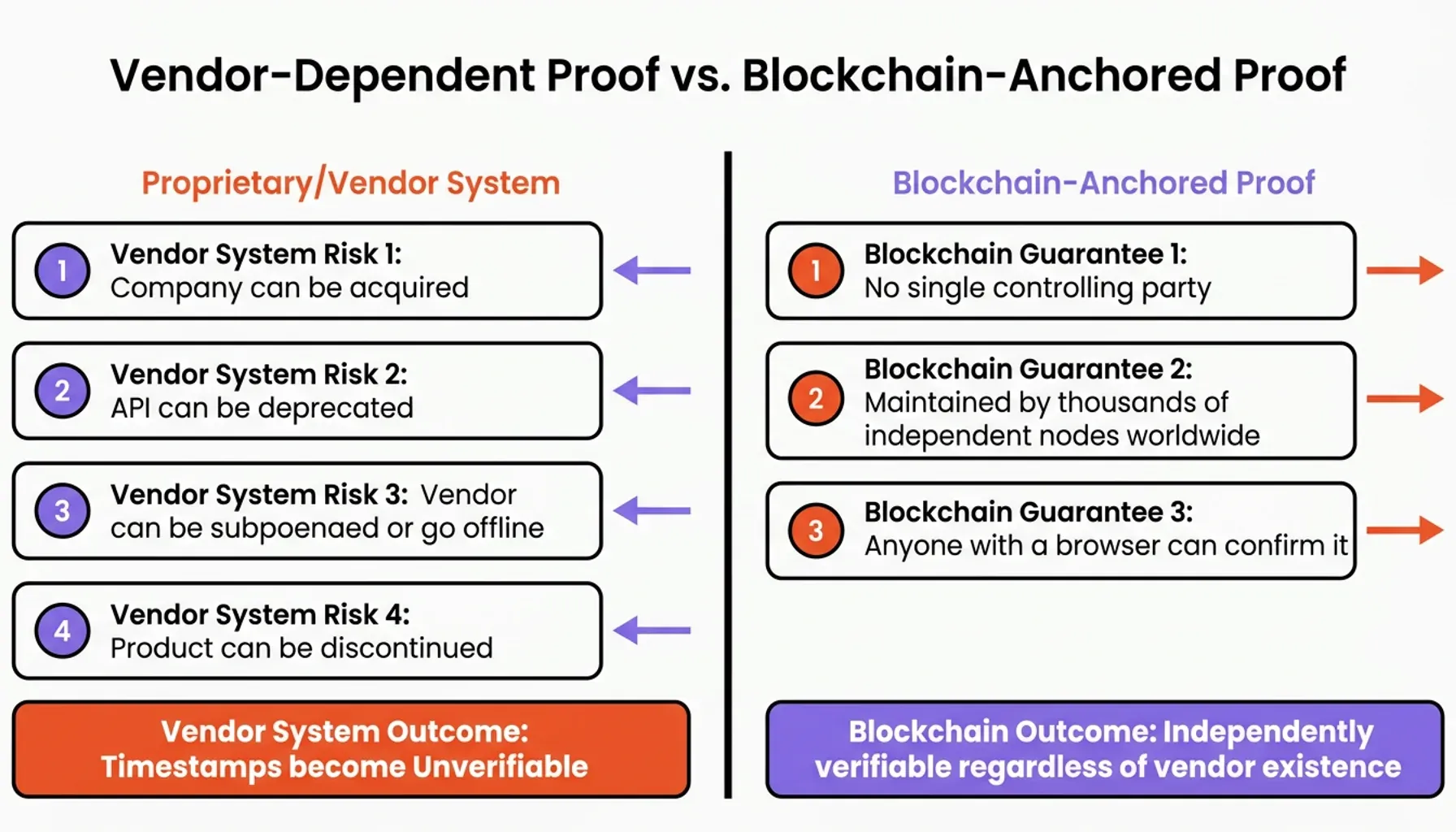
If your chain of custody relies on timestamps issued by a proprietary platform, a closed SaaS service, a vendor-managed logging system, or an enterprise forensics tool, then your proof is only as durable as that vendor's continued existence and cooperation. The company can be acquired. The API can be deprecated. The vendor can be subpoenaed, go offline, or simply discontinue the product. When that happens, your timestamps become unverifiable. Not disputed. Unverifiable. The difference matters enormously in litigation.
This is the concept of digital sovereignty over evidence: the principle that proof of integrity should be anchored to infrastructure that no single party controls, and that no single party can revoke. Bitcoin's blockchain and Ethereum's blockchain are public, decentralized ledgers maintained by thousands of independent nodes worldwide. A timestamp anchored there does not depend on OriginStamp's continued operation to be verified. It does not depend on any vendor. It exists as long as those networks exist, and anyone with a browser can confirm it.
This is a genuinely different class of proof from anything a proprietary system can offer. Your organization's forensic records, litigation holds, and compliance archives deserve infrastructure that will still be independently verifiable in ten years, regardless of which vendors are still in business.
The rest of this article explains how to build that infrastructure, starting with the mathematical foundation that makes it work.
The Three Pillars of Digital Admissibility
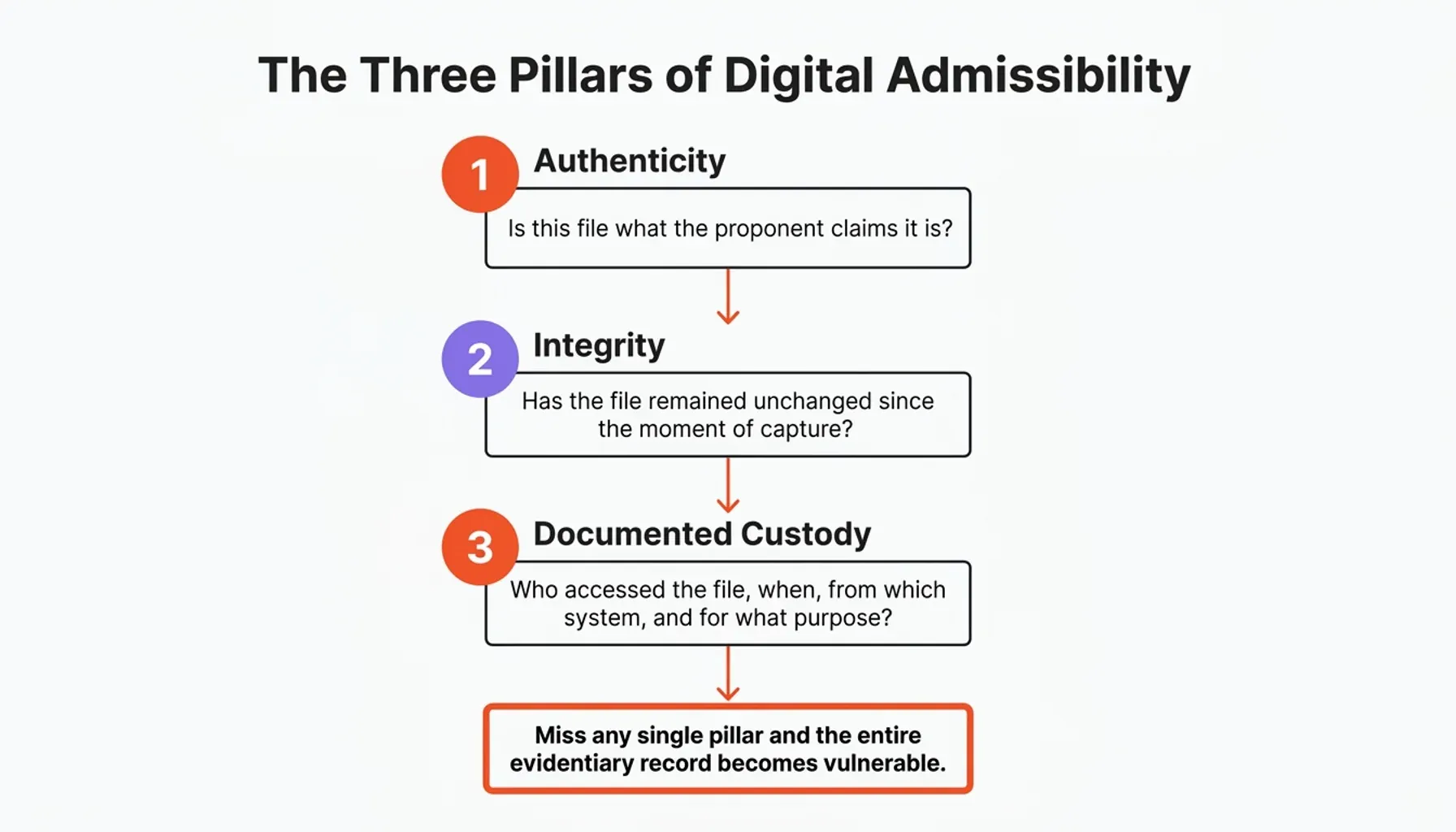
Courts and forensic practitioners converge on three requirements that digital evidence must satisfy before it can be relied upon. Miss any one of them and the entire evidentiary record becomes vulnerable.
Authenticity is the threshold question: is this file what the proponent claims it is? A contract, a log file, a surveillance recording, each must be tied to its claimed origin with something stronger than a witness saying "yes, that's the one." SWGDE standards for digital evidence require that authentication be supported by verifiable technical methods, not just custodian testimony.
Integrity goes further. Identifying the file is not enough. You must demonstrate that it has remained unchanged since the moment of capture. A file that was authentic at collection but modified in transit is worthless. Integrity proof requires a mechanism that can detect any alteration, however minor, at any point in the custody chain.
Documented Custody is the chronological record: who accessed the file, when, from which system, and for what purpose. This is where most organizations fail. Internal audit logs are maintained by the same administrators who have the access rights to alter them. In an adversarial proceeding, that creates a circularity problem: the log that proves integrity is itself controlled by the party whose conduct is in question.
The Sedona Conference Commentary on ESI Evidence & Admissibility makes this tension explicit. When a party relies solely on self-generated logs to authenticate electronically stored information, opposing counsel has a straightforward line of attack: the keeper of the log is also the potential manipulator of the log. The commentary recommends independent verification mechanisms precisely because internal records cannot be self-validating.
This is the structural problem that cryptographic methods are designed to solve. The solution begins with understanding what a hash actually proves, and what it doesn't.
Cryptographic Hashes: The Mathematical DNA of Evidence
A cryptographic hash is a deterministic mathematical function that converts any input, a one-page contract, a 4K video file, a 10-gigabyte database export, into a fixed-length string of characters. Under SHA-256, the Secure Hash Standard, that output is always 256 bits, regardless of input size.
The properties that make SHA-256 forensically relevant are precise:
- Determinism: The same input always produces the same hash. Run the function on the same unaltered file a thousand times and you get the same result every time.
- Collision resistance: No two different inputs produce the same hash. The mathematical probability of a collision is negligible for practical purposes.
- The Avalanche Effect: Change a single bit, one character in a contract, one pixel in an image, and the resulting hash bears no resemblance to the original. There is no partial match, no gradual change. The output is completely different.
This makes SHA-256 an ideal integrity verification tool. Hash a file at the moment of collection. Hash it again at any later point. If the hashes match, the file is byte-for-byte identical to the original. If they differ, something changed, and the mathematics make that conclusion unavoidable.
Courts have recognized this logic. In proceedings where hash matching establishes the identity of digital files across different storage locations, judges have accepted hash equivalence as technically sufficient to demonstrate that two files are identical copies. The reliability of cryptographic hash functions for this purpose is not seriously contested in modern digital forensics.
The limitation, however, is significant. A hash proves identity, that a file is unchanged. It does not prove when the file was created or first hashed. A sophisticated adversary who gains access to evidence before it is secured can modify the file, compute a new hash, and present that hash as the original. The hash will verify correctly, against the tampered version.
This is the gap that blockchain timestamping closes. For a deeper look at how the underlying hash mechanism works within a timestamping workflow, the guide to blockchain timestamping and securing digital proof covers the technical architecture in detail.
Blockchain Timestamping: Anchoring Evidence in Time
System clocks lie. Not by design, necessarily, but by circumstance. A server's clock can be misconfigured. An administrator with sufficient privileges can alter it. A virtual machine can drift. In any of these scenarios, the timestamp attached to a log file or digital artifact reflects the system's reported time, not an independently verifiable external record.
Here's the thing. That single architectural weakness is what blockchain timestamping is built to eliminate. The mechanics are straightforward but the implications are significant.
When a file is timestamped using blockchain anchoring, the process works as follows: the file is hashed using SHA-256, producing its unique cryptographic fingerprint. That hash, not the file itself, is then embedded into a transaction on a public blockchain such as Bitcoin or Ethereum. The network confirms the transaction and records it in a block. From that moment forward, the block's position in the chain, combined with the consensus of thousands of independent nodes worldwide, establishes an immutable record that the hash existed at that specific point in time.
This creates what forensic practitioners call a point-in-time baseline: mathematical proof of existence that is independent of any single administrator, server, or organization. No one controls Bitcoin's blockchain. No one can retroactively alter a confirmed transaction without rewriting every subsequent block, a computational impossibility given the network's current scale.
The strategic advantage for litigation is that the timestamp is decentralized and provider-independent. An opposing party cannot subpoena the timestamp out of existence. They cannot argue that the custodian altered it. The record exists on a public ledger that anyone can verify, using tools that require no specialized expertise to operate. This is exactly the digital sovereignty principle described earlier, applied at the transaction level.
Peer-reviewed research on distributed ledger applications for evidence preservation confirms that blockchain-based timestamping provides a level of temporal proof that server-side logs cannot replicate. Because the anchoring occurs on a public network maintained by independent participants, the resulting timestamp carries no dependency on the integrity of the custodian's own infrastructure.
For your organization managing SIEM events, forensic logs, or any continuous stream of system events, immutable log integrity secured by blockchain timestamping provides exactly this kind of court-defensible temporal record, one that survives even aggressive cross-examination about administrative access.
OriginStamp's approach anchors hashes to both Bitcoin and Ethereum, providing dual-chain redundancy. This methodology is backed by peer-reviewed academic publications across more than 12 years of operational deployment, giving it a defensibility that proprietary or single-vendor timestamping solutions cannot match. If one chain became unavailable, the other independently confirms the same proof. That is not a theoretical benefit. It is the architecture of durable evidence.
Strengthening the Forensic Trail: Immutable Logs and Event Integrity
SIEM platforms and SOC operations generate enormous volumes of event data. Every authentication attempt, every privilege escalation, every file access creates a log entry. In an investigation, whether internal, regulatory, or criminal, these logs are the primary means of reconstructing what happened, when, and who was responsible.
Most companies get this wrong. The problem is architectural. Most log management systems store event data in databases or flat files that privileged administrators can access. The same IT staff who manage the infrastructure that generated the logs also have write access to the logs themselves. In a breach scenario, or in a case involving insider misconduct, this creates an obvious vector for evidence destruction.
ISO/IEC 27037:2012, the international standard for digital evidence handling, identifies this as a preservation risk and requires that evidence be protected from modification from the moment of identification. The standard's guidance on acquisition integrity applies directly to log files: capture and protect them in a manner that makes any subsequent alteration detectable.
This is what a Zero-Trust evidence environment means in practice. Rather than trusting that administrators will not alter logs, design the system so that alteration is mathematically detectable regardless of who attempts it. Each log batch, or each individual event depending on the implementation, is hashed and anchored to a public blockchain. Any subsequent modification to the log produces a hash mismatch against the on-chain record.
SANS Institute research on log management and digital forensics frames the operational requirement clearly: forensic-grade log integrity requires designing the logging system with the assumption that the administrator is a potential adversary. This is not a theoretical concern. Insider threat cases consistently show that the first action taken to cover tracks is modification or deletion of access logs.
If your organization needs to demonstrate to a court, a regulator, or an auditor that event records have not been touched since the moment they were generated, the tamper-proof log integrity infrastructure for SIEM and forensics built on blockchain anchoring provides the only technically defensible answer. The chain from event to hash to blockchain anchor to verification certificate is unbroken, and every link is independently verifiable.
Consider also the regulatory dimension. Frameworks including SOX, HIPAA, PCI-DSS, and GDPR all impose requirements on the integrity and auditability of records. In each case, the question an auditor asks is structurally identical to the question a court asks: can you prove this record is unchanged from the moment it was created? Blockchain-anchored hashing answers that question with mathematics rather than testimony, and that answer holds up regardless of which auditor, regulator, or opposing counsel is asking.
Practical Execution: Building a Defensible Workflow
The principles above are only useful if they translate into operational practice. Here is how a defensible digital chain of custody workflow is structured in practice.
Step 1: Hash at the point of capture. The moment a digital artifact is collected, whether from a dashcam, a mobile device, an ERP export, or a server log, hash it immediately. Any delay introduces a window during which the file could be altered. Record the hash value and the collection timestamp from the capturing device together. For video evidence specifically, the documented case of blockchain timestamping defeating deepfake challenges to dashcam footage illustrates why immediate hashing at capture is non-negotiable.
Step 2: External blockchain anchoring. Submit the hash immediately to a public blockchain timestamping service. This step moves the proof of existence out of the custodian's control and into a decentralized, publicly verifiable record. The resulting blockchain certificate contains the hash, the transaction ID, the block number, and the confirmed timestamp from the network.
Step 3: Maintain the dual-layer record. The evidentiary package consists of two elements: the original file and its blockchain certificate. Anyone can verify the file against the certificate at any time. If the file has changed, the verification fails. If the certificate is authentic, the timestamp is immutable.
Step 4: Present mathematical proof without expert testimony. One practical advantage of well-structured blockchain timestamps is that verification does not require a blockchain expert witness. Digital evidence best practices guidance increasingly recognizes that self-verifying cryptographic certificates can reduce the evidentiary burden on the proponent. A judge or auditor can independently verify the hash match using publicly available tools.
Step 5: Integrate with established ESI frameworks. The EDRM framework for electronically stored information provides a complementary structure for organizing the collection, processing, and production of digital evidence. Integrating blockchain timestamping into the EDRM workflow at the collection and preservation stages creates a defensible record that satisfies both technical and legal requirements. Your organization's legal and IT teams should align on exactly where in the EDRM lifecycle hashing and anchoring occur, because ambiguity at that junction is the most common source of chain-of-custody gaps.
Step 6: Document the verification procedure itself. The workflow is only court-defensible if it is documented. Maintain a written procedure that specifies which hashing algorithm is used, which blockchain service receives the anchor, how certificates are stored, and who is authorized to initiate the process. This procedure becomes part of the evidentiary foundation, allowing a witness to explain the chain of custody without relying on technical expertise the court may not have.
The operational cost of this workflow is low. The evidentiary benefit, the ability to present mathematical proof rather than custodian testimony, is substantial. How blockchain timestamps build verifiable trust with customers and counterparties extends this logic beyond litigation into broader trust infrastructure.
Digital Sovereignty: Why Vendor-Independent Proof Is the Only Durable Proof
This point deserves its own treatment, because it is the one most organizations discover too late.
Every proprietary timestamping solution, every closed platform that issues certificates, every enterprise tool that maintains its own ledger of record, creates a dependency. Your proof of integrity is only as good as that vendor's continued existence, continued cooperation, and continued accessibility. When the vendor is acquired and the API is sunset, your certificates may become unverifiable. When the vendor is subpoenaed by an opposing party, your timestamps become a contested artifact rather than an independent record. When the platform is discontinued, your forensic records lose their anchor.
This is not a hypothetical risk. Enterprise software platforms are acquired, pivoted, and discontinued regularly. SaaS services change their terms of service. Vendors go out of business. In each scenario, the organization that anchored its evidence to that vendor's proprietary infrastructure is left holding certificates that cannot be independently verified, because the verifying authority no longer exists or no longer cooperates.
Blockchain-anchored proof is structurally different. A hash anchored to Bitcoin's blockchain in 2015 is verifiable today by anyone with an internet connection, using any block explorer, with no involvement from any vendor. It will be verifiable in 2035 under the same conditions. The proof does not expire. The verification does not require the original service provider. The record is not subject to subpoena because it is not held by any single party.
This is what digital sovereignty over evidence means in practice. Your organization's forensic records, litigation holds, regulatory archives, and compliance documentation should be anchored to infrastructure that outlasts any vendor relationship. The foundational principles of blockchain technology and data integrity explain why decentralized consensus produces this property, and why no centralized system, however well-designed, can replicate it.
For organizations operating across jurisdictions, digital sovereignty has an additional dimension. A timestamp anchored to a public blockchain is verifiable under any legal system, by any court, without requiring the cooperation of a foreign vendor or a cross-border data request. The mathematics are jurisdiction-neutral. That is a meaningful advantage in international arbitration, cross-border regulatory proceedings, and multinational litigation.
The practical implication is straightforward. When evaluating any evidence integrity solution, ask one question before any other: if this vendor ceased to exist tomorrow, could you still independently verify your timestamps? If the answer is no, the solution is not fit for long-term forensic use.
Conclusion: Facts Over Promises in the Digital Age
Digital evidence is only as strong as the infrastructure behind it. A file without a verifiable chain of custody is a claim. A file with a cryptographic hash, anchored to a public blockchain at the moment of capture, is a provable fact.
The combination of SHA-256 hashing and blockchain timestamping transforms the chain of custody from a paper trail, which can be falsified, into a mathematical record that is independent of any administrator, any vendor, and any jurisdiction. The hash proves the file is unchanged. The blockchain timestamp proves when that hash was created. Together, they close the gap that opposing counsel exploits.
The strategic shift this enables is from reactive to proactive. Organizations that build tamper-proof evidence infrastructure before a dispute arises, rather than scrambling to reconstruct provenance after the fact, hold a decisive advantage in any adversarial proceeding. This applies equally to litigation, regulatory audits, insurance claims, and internal investigations.
And it applies permanently. Proof anchored to Bitcoin or Ethereum does not expire when a vendor contract lapses or a platform is discontinued. It exists as long as those networks exist, independently verifiable by anyone, at any time, without the cooperation of any intermediary. That is the standard your evidence infrastructure should meet.
If your organization's event logs, forensic records, or critical documents need to survive cross-examination, explore OriginStamp's blockchain-sealed log integrity solution for SIEM and forensic workflows, built for exactly the environments where the integrity of the record is itself the evidence.
Thomas Hepp
Co-Founder
Thomas Hepp is the founder of OriginStamp and creator of the OriginStamp timestamp, which has set the standard for tamper-proof blockchain timestamps since 2013. As one of the earliest innovators in the field, he combines deep technical expertise with a pragmatic focus on solving real business problems, and is a recognized voice in blockchain security, AI analytics, and data-driven decision support. His work has earned multiple international awards, including a top Best Project recognition from ETH Zurich and the Swiss Confederation. He publishes regularly on blockchain, AI, and digital innovation.