
MiCA Record-Keeping: Proving Data Integrity for CASPs
Jun 11, 2026

Thomas Hepp
Jun 11, 2026

The MiCA Record-Keeping Mandate: Beyond Simple Storage
Picture this: it's a Tuesday morning, and the compliance team at Vaultex, a fictional but entirely plausible mid-sized CASP operating out of Amsterdam, receives an email from the Dutch AFM. Their first formal NCA inspection under MiCA is scheduled for six weeks' time. The inspector wants full transaction records and associated compliance documentation for a 90-day window from 18 months ago. Every record must be demonstrably original.
The team knows the data exists. What they can't immediately answer is whether they can prove it hasn't changed since the day it was created.
That gap, between having data and proving it's original, is the core challenge of MiCA record-keeping. If you run compliance at a CASP, it's a gap worth examining before your own Tuesday morning email arrives.
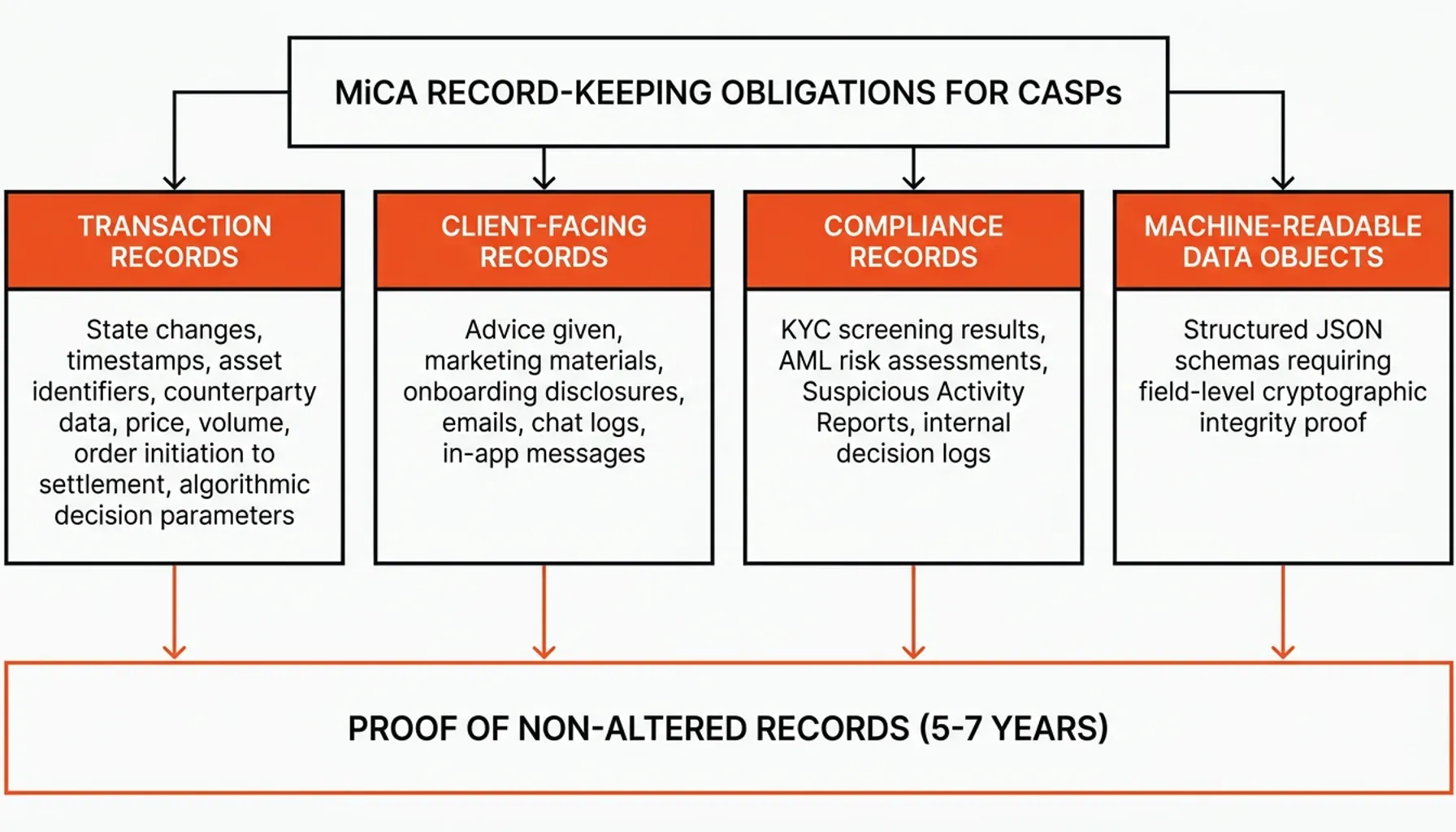
Regulation (EU) 2023/1114, which entered full application in December 2024, doesn't merely ask CASPs to store records. Article 68(9) demands that every relevant record be retained for a minimum of five years, and up to seven years when an NCA requests it, in a form that is complete, accurate, and fully reconstructable.
That word, reconstructable, carries significant legal weight. It means a regulator must be able to rebuild the complete history of any transaction, client interaction, or compliance decision from your archived data alone. If a record has been altered, even inadvertently, the reconstruction fails. The audit fails. And the firm faces consequences.
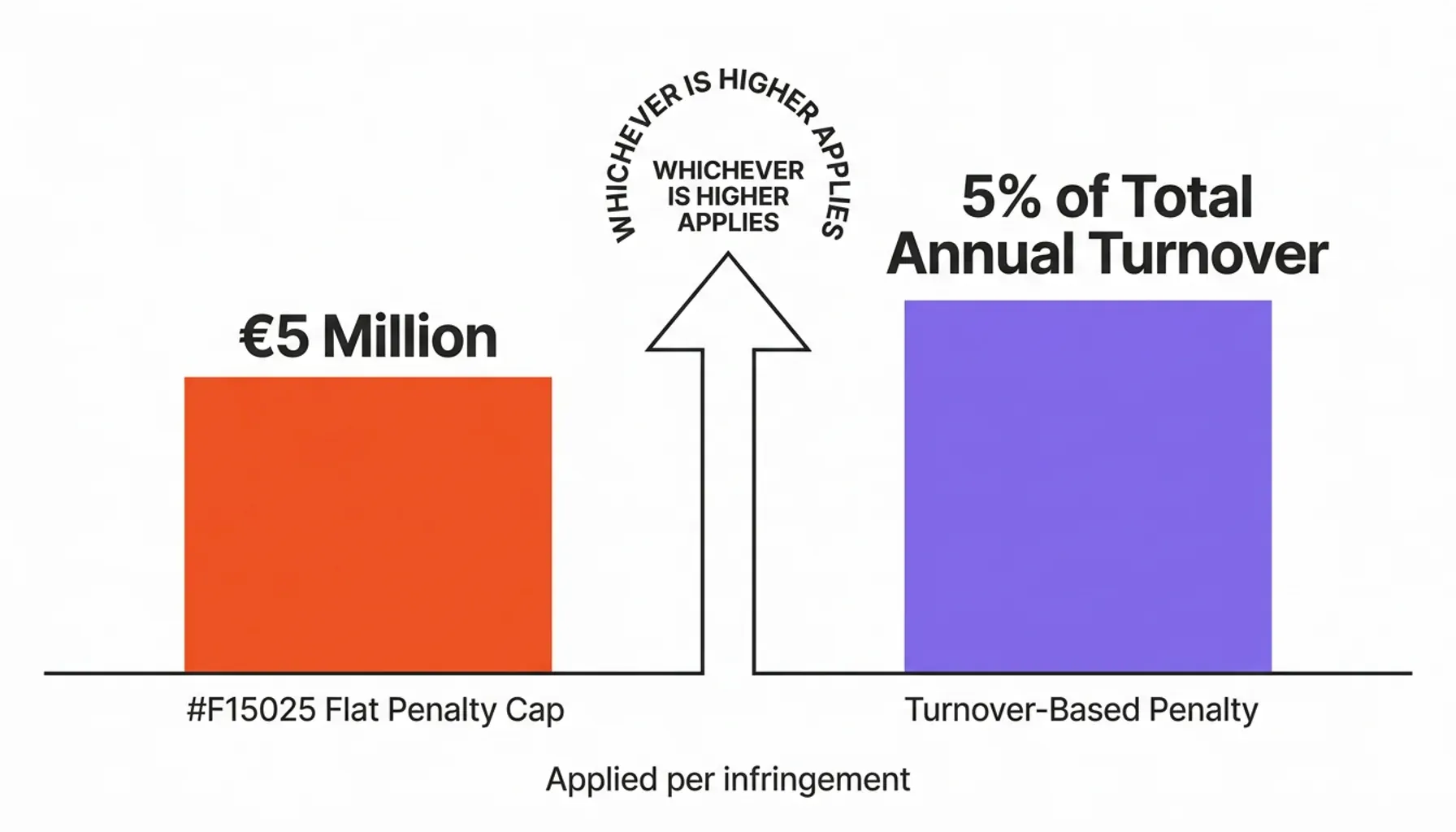
The financial stakes are real. Under MiCA's enforcement framework, record-keeping failures expose CASPs to administrative penalties of up to €5 million or 5% of total annual turnover, whichever is higher, applied per infringement. For a mid-sized exchange processing significant daily volume, a systemic failure in data integrity could trigger penalties across thousands of individual records.
What changed with MiCA is the shift from voluntary best practices to hard regulatory enforcement. NCAs across EU member states now have explicit supervisory authority over CASP record-keeping systems. The era of storing data in a folder and hoping for the best is over. What's required now is a verifiable, tamper-evident audit trail, one that can withstand forensic scrutiny years after the original record was created.
What Must Be Retained? Mapping the Data Landscape
Most compliance teams underestimate the scope of what MiCA actually requires. Think of it less like filing a cabinet and more like maintaining a chain of custody in a criminal case: every handoff documented, every seal unbroken.
Transaction records must capture not just the final execution but every state change along the way, timestamps, asset identifiers, counterparty data, price, volume, and the full sequence from order initiation to settlement. Pre-trade communications that influenced execution, including algorithmic decision parameters, fall within scope. Client-facing records are equally broad: advice given, marketing materials distributed, onboarding disclosures, and any interaction material to a later dispute, spanning emails, chat logs, and in-app messages. Then there's the compliance layer: KYC screening results, AML risk assessments, Suspicious Activity Reports, and the internal decision logs documenting why a transaction was approved or flagged.
This last category creates a dual compliance burden, because AML/CFT obligations for payment and e-money institutions demand the same depth of documentation. A unified archiving approach isn't just efficient here, it's necessary.
Back at Vaultex, the compliance team quickly discovers that their transaction data is intact, their client communications are scattered across three platforms, and their AML decision logs exist in a format that was migrated during a system upgrade 14 months ago. The chain of custody, in other words, has some missing links.
The ESMA JSON Schema: Machine-Readable by Design
One of the most operationally significant developments under MiCA is RTS 2025/1140, ESMA's implementing technical standard mandating machine-readable JSON schemas for standardised reporting. This matters more than it might first appear: records are no longer just human-readable documents. They are structured data objects, and their integrity must be provable at the field level, not just the file level.
A PDF can be visually inspected for tampering. A JSON record with altered numeric fields may look identical to the human eye. Proving the integrity of machine-readable records requires cryptographic methods, not visual inspection.
The volume of data this generates is significant. A CASP processing 100,000 daily transactions, with associated communications and compliance logs, will accumulate tens of millions of individual records annually. Managing that volume while maintaining individual cryptographic integrity is the operational challenge that separates adequate compliance from audit-proof compliance.
For CASPs building or evaluating their archiving infrastructure, OriginVault's audit-proof compliance archive is purpose-built to handle this scale, sealing records cryptographically at the point of creation, before any opportunity for tampering exists.
The Integrity Gap: Why Storage Is Not Proof
Here's the thing. Storing a record and proving that record is original are two fundamentally different problems, and most IT and compliance teams haven't fully confronted that distinction.
Data Availability vs. Data Integrity
Data availability means the file exists and can be retrieved. Data integrity means the file is byte-for-byte identical to what was originally created. A traditional database guarantees the former. It does not, by itself, guarantee the latter.
Database administrators have write access. Backup restoration processes can introduce subtle corruption. Software migrations over a seven-year retention horizon can alter encoding, formatting, or metadata. None of these events necessarily leave an obvious trace, but all of them break the chain of authenticity that an NCA inspection requires.
This is exactly what Vaultex's team finds when they dig into their migrated AML logs. The records exist. The migration process, however, reformatted timestamp fields from UTC to local time and stripped trailing metadata. The data is functionally the same. Provably the same? That's a harder question, and it's the one the AFM will ask.
The Limits of Read-Only Storage
Some CASPs rely on write-once, read-many (WORM) storage configurations as their integrity solution. WORM storage prevents direct overwrites, but it doesn't prove that the data written was correct at the time of writing. It also doesn't protect against vulnerabilities at the storage infrastructure layer or administrative access below the application level. A determined insider or a compromised system can circumvent WORM controls in ways that leave no detectable trace in the storage layer itself.
The Burden of Proof in an NCA Audit
During an NCA inspection, the burden of proof rests entirely with the CASP. Regulators won't assume records are authentic, they'll require demonstration. Asserting that your systems are secure is not evidence. Showing that a record's cryptographic fingerprint matches an independently verifiable anchor point, created at the moment of the record's creation and recorded on a public blockchain, is evidence.
This is the integrity gap: the space between what most current archiving systems can provide and what high-stakes regulatory scrutiny actually demands. ISO/IEC 27001 defines data integrity as a core security objective, but it doesn't prescribe how integrity must be proven, leaving CASPs to select the appropriate technical mechanism.
The mechanism that closes this gap is cryptographic timestamping anchored to a public blockchain.
Blockchain Timestamping: A Mathematical Seal for CASP Records
Blockchain timestamping transforms the integrity question from a matter of assertion into a matter of mathematics. It's the technical foundation that converts a stored record into verifiable evidence.
How SHA-256 Hashing Works in Practice
Every record, whether a JSON transaction log, a client communication, or a KYC screening result, can be processed through a SHA-256 hashing algorithm to produce a unique 64-character hexadecimal fingerprint. This hash is deterministic: the same input always produces the same output. And it is collision-resistant: no two different inputs produce the same hash with any practical probability.
Any change to the original record, even altering a single character, produces a completely different hash. This makes hashing the ideal tool for detecting tampering, because it makes tampering mathematically detectable rather than merely procedurally detectable. If you want a deeper grounding in how this works end-to-end, the Blockchain Timestamping Guide: Securing Digital Proof walks through the full workflow.
Anchoring to Public Blockchains
The hash alone proves nothing about when it was created. Anchoring that hash to a public blockchain, Bitcoin or Ethereum, solves the timing problem. Once a hash is embedded in a confirmed blockchain transaction, the blockchain's own immutability guarantees that the hash existed at that block's timestamp. No party, not the CASP, not OriginStamp, not any administrator, can retroactively alter a confirmed blockchain record.
This creates what is technically termed Proof of Existence: mathematical evidence that a specific piece of data existed in a specific form at a specific point in time. For MiCA compliance, this means a CASP can prove to an NCA that a transaction record created in 2025 has not been altered when it's presented for inspection in 2031. For a plain-language explanation of why blockchain technology underpins data integrity and trust at this level, it's worth understanding the fundamentals before evaluating vendors.
Independence from Internal Infrastructure
The strategic advantage of blockchain timestamping extends beyond cryptography. Because the proof is anchored to a public, decentralised network, it's completely independent of the CASP's own IT infrastructure. Even if the CASP migrates systems, changes vendors, or experiences a catastrophic data centre failure, the blockchain anchor remains intact and verifiable by anyone.
This independence is what makes the approach viable over a seven-year retention horizon. Technology stacks change. Vendors get acquired. Storage systems reach end-of-life. A blockchain timestamp created today on Bitcoin will be verifiable in 2032 using nothing more than the original record and a publicly available blockchain explorer, no proprietary software, no vendor relationship required.
Had Vaultex been using blockchain-anchored timestamping before their system migration, the answer to the AFM's question would have been straightforward: here is the record, here is its hash from the day it was created, here is the Bitcoin transaction confirming that hash existed on that date. Match confirmed. Integrity proven. Inspection over.
Peer-Reviewed Foundations
This approach isn't theoretical. Academic research has validated the cryptographic integrity model across multiple peer-reviewed publications, establishing the technical credibility that regulators and courts increasingly recognise. The W3C Verifiable Credentials Data Model further formalises how cryptographic proofs can be structured for institutional verification, a standard directly applicable to CASP compliance documentation.
Record-Keeping Controls for Outsourcing, Cloud Storage, and Third-Party Providers
Most companies get this wrong. When records don't live on your own infrastructure, many CASPs assume the responsibility shifts with the data. It doesn't.
The Outsourcing Problem
Many CASPs outsource custody, trading infrastructure, or compliance functions to third-party providers. Under MiCA, outsourcing an operational function does not outsource the regulatory obligation. Article 30 of MiCA imposes strict requirements on outsourcing arrangements, including the obligation to ensure that outsourced activities do not impair the quality of internal controls or the NCA's ability to supervise. In practice, your outsourcing contracts must explicitly address record-keeping standards, and your oversight function must be able to verify that those standards are being met.
If your custody provider holds transaction records on your behalf, you need contractual rights to retrieve those records in a format that satisfies MiCA's reconstructability standard. You also need a mechanism to verify their integrity independently, which brings you back to cryptographic timestamping. A hash anchored to a public blockchain by your provider at the point of record creation gives you an independent verification path that doesn't rely on trusting the provider's internal controls.
Cloud Storage: Shared Responsibility, Undivided Liability
Cloud infrastructure providers operate on a shared responsibility model: the provider secures the infrastructure; the customer secures the data and applications running on it. This model is well understood in cybersecurity. It is far less well understood in the context of regulatory record-keeping.
Storing MiCA-regulated records in a major cloud environment, AWS, Azure, Google Cloud, does not by itself satisfy the integrity requirement. Cloud providers can and do perform maintenance operations, storage migrations, and format conversions that may alter record metadata without your knowledge. Their service agreements typically disclaim liability for data integrity at the application layer. You need controls at the record level, cryptographic seals applied before data leaves your application, not just at the infrastructure level.
The practical implication: seal records cryptographically at the point of creation, before they are written to cloud storage. The cloud becomes your availability layer; the blockchain becomes your integrity layer. These are separate concerns and must be addressed separately.
Third-Party Compliance Platforms
A growing number of CASPs use third-party platforms for KYC screening, AML monitoring, and transaction surveillance. These platforms generate compliance records, screening results, risk scores, alert dispositions, that fall squarely within MiCA's retention scope. The question is whether those records, generated and initially stored by a third party, can be retrieved in a form that satisfies the reconstructability standard years later.
The risks are real. The vendor may be acquired, may change their data model, or may simply discontinue the product. Best practice is to export compliance records from third-party platforms into your own archive at the point of generation, and to apply cryptographic sealing at that point, so the integrity proof is yours to control, not the vendor's. OriginVault's compliance archive supports exactly this pattern, ingesting records from external platforms and sealing them independently of the originating system.
Building an Audit-Proof Archive for Scalable Compliance
Understanding the cryptographic principles is necessary. Operationalising them at CASP scale is the harder problem.
The Volume Challenge
A CASP processing significant transaction volumes generates millions of individual records daily. Each record requires its own cryptographic seal. Naive implementation, hashing and anchoring each record individually in real time, would create unacceptable latency and blockchain transaction cost. The solution is Merkle tree aggregation: batching thousands of hashes into a single cryptographic structure, anchoring the root hash to the blockchain once, and preserving the individual proof paths for each record. This approach maintains per-record provability while reducing blockchain transaction overhead by orders of magnitude. The technical mechanics of blockchain timestamping at scale are worth understanding before you evaluate any vendor's implementation claims.
Integration Without Performance Degradation
Archiving infrastructure must integrate with existing transaction engines, ERP systems, and compliance platforms without adding latency to live operations. The correct architectural pattern is asynchronous sealing: records are written to the archive immediately upon creation, and the cryptographic sealing process runs as a background operation. The record is available instantly; the tamper-evident proof is generated and attached within seconds to minutes.
Multi-Tenancy for Complex Organisational Structures
Many CASPs operate as infrastructure providers for sub-agents, institutional clients, or white-label partners. An audit-proof archive must support multi-tenancy, maintaining cryptographically isolated record spaces for each entity while operating on shared infrastructure. This isn't just an operational convenience; it's a compliance requirement when different clients are subject to different regulatory obligations or jurisdictions.
For ERP vendors and CASP infrastructure providers evaluating how to deliver this capability to their clients, OriginVault's white-label compliance archive backend provides exactly this architecture: multi-tenant, cloud-agnostic, and deployable under the partner's own brand.
European Standards Alignment
MiCA doesn't operate in isolation. CASPs operating in Germany must align with GoBD requirements for electronic record-keeping. Those operating in Switzerland face GeBüV obligations. An archiving system that meets MiCA's reconstructability standard while simultaneously satisfying KRM certification requirements for GeBüV compliance eliminates the need for parallel compliance architectures, reducing both cost and operational complexity.
Preparing for an NCA Inspection: The Verification Workflow
Compliance infrastructure is only as valuable as its performance under scrutiny. Building an audit-proof archive is step one. Demonstrating it to regulators efficiently is step two.
Simulating the Audit Before It Happens
The most effective preparation for an NCA inspection is running internal audit simulations. Select a record from two or three years prior. Extract it from the archive along with its associated blockchain certificate. Recompute the SHA-256 hash of the current file. Compare it to the hash anchored on the blockchain at the time of creation. If they match, and they should, you've just produced mathematical proof of integrity in under sixty seconds.
This simulation reveals gaps before regulators do. If your team can't extract a specific record and its proof certificate in under five minutes, your archive has an operational problem that will become visible under inspection pressure.
Vaultex, working through their six-week preparation window, runs exactly this exercise. The transaction records pass. The client communications, once consolidated from three platforms into a unified archive, pass. The migrated AML logs don't pass, because the migration altered the timestamp format. That's a finding they can remediate before the AFM arrives. Without the simulation, it would have been a finding the AFM made for them.
What Regulators Actually Want to See
ESMA supervisory guidance consistently emphasises demonstrable, not merely documented, compliance. NCAs conducting MiCA inspections will want to see:
- The original record in its retained format
- The cryptographic hash generated at the time of creation
- The blockchain transaction confirming the hash anchor and its timestamp
- A live demonstration that the current record produces the same hash
This four-step verification workflow is self-contained and requires no proprietary tools. Any inspector with basic technical literacy can verify it independently using public blockchain explorers, which is precisely what makes it credible.
Reducing Legal Costs Through Transparency
Protracted regulatory investigations are expensive. Legal fees, management time, and operational disruption during an extended NCA inquiry can far exceed the cost of building solid archiving infrastructure. A CASP that can respond to a data integrity challenge with a self-service verification demonstration, rather than weeks of forensic investigation, compresses audit duration and reduces legal exposure significantly.
The Strategic Posture Shift
The firms that navigate MiCA enforcement most effectively won't be those that treat record-keeping as a checkbox. They'll be the ones that have transitioned from reactive data storage, keeping records because they have to, to proactive, tamper-proof compliance posture: keeping records in a way that generates its own evidence of integrity.
That posture shift isn't primarily a technology decision. It's a strategic one. It reflects a recognition that in a regulated market, the ability to prove trustworthiness is a competitive advantage, not just a compliance cost. The firms that invest in cryptographic proof infrastructure are positioning themselves as the counterparties that institutional clients and regulators can rely on without reservation, and as explored in how blockchain timestamps build verifiable trust, that trust translates directly into commercial credibility.
Conclusion: Integrity Is the Standard, Not the Stretch Goal
MiCA record-keeping is not a storage problem. It's a proof problem. The regulation's reconstructability standard, enforced by NCAs with meaningful penalty authority, demands that CASPs move beyond file retention and into verifiable data integrity.
The technical path is well-established. SHA-256 hashing creates tamper-detectable fingerprints. Blockchain anchoring creates immutable, timestamped proof of existence. Merkle tree aggregation makes this scalable to millions of daily records. A purpose-built archive backend makes the entire workflow operational without degrading system performance or requiring bespoke development.
Controls for outsourcing, cloud storage, and third-party platforms aren't optional extras. They're the places where integrity chains most commonly break. Sealing records at the point of creation, before they travel to any external system, is the only approach that keeps the proof in your hands rather than your vendor's.
The CASPs that build this infrastructure now, before their first NCA inspection, will spend less time in regulatory proceedings, less money on legal defence, and more time competing on the merits of their services. Those that treat record-keeping as an afterthought will discover, at the worst possible moment, that having data and proving it's original are not the same thing.
Vaultex, for what it's worth, gets through their AFM inspection. It takes four weeks of intensive remediation work, a lot of late nights, and a frank conversation about what their archiving infrastructure was never designed to do. They pass, but they'll tell you it's not a process they want to repeat.
You don't have to wait for your own Tuesday morning email to find out where your gaps are.
If you're evaluating how to close the integrity gap in your compliance architecture, explore OriginVault's audit-proof archive for MiCA and European compliance requirements, built for the scale, standards, and scrutiny that CASPs now face.
Thomas Hepp
Co-Founder
Thomas Hepp is the founder of OriginStamp and creator of the OriginStamp timestamp, which has set the standard for tamper-proof blockchain timestamps since 2013. As one of the earliest innovators in the field, he combines deep technical expertise with a pragmatic focus on solving real business problems, and is a recognized voice in blockchain security, AI analytics, and data-driven decision support. His work has earned multiple international awards, including a top Best Project recognition from ETH Zurich and the Swiss Confederation. He publishes regularly on blockchain, AI, and digital innovation.