
Trusted Timestamping & TSA: The Future of Data Integrity
Dec 19, 2025

Thomas Hepp
Dec 19, 2025

Picture this: a mid-sized software firm gets sued by a former contractor who claims he invented a core algorithm — before the company did. The lawyers are confident. Internal files, commit logs, version histories — they have everything. Then opposing counsel does something devastating: they point out that the development server's system clock was never synchronized, had drifted by eleven days, and could have been set to any date by anyone with admin access. The case drags on for two years. Millions in legal fees. All because a timestamp couldn't be trusted.
I've seen variations of that story play out more often than most organizations realize. And it's entirely preventable.
Data integrity is no longer a luxury — it's the foundational requirement for every digital transaction, legal claim, and corporate archive. In an era where digital files can be altered without leaving a trace, you need to prove, unequivocally, that a specific document existed in a precise state at an exact moment. That mathematical certainty is what trusted timestamping delivers.
The Anatomy of Digital Trust: What is Trusted Timestamping?
To understand why trusted timestamps matter, you first need to recognize the fundamental flaw in standard digital timekeeping. System time — the clock running on a local server, laptop, or mobile device — is inherently unreliable. Users can manipulate it. Network latency can desynchronize it. Malicious actors can spoof it by altering Network Time Protocol (NTP) responses. If a critical contract or piece of digital evidence relies solely on system time, its legal and factual validity can be dismantled in an audit or courtroom in minutes.
Your system clock is a liability. Full stop.
Trusted timestamping solves this by establishing a secure, independent, and verifiable temporal anchor for your data. It's a cryptographic mechanism that proves a document existed at a specific point in time — without relying on the device clock that created it.
The process centers on a cryptographic hash: a unique, fixed-length alphanumeric string derived from the original file. Think of it as an irreversible digital fingerprint. Binding that fingerprint to a verified time source creates an immutable record of the data's exact state at that moment. No one can alter the document later and pretend it was always that way.
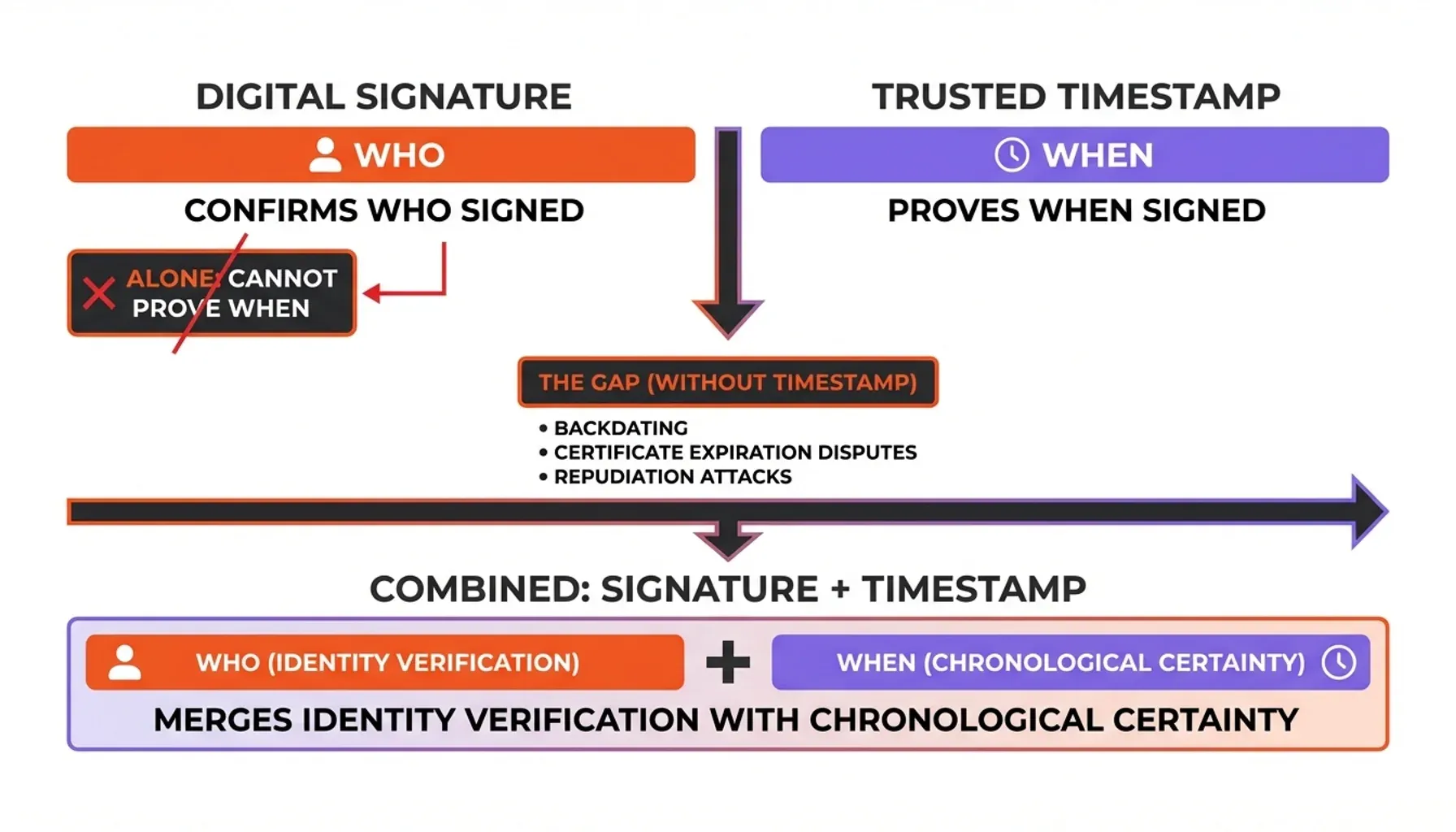
Here's where most people conflate two different things: digital signatures and timestamps. A digital signature confirms who signed a document. Without a trusted timestamp, it cannot prove when that signature was applied. That gap exposes organizations to backdating, certificate expiration disputes, and repudiation attacks. Adhering to rigorous cryptographic timestamping standards merges identity verification with chronological certainty — creating a record that's genuinely unassailable.
How a Time Stamp Authority (TSA) Works
For decades, the standard approach has been routing timestamp requests through a Time Stamp Authority (TSA) — an independent, trusted third party that issues timestamps under strict cryptographic protocols. Understanding how a TSA works is essential before you can appreciate why the model has real cracks in it.
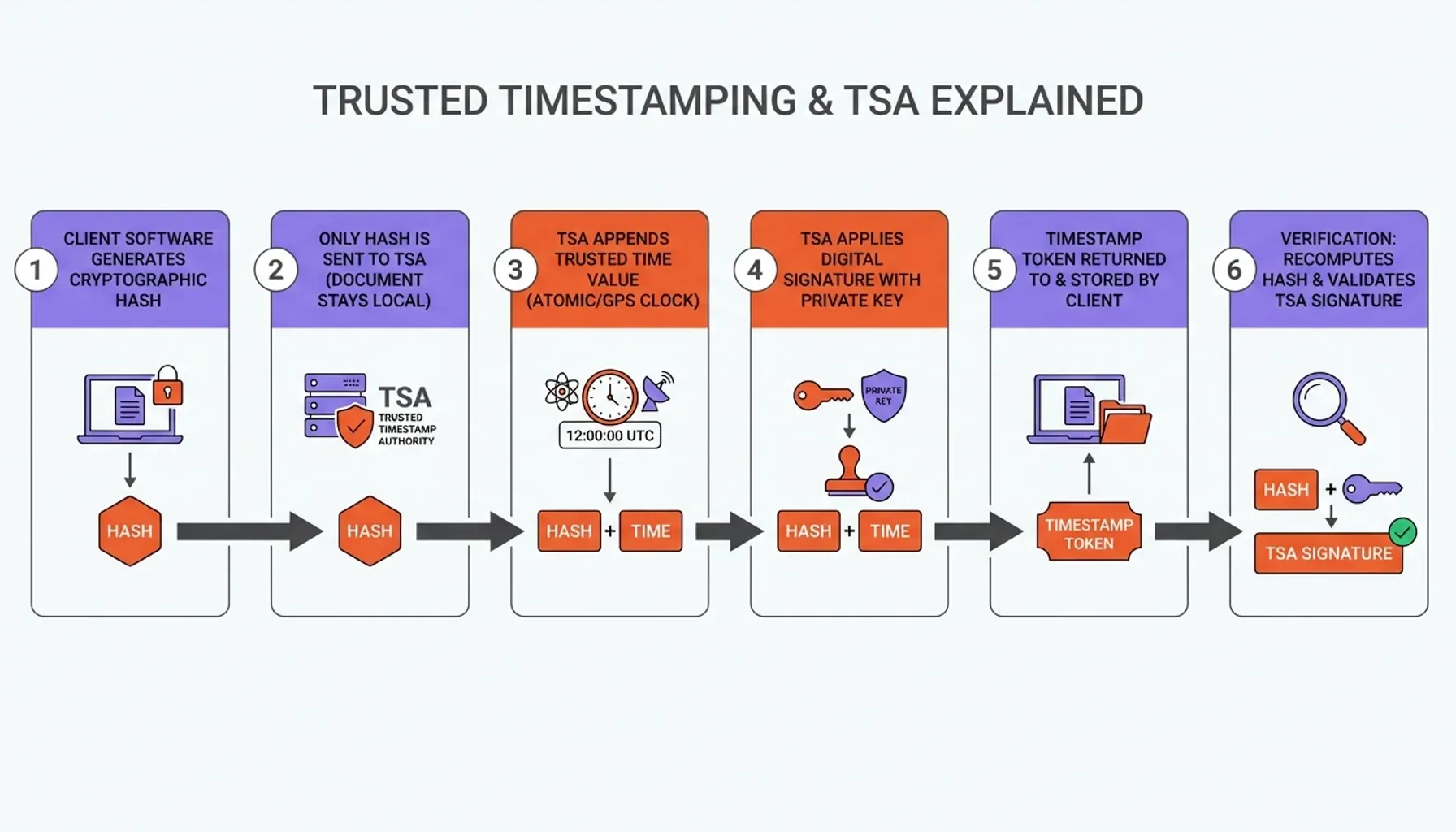
The process starts when client software generates a cryptographic hash of a document. Critically, the actual document never leaves your system — only the hash travels to the TSA, preserving privacy and minimizing bandwidth. The TSA receives the hash, appends a trusted time value from a highly accurate synchronized clock (often tied to atomic clocks or GPS signals), then applies its own digital signature to the combined data using its private key. The result is a timestamp token, returned to the client and stored alongside the original document.
Verification is straightforward: anyone can independently compute the file's hash, extract the TSA's public key, and validate the signature to confirm the token is authentic and the data unaltered.
This entire system depends on a Public Key Infrastructure (PKI) model built on Root Certificates. The TSA's public key is certified by a higher-level Certificate Authority (CA), creating a chain of trust. But that chain is only as strong as its weakest institutional link — and the whole thing rests on strict security requirements for trust service providers.
That's where the model gets uncomfortable.
Certificates expire. Cryptographic algorithms get deprecated. Businesses go offline. If a TSA's root certificate is compromised — or if the provider simply shuts down — the historical validity of every timestamp it ever issued comes into question. This single point of failure forces organizations into a continuous cycle of re-timestamping and long-term key management. It adds overhead, complexity, and long-term risk to archive maintenance that most teams quietly underestimate.
For a deeper look at how these traditional mechanisms work — and where they fall short — the guide on how cryptographic proofs are handled under the hood is worth your time.
The Evolution: From Centralized TSAs to Blockchain Timestamping
The fundamental weakness of the traditional TSA model is its reliance on institutional trust. You're trusting a company, a server, and a certificate chain. Most security architects quietly admit that's not good enough for truly long-term data integrity.
The paradigm shift came with a simple but powerful realization: mathematical proof is more resilient than any business entity. That insight drove the evolution from centralized TSAs to decentralized blockchain timestamping.
Blockchain technology fundamentally transforms how immutable proof of existence is generated and preserved. Instead of trusting a single authority to sign a hash and keep its keys secure indefinitely, a blockchain timestamp anchors the cryptographic hash into a globally distributed ledger. Once a block is mined and added to a public blockchain like Bitcoin or Ethereum, the data within it becomes mathematically immutable. Altering a historical record would require rewriting the entire subsequent chain across thousands of decentralized nodes — a computationally impossible feat.
The contrast with traditional RFC 3161 timestamps is stark. A TSA timestamp is only valid as long as the issuing authority's public key remains secure and recognized. A blockchain timestamp outlives any single organization. There are no certificates to expire, no centralized servers to crash, and no proprietary databases to compromise.
OriginStamp has built its infrastructure around this principle, anchoring data to Bitcoin and Ethereum to create immutable, globally distributed proof of existence that requires zero ongoing maintenance from the client. The integrity of the data is secured by the consensus mechanisms of the world's most robust cryptographic networks. You don't have to trust a provider's promise — you verify the mathematical facts recorded on the ledger.
If you're a data architect evaluating long-term archiving strategies, understanding how blockchain timestamps are structured and verified is essential for future-proofing your digital archives against the inevitable degradation of centralized trust systems.
Compliance and Legal Validity: GoBD, GeBüV, and eIDAS
Technological elegance means nothing if it doesn't hold up in court or pass a regulatory audit. For ERP vendors, healthcare providers, and industrial software developers operating in Europe, the legal weight of timestamps is a paramount concern. Blockchain timestamping isn't just a security upgrade — it's a direct path to regulatory compliance.
European regulations place rigorous demands on electronic archiving and document retention. In Germany, the GoBD (Grundsätze zur ordnungsmäßigen Führung und Aufbewahrung von Büchern) mandates that all relevant digital documents be archived completely, tamper-proof, and traceably. It's not a guideline — it's a legal requirement with real consequences for non-compliance. In Switzerland, the GeBüV (Geschäftsbücherverordnung) establishes the legal basis for electronic archiving, requiring strict adherence to data integrity and auditability over long retention periods.
These aren't abstract compliance checkboxes. When a German tax authority requests records going back ten years, or a Swiss regulator questions the integrity of archived contracts, you need an unbroken, mathematically verifiable chain of custody. Not a folder of PDFs with system-generated timestamps.
OriginVault — the compliance and archiving engine built on OriginStamp's technology — is specifically designed to meet these standards. It holds 'KRM-certified' status, validating strict adherence to Swiss GeBüV compliance and broader European archiving mandates. That certification isn't a marketing badge; it's a rigorous validation by independent legal and technical auditors confirming that the system's tamper-evident architecture meets the highest evidentiary standards.
The eIDAS regulation across the EU further legitimizes electronic trust services, giving mathematically provable electronic seals and timestamps significant evidentiary weight in legal proceedings. eIDAS also establishes the legal framework for qualified electronic signatures (QES) and electronic seals — both of which require a trusted timestamp to be legally binding under EU law. When your organization faces litigation, a tax audit, or a regulatory inquiry, a tamper-evident audit trail is your strongest defense. Blockchain-anchored timestamps let you prove to auditors and judges — definitively — that specific records have remained entirely unaltered since the exact moment they were archived.
That transforms regulatory compliance from a burdensome overhead into an automated, invisible layer of protection.
Document Signing, PDF Timestamps, and eIDAS in Practice
One area that often catches teams off guard is the intersection of document signing workflows and trusted timestamping. Signing a PDF with a digital certificate is not the same as timestamping it. A signed PDF without an embedded trusted timestamp is only valid for as long as the signing certificate remains active — once the certificate expires or is revoked, the signature's legal standing becomes questionable.
The PDF Advanced Electronic Signature (PAdES) standard, defined under eIDAS, addresses this directly. PAdES embeds a trusted timestamp token inside the PDF signature container itself, creating a long-term validation (LTV) structure that remains verifiable even after the original signing certificate has expired. For organizations producing legally binding contracts, invoices, or regulatory filings, this isn't optional — it's the baseline for compliance.
In practice, this means your document signing pipeline should:
- Generate a cryptographic hash of the finalized PDF before signing
- Request a timestamp token from a TSA (or a blockchain-anchored equivalent) at the moment of signing
- Embed that token into the PAdES signature container
- Archive the complete signed document with its embedded timestamp proof
Blockchain-anchored timestamps fit naturally into this workflow. Rather than depending on a TSA's certificate infrastructure to remain valid indefinitely, the timestamp proof is anchored to a public ledger that no single entity controls. For regulated industries producing documents with 10- or 30-year retention requirements, that architectural difference is the whole ballgame.
What Happens When You Get It Wrong
The compliance stakes deserve a concrete illustration. In 2020, a major European financial institution faced regulatory censure after auditors found that archived transaction records could not be independently verified — the TSA that had issued the original timestamps had been acquired, rebranded, and its certificate infrastructure quietly deprecated. Years of records were in legal limbo. The remediation cost ran into eight figures. The reputational damage was harder to quantify.
This isn't an edge case. It's the predictable consequence of building long-term compliance on short-term institutional trust. The GoBD's requirement for Unveränderbarkeit — immutability — doesn't make exceptions for TSA business continuity failures. Your archiving infrastructure needs to outlast any single vendor, and that's precisely what blockchain anchoring is designed to do.
Critical Use Cases for Modern Enterprises
Decentralized trusted timestamping extends far beyond basic document archiving. Wherever data integrity, traceability, and trust are mission-critical, blockchain anchoring provides a decisive advantage. Here are the high-stakes environments where this technology earns its keep.
Intellectual Property and Trade Secrets: In competitive industries, establishing prior art is everything. Before a formal patent is filed, R&D teams generate enormous volumes of proprietary data — research logs, source code commits, design iterations. By continuously timestamping this output, organizations build an immutable timeline of innovation. If a competitor later claims they invented something first, or alleges intellectual theft, you can present mathematically verified proof of existence showing exactly when you possessed that intellectual property. No court can dismiss that.
Legal & Insurance Evidence: AI-generated deepfakes and manipulated digital media now pose a genuine threat to legal proceedings. Dashcam footage, surveillance video, and digital photographs submitted as evidence can no longer be taken at face value. By hashing and timestamping video evidence at the point of capture, insurers and legal professionals lock that evidence against tampering. Alter a single pixel after the fact, and the hash changes — instantly flagging the manipulation. This is the kind of forensic certainty that wins cases and settles disputes before they reach trial.
Supply Chain and IoT: Global supply chains run on continuous data streams from IoT sensors tracking temperature, humidity, and location during transit. Disputes over when and where a shipment was compromised are common — and expensive. An immutable log of sensor data and digital handovers anchored to the blockchain creates a single source of truth. No party can retroactively alter logs to dodge liability. The record is the record.
Software Development and Supply Chain Security: Supply chain attacks — where malicious actors infiltrate development pipelines to distribute compromised updates — have surged in recent years. By cryptographically signing and timestamping code releases and build artifacts, software vendors guarantee the integrity of their deployments. End-users install exactly the code the developers compiled. This approach significantly bolsters information security management and closes a vector that has caused some of the most damaging breaches of the past decade.
Healthcare Records and Clinical Trials: In healthcare, the integrity of patient records and clinical trial data is not just a compliance matter — it's a patient safety issue. Regulators require that clinical data be demonstrably unaltered from the moment of collection. Blockchain-anchored timestamps provide an audit trail that satisfies both regulatory bodies and ethics committees, without adding friction to clinical workflows. A tampered trial result is a criminal matter; a mathematically sealed one is bulletproof evidence.
Financial Services and Audit Trails: Banks, asset managers, and insurance firms operate under some of the strictest data retention requirements in any industry. MiFID II, DORA, and Basel III all demand that transaction records and communications be preserved with verifiable integrity. Blockchain timestamping provides the kind of immutable, independently verifiable audit trail that regulators increasingly expect — and that internal compliance teams can actually rely on when the pressure is on.
Creative Industries and Content Provenance: Photographers, journalists, and media organizations face a growing crisis of content authenticity. In an era of generative AI and synthetic media, proving that an image or article existed — unaltered — at a specific moment is increasingly valuable. Blockchain timestamping gives creators a tamper-proof certificate of authorship and provenance. For news organizations operating under content authenticity standards, this kind of verifiable provenance is rapidly becoming a baseline expectation rather than a differentiator.
Technical Deep Dive: Hashes, Merkle Trees, and Aggregation
To fully appreciate the scalability and security of blockchain timestamping, you need to understand the cryptographic architecture underneath it. It's less complicated than it sounds.
The foundation is the SHA-256 hash function — the gold standard for creating digital fingerprints. Feed it any input, from a single text file to a multi-gigabyte video, and it produces a unique 256-bit hash. Change even one character in the source document and the output hash changes completely. This sensitivity makes undetected alteration mathematically impossible.
But here's the practical problem: anchoring thousands of individual hashes directly to a public blockchain like Bitcoin would be prohibitively expensive and slow. Transaction fees and network constraints make it unworkable at scale.
Merkle Trees solve this elegantly.
A Merkle Tree is a hierarchical data structure that enables efficient, secure verification of large datasets. Thousands of individual document hashes are paired and hashed together repeatedly, converging into a single 'Root Hash'. That single Root Hash is what gets submitted to the blockchain in one transaction. This aggregation allows OriginStamp to anchor millions of documents simultaneously — driving down costs while maintaining absolute mathematical certainty for every individual file in the tree.
That's the elegance of it: one blockchain transaction. Millions of documents. Every single one independently verifiable.
Privacy is guaranteed by design. Hashing happens locally on the client's infrastructure. The actual data never leaves your premises — only the anonymous hash travels to the timestamping API. For organizations handling sensitive data, that's not a minor detail; it's a fundamental architectural requirement.
To understand why rewriting that history is computationally infeasible, the mechanics of how distributed consensus makes tampering practically impossible are worth understanding in full.
OriginVault takes this further with its proprietary 'Data Seal' — wrapping the original document in AES-256 encryption and binding it directly to the blockchain certificate. Even system administrators with root access cannot modify, read, or silently delete archived documents without instantly breaking the seal and triggering an audit alert. The architecture enforces integrity at the infrastructure level, not just the policy level.
Long-Term Cryptographic Agility
One question I hear from security architects is: what happens when SHA-256 is eventually deprecated? It's a fair concern. Cryptographic standards do evolve — MD5 and SHA-1 are cautionary tales.
The answer lies in cryptographic agility: designing systems that can migrate hash functions without invalidating historical records. A well-architected blockchain timestamping system maintains the original hash alongside the blockchain anchor, allowing re-hashing with a stronger algorithm while preserving the original proof. The blockchain record itself doesn't need to change — the new hash simply creates an additional, forward-compatible layer of verification. This is one area where blockchain-based systems have a structural advantage over traditional PKI: the proof of existence is independent of any single algorithm's longevity.
Implementation and Integration: APIs, Tools, and Operational Best Practices
Understanding the theory is one thing. Actually integrating trusted timestamping into your existing systems is where most teams hit friction. The good news: done right, it's largely invisible to end users and surprisingly lightweight to maintain.
API-First Integration
OriginStamp exposes a REST API that lets you submit document hashes programmatically and retrieve timestamp certificates without any manual steps. A typical integration looks like this:
- Hash locally. Your application computes the SHA-256 hash of the document on your own infrastructure. The file itself never leaves your environment.
- Submit the hash. A single POST request to the API submits the hash for anchoring. The API returns a submission ID and a pending certificate.
- Retrieve the certificate. Once the hash is anchored to the blockchain (typically within a few hours for Bitcoin, faster for Ethereum), you retrieve the completed timestamp certificate via a GET request. This certificate contains the blockchain transaction ID, the Merkle proof, and the anchor timestamp.
- Store alongside the document. Store the certificate with — or embed it into — the original file. Verification requires no connection to OriginStamp; anyone can independently verify the Merkle proof against the public blockchain.
For teams already running CI/CD pipelines, this maps cleanly onto build artifact signing. After each release build, a post-build step hashes the compiled artifacts and submits them to the API. Store the resulting certificates in your artifact registry alongside the binaries. If a customer ever questions whether a binary was tampered with in transit, you have a blockchain-anchored proof that it hasn't.
Webhook and Event-Driven Workflows
For high-volume environments, polling the API for certificate completion is inefficient. OriginStamp supports webhooks: once a hash is anchored, the platform sends a callback to your configured endpoint with the completed certificate payload. This fits naturally into event-driven architectures — your document management system can automatically attach the certificate to the corresponding record the moment anchoring completes, with no human intervention.
ERP and Document Management Integration
For ERP vendors, the integration pattern is typically a middleware layer that intercepts document finalization events — invoice approval, contract execution, record archival — and triggers a hash submission automatically. The end user sees nothing. The compliance layer runs silently in the background. When an auditor requests proof of integrity for a specific record, the ERP system retrieves the stored certificate and presents it alongside the document. The auditor can verify it independently against the public blockchain without needing access to any OriginStamp system.
Operational Best Practices
Getting the integration right is only half the job. Keeping it reliable over years or decades requires some operational discipline:
- Timestamp at creation, not at archival. The earlier you anchor a document's hash, the stronger your proof. Timestamping a contract the moment it's finalized is far more defensible than timestamping it when you move it to cold storage three months later.
- Store certificates redundantly. The blockchain anchor is immutable, but your certificate file isn't. Store it in at least two independent locations — your primary document store and a separate backup. Losing the certificate doesn't invalidate the blockchain record, but it does make verification harder.
- Automate certificate retrieval. Don't rely on manual processes to collect completed certificates. Webhook-driven automation ensures no document slips through without a stored proof.
- Log every submission. Maintain an internal audit log of every hash submitted, the submission timestamp, and the returned certificate ID. This gives you an independent record that predates the blockchain anchor — useful if you ever need to demonstrate the chain of custody in detail.
- Test your verification process. Periodically run verification checks on a sample of archived documents to confirm that stored certificates remain valid and that your verification tooling still works correctly. This is especially important after system migrations or software updates.
- Plan for algorithm migration. Establish a policy for re-hashing archived documents if SHA-256 is ever deprecated. A well-maintained audit log makes this straightforward: you know exactly which documents need re-anchoring and when they were originally timestamped.
These aren't heroic measures. They're the kind of operational hygiene that separates organizations that sail through audits from those that scramble when the regulator calls.
Infrastructure vs. Service: Integrating Timestamps into ERP Systems
For enterprise software providers — particularly ERP vendors — building a legally compliant, tamper-proof archiving system from scratch is a massive misallocation of engineering resources. Developing the cryptographic architecture, navigating European archiving law, and maintaining multi-tenant security takes years of dedicated development and ongoing regulatory vigilance. Most ERP teams have better things to build.
OriginVault positions itself as an invisible compliance layer — not a tool you manage, but infrastructure that runs silently beneath your product. The API-first design lets ERP vendors integrate Swiss-grade blockchain timestamping directly into existing B2B workflows. The system is cloud-agnostic, running on AWS, Azure, or on-premise environments, so the vendor retains full control over their infrastructure stack.
The solution is entirely white-labeled. OriginVault operates in the background; the ERP partner presents premium GoBD and GeBüV-compliant archiving features under their own brand. End customers — large healthcare providers, industrial manufacturers, financial institutions — see no OriginStamp branding. They see enhanced security and compliance capabilities from their trusted ERP provider.
The financial logic is straightforward. The OriginVault pricing model — typically structured around a 25k CHF setup fee, a 120k CHF annual license, and a 60k CHF support tier — is a fraction of what it costs to build, certify, and maintain an in-house enterprise content management system. More importantly, it eliminates the long-term risk of non-compliance. ERP vendors can immediately upsell premium compliance modules to their end customers, turning a regulatory burden into a profitable, defensible competitive advantage.
And consider the flip side: the cost of not having this infrastructure. A single failed audit, a disputed timestamp in litigation, or a data integrity breach in a regulated industry can cost orders of magnitude more than any licensing fee. The software firm from the opening of this article learned that lesson the hard way.
In a digital landscape defined by zero trust, you can no longer rely on promises, system clocks, or centralized authorities to prove your data's integrity. The transition to decentralized trusted timestamping delivers the mathematical certainty needed to secure digital legacies, enforce compliance, and build trust that doesn't depend on anyone's good intentions. Whether you're an ERP vendor integrating invisible compliance or an enterprise locking down mission-critical data, the future of data integrity is immutable, verifiable, and anchored to the blockchain.
The question isn't whether you need it. It's whether you can afford to wait until a courtroom forces the issue.
Thomas Hepp
Co-Founder
Thomas Hepp is the founder of OriginStamp and creator of the OriginStamp timestamp, which has set the standard for tamper-proof blockchain timestamps since 2013. As one of the earliest innovators in the field, he combines deep technical expertise with a pragmatic focus on solving real business problems, and is a recognized voice in blockchain security, AI analytics, and data-driven decision support. His work has earned multiple international awards, including a top Best Project recognition from ETH Zurich and the Swiss Confederation. He publishes regularly on blockchain, AI, and digital innovation.