
Securing AP2 Agent Transactions with Blockchain Timestamps
Jun 11, 2026

Thomas Hepp
Jun 11, 2026

The Rise of the Agent Economy: When Machines Transact
Machines are no longer just executing instructions from humans. They are negotiating, purchasing, and authorizing on behalf of humans at speeds and volumes no compliance team can monitor in real time.
This is the autonomous agent economy, and it is arriving faster than enterprise security frameworks can adapt. By 2028, agentic AI systems are projected to handle a significant portion of enterprise software interactions without direct human input. The implications for trust, accountability, and evidence preservation are profound.
The core challenge is not technical complexity. It is the trust gap. When a human approves a purchase order, there is a clear chain of intent: a person, a decision, a signature. When Agent A autonomously instructs Agent B to procure cloud resources on behalf of a principal organization, that chain becomes probabilistic. Who authorized what? When exactly? Can that authorization be proven independently, weeks later, in a dispute?
Current audit logs fail this test. They are generated by the same systems they are meant to audit, stored in databases controlled by administrators who can, intentionally or accidentally, alter them. They depend on system clocks that drift, can be manipulated, and carry no external verification. For low-stakes interactions, this is a manageable risk. For AP2 agent transactions involving financial commitments, infrastructure access, or sensitive data, it is a structural vulnerability.
What the A2A economy needs is a neutral, provider-independent evidence layer, one that captures the state of a transaction at a specific moment and makes that record mathematically impossible to alter retroactively. That layer exists. The question is whether enterprises will build it in from the start or scramble to add it after the first major dispute.
Understanding AP2: The Blueprint for Machine-to-Machine Payments
The Agent Payments Protocol (AP2) is an emerging specification designed to standardize how autonomous agents authorize, negotiate, and settle machine-to-machine commerce transactions. It addresses a gap that traditional payment rails were never designed to fill: enabling software agents to transact with each other without requiring a human to approve each step.
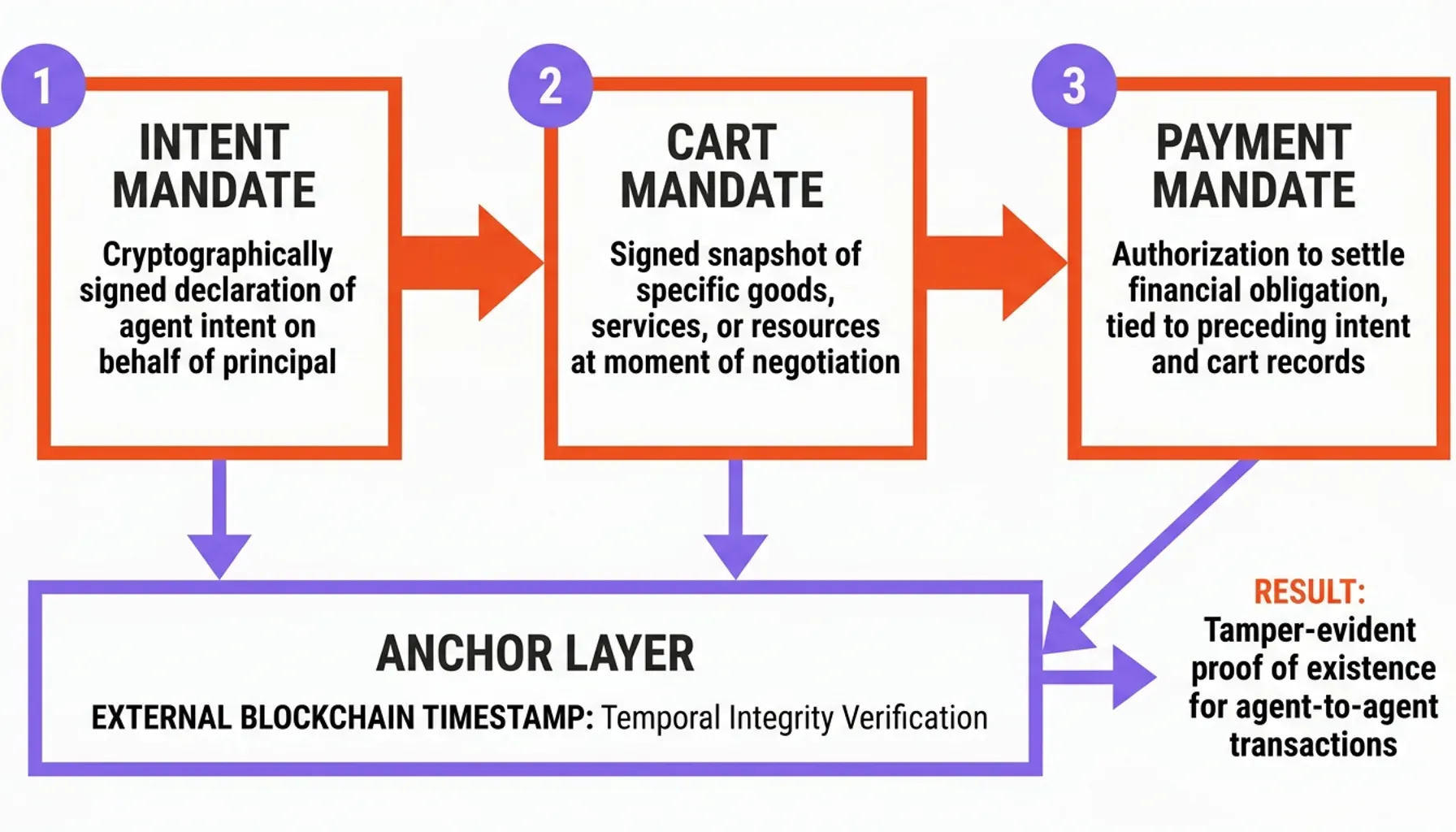
AP2 structures its evidence model around three core mandate types:
- Intent Mandate, A cryptographically signed declaration that an agent intends to perform a specific action or class of actions on behalf of its principal.
- Cart Mandate, A signed snapshot of the specific goods, services, or resources being requested at the moment of negotiation.
- Payment Mandate, The authorization to settle a financial obligation, tied directly to the preceding intent and cart records.
Each mandate is cryptographically signed, creating a verifiable chain of agreement between two autonomous entities. This is a significant architectural improvement over informal API calls or session tokens. The signature proves what was agreed. It does not, by itself, prove when that agreement was made in a globally verifiable, tamper-evident way.
That distinction matters enormously in practice. Consider a scenario where an agent executes a high-value procurement decision and the transaction is later disputed. The internal log shows a timestamp of 14:32:07 UTC. But that timestamp was generated by the agent platform's own clock, stored in the agent platform's own database, administered by the agent platform's own engineers. Its credibility in a dispute depends entirely on trusting the platform, the very party that may have an interest in the outcome.
This is the limitation AP2's mandate architecture cannot solve on its own. Cryptographic signatures prove content integrity. They do not prove temporal integrity. An attacker, or a negligent administrator, can create a validly signed mandate with a manipulated timestamp. The signature will verify. The timestamp will lie.
For AP2 agent transactions to carry genuine legal and operational weight, every mandate exchange needs an external anchor: proof of existence at a specific point in time, recorded on infrastructure that no single party controls. This is precisely what blockchain timestamping provides for autonomous payment workflows.
Verifiable Credentials: The Foundation of Agent Identity and Authorization
W3C Verifiable Credentials (VCs) are the identity backbone of the agentic enterprise. A VC is a cryptographically signed digital credential that asserts something about its subject, in this context, that a specific agent has the authority to spend funds, negotiate contracts, or access sensitive systems on behalf of a named principal.
The W3C Verifiable Credentials Data Model 2.0 provides a standardized format for these assertions, enabling interoperability across platforms and organizations. Combined with Decentralized Identifiers (DIDs), VCs allow agents to prove their provenance without relying on a central authority to vouch for them.
Architecturally elegant. But there is a critical blind spot.
A VC proves what was signed and by whom. The cryptographic signature is mathematically sound. What it cannot prove, without an external reference, is when that credential was valid in a globally verifiable sense. The issuance timestamp embedded in a VC is self-reported by the issuer. It can be backdated. It can be post-dated. In a complex agentic workflow where an agent's authorization scope changes rapidly, spending limits adjusted, access permissions revoked, delegation chains updated, the precise moment a credential was issued or presented is legally and operationally critical.
Consider the risk: an agent executes a transaction at 09:15 UTC. Its authorization credential was revoked at 09:10 UTC. The agent platform's logs, however, show the credential as valid at time of transaction. If those logs are under administrative control, the discrepancy can be obscured. A neutral, external timestamp on the VC presentation event would make this manipulation immediately detectable.
This is why a Verifiable Credentials audit trail must go beyond the VC itself. The credential proves identity and authorization scope. A blockchain timestamp proves the moment that credential was presented and accepted, independently, immutably, and without relying on any party to the transaction.
The Missing Link: Why Timestamps Complete the Audit Trail
Here's the thing. System clocks are not neutral arbiters of truth. They drift. Administrators can set them forward or backward. In virtualized cloud environments, clock synchronization is a known operational challenge. For routine logging, this is acceptable. For evidence that must hold up in a regulatory audit, a commercial dispute, or a legal proceeding, local timestamps are structurally insufficient.
Blockchain timestamping reduces the cost of verification to near zero while making the evidence independent of any single provider. The mechanism is precise: a SHA-256 cryptographic hash of the document or log entry is computed. This hash, a unique, fixed-length digital fingerprint, is anchored to the Bitcoin or Ethereum blockchain. The blockchain's consensus mechanism, maintained by thousands of independent nodes globally, records the hash at a specific block height. From that moment forward, anyone can verify that the document existed in that exact form at that exact time, without contacting OriginStamp, the agent platform, or any other party.
This is what "mathematical proof of existence" means in practice. Not a claim. A verifiable fact, anchored in public infrastructure that no administrator can retroactively modify.
For AP2 agent transactions, this creates a four-layer evidence stack:
- The AP2 mandate, cryptographically signed content of the agreement
- The Verifiable Credential, cryptographically signed proof of agent authorization
- The blockchain timestamp, externally verifiable proof of when each element existed
- The audit trail, a tamper-evident log linking all three layers across the transaction lifecycle
The independence from the provider is not a technical nicety. It is the entire point. Blockchain timestamps for critical infrastructure security remain valid even if the agent platform is decommissioned, the ERP vendor goes offline, or the original signing keys are rotated. The Bitcoin blockchain does not go offline. The evidence survives the lifecycle of the systems that generated it.
Securing the Chain: From Agent Decisions to Critical Infrastructure
The stakes of unsecured agent transactions escalate sharply when agents move from software procurement into physical control. Agents managing energy distribution, manufacturing automation, or defense logistics do not just process invoices. They send commands to Operational Technology (OT) and SCADA systems that control physical infrastructure.
In these environments, a replay attack, where a previously valid command is re-executed at an unauthorized time, is not a billing anomaly. It is a potential safety incident. An agent authorized to open a valve at 02:00 UTC should not be able to replay that authorization at 14:00 UTC. The difference between a valid command and a replayed command is entirely temporal, and proving that difference requires a timestamp that cannot be forged.
This is where autonomous agent security intersects with critical infrastructure protection. The same blockchain timestamping logic that proves when an AP2 payment mandate was signed also proves when an OT command was issued, by which agent, under which authorization credential. Every instruction to a physical device becomes an entry in a tamper-evident timeline.
For sectors operating under ISO/IEC 27001 information security frameworks, this is not theoretical. It is an architectural requirement. Access control logs must be trustworthy. Audit trails must be tamper-evident. The question is not whether to implement integrity controls, but whether those controls are strong enough to survive adversarial scrutiny.
The convergence of AP2 transactions and infrastructure security demands a single, coherent answer: every machine decision that touches a physical asset must be anchored in a provable, provider-independent timeline. Reactive auditing, examining logs after an incident, is too slow and too vulnerable to tampering. Proactive integrity means every command is timestamped at the moment of issuance, creating a real-time chain of evidence that makes post-incident manipulation immediately detectable.
The Chained Evidence Problem: Multi-Agent Workflows
Single-agent transactions are complex enough. The emerging reality of agentic meshes, where Agent A hires Agent B to fulfill a request delegated by Agent C, acting on behalf of principal organization D, introduces a combinatorial evidence problem that breaks conventional audit approaches entirely.
Each handoff in this chain is a potential point of dispute. Did Agent A actually delegate to Agent B before Agent B acted? Did Agent C's authorization scope cover the specific action Agent B ultimately took? In a multi-agent workflow, these questions cannot be answered by examining any single system's logs, because each agent may run on a different platform, in a different cloud environment, under a different administrative domain.
Most companies get this wrong. They treat the logs from each platform as sufficient, then discover in a dispute that no single record is independently verifiable. This is the agent-to-agent trust problem at scale. Blockchain timestamps solve it by providing a shared, neutral reference timeline that all parties can verify independently. When every delegation event, every mandate exchange, and every authorization presentation is hashed and anchored to a public blockchain, the sequence of events becomes provable across organizational boundaries.
Human auditors examining a complex agentic workflow no longer face a black box. They have a cryptographically ordered timeline: Agent C issued delegation at block 840,112. Agent A accepted and re-delegated at block 840,119. Agent B executed at block 840,134. The sequence is mathematically verifiable. Any attempt to insert a retroactive step or alter the order of events would require rewriting the blockchain, which is computationally infeasible.
For enterprises building agentic commerce infrastructure, this is the difference between having logs and having evidence. Logs are internal. Evidence is independently verifiable.
Future-Proofing the Agentic Enterprise
The machine economy is not a future scenario. It is scaling right now, faster than most enterprise security architectures were designed to handle. For CTOs and CPOs making architectural decisions today, the question is not whether to address agent transaction integrity. It is whether you build it in from the start or inherit the liability of not doing so.
Integrity-by-design means treating every agent decision as a potential audit event from day one. It means selecting AP2 implementations that natively support external timestamp anchoring. It means ensuring that Verifiable Credentials are not just issued and signed, but timestamped at the moment of presentation. It also means recognizing that AI agent observability and verifiable records are not the same thing. Observability tells you what happened inside your system. Verifiable records prove it to the outside world.
The competitive advantage is real and measurable. Organizations that can demonstrate tamper-evident, provider-independent audit trails for their agent transactions will move faster in regulated markets, resolve disputes without litigation, and build the kind of institutional trust that converts into long-term commercial relationships. Decentralized identifiers and transaction mandates anchored to public blockchains are not compliance overhead. They are a resilient foundation for every digital asset the enterprise controls.
The agentic enterprise that anchors its decisions in mathematical proof does not just survive audits. It wins them.
Explore how blockchain timestamping secures access control, OT commands, and agent transaction logs for critical operations, and build the evidence layer your autonomous systems need before the first dispute arrives.
Thomas Hepp
Co-Founder
Thomas Hepp is the founder of OriginStamp and creator of the OriginStamp timestamp, which has set the standard for tamper-proof blockchain timestamps since 2013. As one of the earliest innovators in the field, he combines deep technical expertise with a pragmatic focus on solving real business problems, and is a recognized voice in blockchain security, AI analytics, and data-driven decision support. His work has earned multiple international awards, including a top Best Project recognition from ETH Zurich and the Swiss Confederation. He publishes regularly on blockchain, AI, and digital innovation.