
Agent Trust: Why Identity Needs Verifiable Proof of Action
Jun 11, 2026

Thomas Hepp
Jun 11, 2026

The Identity Paradox in the Agent-to-Agent Economy
Autonomous AI agents are already executing financial transactions, negotiating contracts, and managing critical infrastructure, often without a single human in the loop. The question keeping security architects awake at night isn't whether these agents can be identified. It's whether their actions can be proven.
The shift from Human-to-Machine (H2M) to Machine-to-Machine (M2M) interaction is accelerating faster than the governance frameworks designed to contain it. Over half of agentic AI projects are projected to be cancelled by 2027, not because the technology fails, but because organizations can't establish the trust and accountability these systems demand. By 2026, agentic systems will handle a significant share of enterprise workflows, operating in pipelines where one agent's output becomes another agent's input with no human checkpoint between them. This is the agent-to-agent economy, and it has a trust problem.
The emerging discipline of KYA, Know Your Agent, attempts to solve the identity layer of this problem. Who is this agent? What model is it running? Who authorized it? These are legitimate and necessary questions. Standards bodies like the W3C Verifiable Credentials Data Model are building the vocabulary to answer them, enabling agents to carry machine-readable credentials that assert their identity and capabilities.
Here's the thing: identity is not integrity. Knowing who an agent is tells you nothing about what it did, when it did it, or whether that record has been altered since. Authentication solves half the security equation. The other half, the half that matters most in high-stakes environments, is non-repudiable proof of action.
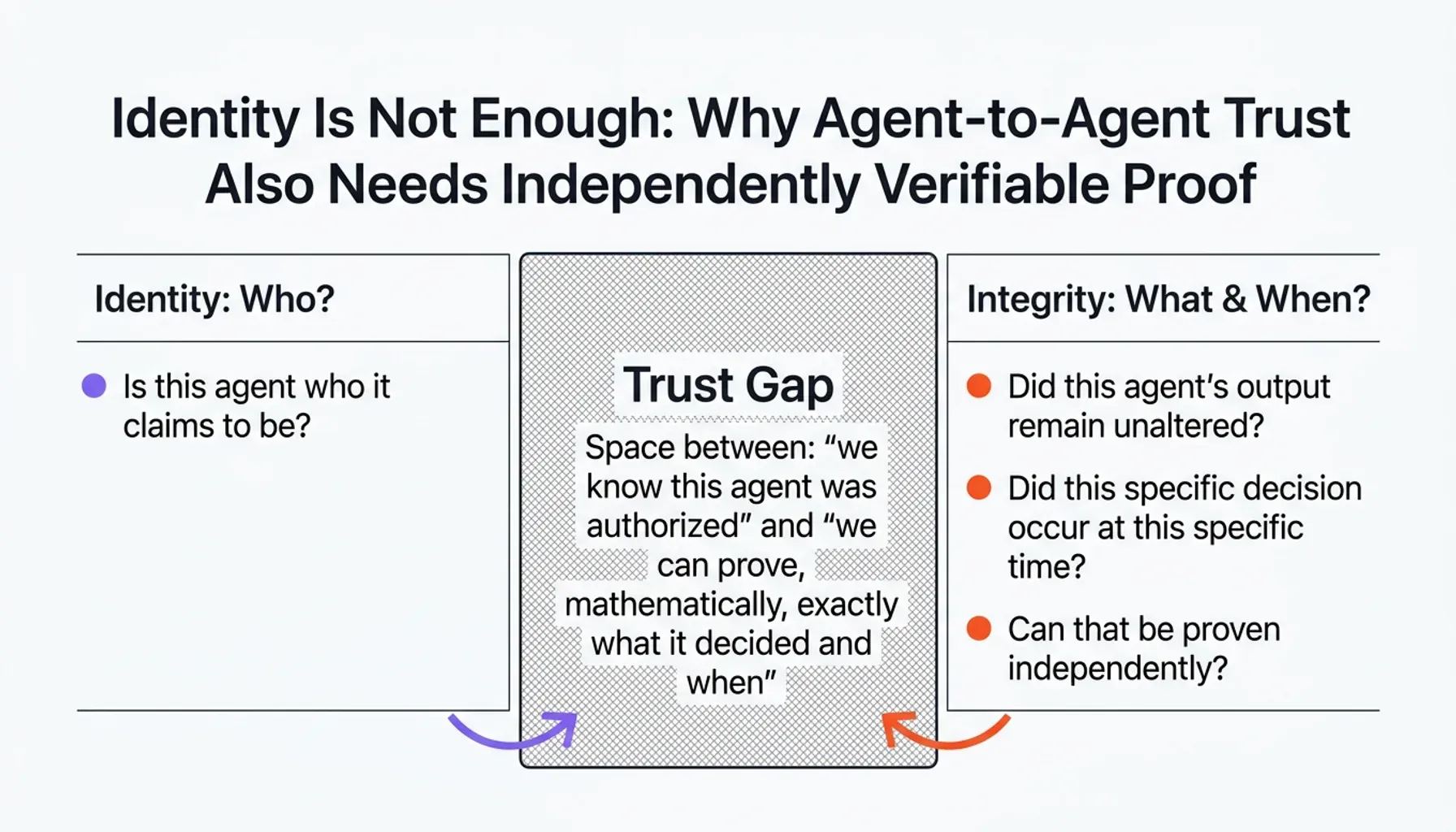
This is the Trust Gap: the space between "we know this agent was authorized" and "we can prove, mathematically, exactly what it decided and when." In decentralized systems where agents operate across organizational boundaries, that gap isn't a theoretical concern. It's an active attack surface.
Beyond DIDs: The Need for Temporal and Behavioral Context
Decentralized Identifiers (DIDs) represent a genuine step forward. Developed under the Decentralized Identity Foundation and standardized by the W3C, a DID functions as a cryptographically controlled identifier, a passport for an AI agent that no central authority can revoke or manipulate. Agent Name Services (ANS) extend this concept further, providing human-readable namespaces that resolve to machine-verifiable identity documents.
These tools are necessary. They are not sufficient.
The fundamental limitation of identity infrastructure is that it's static by design. A DID describes what an agent is at the point of registration. It says nothing about what that agent does across thousands of subsequent interactions. Agent behavior is dynamic, context-dependent, and non-linear. A legitimately credentialed agent can be compromised, manipulated through adversarial prompting, or simply make decisions that diverge from its authorized parameters, and its DID will remain perfectly valid throughout.
This is the distinction between Identity (Who) and Integrity (What/When):
- Identity answers: Is this agent who it claims to be?
- Integrity answers: Did this agent's output remain unaltered? Did this specific decision occur at this specific time? Can that be proven independently?
The IETF SCITT (Supply Chain Integrity, Transparency, and Trust) framework is one of the few emerging standards that explicitly addresses this gap. SCITT introduces the concept of a transparent, append-only ledger for recording claims about software artifacts and agent behaviors, but its adoption in live agentic systems remains nascent.
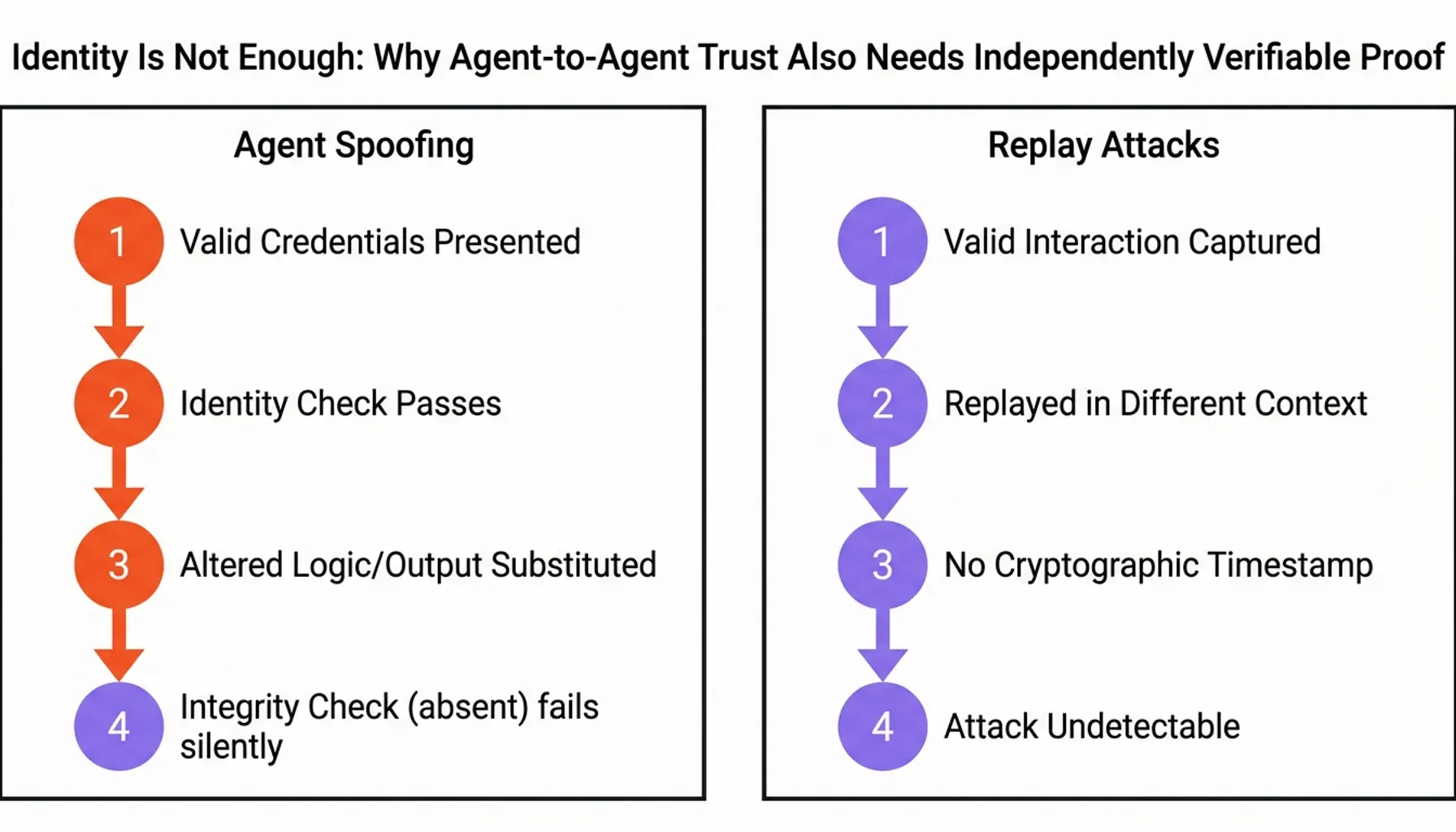
Without temporal and behavioral context, agent identity infrastructure is vulnerable to two specific attack classes worth understanding:
Agent Spoofing: An attacker presents valid credentials for a known agent while substituting altered logic or outputs. The identity check passes. The integrity check, if it existed, would not.
Replay Attacks: A valid, previously authorized agent interaction is captured and replayed in a different context. Without a cryptographic timestamp anchoring that specific interaction to a specific moment in time, replay attacks are difficult to detect and nearly impossible to prove in post-incident analysis.
Independent, third-party verification, not internal system logs, is the only architectural pattern that closes these vectors. The integrity proof must live outside the system being verified.
Reputation, Provenance, and Trust Scoring Between Agents
Most identity frameworks miss this entirely: in a multi-agent pipeline, trust isn't binary. It's a spectrum, and it needs to be earned over time.
Think about how trust works between humans in a supply chain. You don't grant a new supplier the same latitude as one with a ten-year track record of reliable delivery. The same logic applies to agents. An agent that has executed ten thousand verified, uncontested interactions carries a fundamentally different risk profile than one making its first handshake. Yet most current agent architectures treat every interaction as if it were the first.
Agent reputation systems address this by building a longitudinal record of agent behavior. Each verified, blockchain-anchored interaction contributes to a provenance trail, a cryptographically linked history of what an agent did, when it did it, and whether those actions matched its declared parameters. Over time, this trail becomes a trust score: a quantitative signal that downstream agents and human operators can use to calibrate how much autonomy to extend.
The mechanics work like this:
- Provenance anchoring: Every agent interaction is hashed and timestamped, creating an immutable chain of custody. This isn't just a record of outputs, it captures the agent's logic state, model version, and context at execution time. You can trace any decision back to its exact origin.
- Behavioral consistency scoring: Deviations from declared parameters, even minor ones, are detectable because the anchored record provides a ground truth. An agent whose behavior consistently matches its credentials accumulates a positive trust signal. One that drifts accumulates flags.
- Cross-organizational trust propagation: When agents operate across organizational boundaries, a shared, verifiable provenance record allows trust signals to travel with the agent. Organization B doesn't have to take Organization A's word for it, they can independently verify the anchored history.
This matters enormously for agentic commerce. When an AI purchasing agent negotiates with an AI vendor agent, neither party has a human relationship to fall back on. The trust infrastructure is the relationship. An agent with a verified provenance trail and a strong behavioral consistency score can be granted greater autonomy: faster approvals, higher transaction limits, fewer escalations. An agent without that trail gets treated as a stranger at every interaction.
This is where real competitive differentiation will emerge. Organizations that invest in building verifiable agent provenance now are accumulating a trust asset that compounds over time. Those that don't will find their agents operating at a permanent disadvantage, slower, more restricted, and more expensive to integrate with external partners.
The governance implications are significant too. Regulators increasingly want to know not just what an AI system decided, but whether that system has a consistent, auditable history of reliable behavior. A reputation system built on cryptographic provenance answers that question in a way that no self-reported compliance document can.
Authentication vs. Non-Repudiation: Fixing Actions in Time
There's a concept in security law and cryptography that enterprise architects consistently underestimate, until they need it in a dispute: non-repudiation. It means a party cannot credibly deny having performed a specific action. In human systems, a notarized signature provides this. In agent systems, nothing provides this by default.
Standard API logs, the default audit mechanism for most agentic frameworks, fail the non-repudiation test for several reasons:
- They are generated and stored by the same system they are meant to audit
- System administrators can modify them
- They carry no independent cryptographic proof of when they were created
- They cannot prove that a logged entry reflects the actual state of data at execution time
For routine operations, this is acceptable. For high-stakes agent interactions, financial settlement, legal commitment, medical decision support, or infrastructure control, it is not. If you've ever tried to use an application log as evidence in a dispute, you already know how quickly opposing counsel dismisses it. As explored in why application logs fall short as audit evidence for AI agents, the gap between a log entry and legally defensible evidence is significant.
The NIST SP 800-57 framework for key management establishes the cryptographic foundations for non-repudiation: digital signatures combined with trusted timestamping. Applied to agent systems, this translates to a specific technical pattern:
- Hash every agent-to-agent handshake: Apply SHA-256 to the complete interaction payload, inputs, outputs, model parameters, and context, producing a unique cryptographic fingerprint of that exact state.
- Anchor the hash to a public blockchain: Submit the hash to Bitcoin or Ethereum, where it becomes part of an immutable, publicly verifiable record. The blockchain transaction timestamp proves that this specific hash existed at this specific moment.
- Store the certificate independently: The blockchain anchor record lives outside the agent system, making it tamper-evident even if the system itself is compromised.
This isn't theoretical. OriginStamp's blockchain timestamping for AI outputs implements exactly this pattern, creating mathematically provable proof of existence for any digital artifact, including agent decision records.
The result is non-repudiation at machine scale. An agent cannot later "deny" a decision because the decision's cryptographic fingerprint is permanently recorded on a public blockchain. Neither can an administrator quietly alter the log: any change to the underlying data produces a completely different hash, one that no longer matches the anchored record.
Securing the Black Box: Output Integrity in Critical Infrastructure
The stakes of agent-to-agent trust escalate sharply when the agents in question manage energy distribution networks, industrial control systems, or defense-related protocols. Here, the failure mode isn't a disputed invoice. It's a silent, undetected deviation from authorized behavior that may only surface during post-incident forensics, if it surfaces at all.
The threat model in critical infrastructure has a specific name: Silent Failures. An agent operating within a complex pipeline produces an output that is subtly wrong, not wrong enough to trigger immediate alarms, but wrong enough to cause downstream consequences. Without an external integrity layer, the only record of what the agent actually decided may be the internal log it generated itself. If that log was compromised, or if the agent's state at execution time was altered, there is no independent ground truth.
ENISA's research on AI security risks in critical infrastructure identifies the integrity of AI decision outputs as a primary concern, noting that the trustworthiness of AI systems cannot be established through internal mechanisms alone. External, independent verification is architecturally necessary.
The ISO/IEC 42001 AI Management System standard reinforces this: organizations deploying AI in high-risk contexts must demonstrate that AI outputs are traceable, auditable, and verifiable, not just that the system was authorized to operate.
Implementing an external integrity layer for agent systems involves three components:
1. Decision Trail Anchoring Every significant agent decision, not just final outputs but intermediate reasoning states, gets hashed and anchored to an independent blockchain. This creates a tamper-evident audit trail that survives even a full system compromise.
2. Digital Twin of Logic State Beyond anchoring outputs, the agent's logic state, model version, active parameters, context window, is captured and hashed at the moment of execution. This is the "Digital Twin" of the agent's reasoning: a provable record of not just what the agent decided, but with what configuration it decided it.
3. Post-Incident Forensics Capability When an incident occurs, investigators can reconstruct the exact state of the agent at any point in time by comparing current logs against the blockchain-anchored record. Any discrepancy is mathematically provable. This transforms post-incident analysis from "what do the logs say?" to "what can we prove?"
For CTOs evaluating how blockchain anchoring protects AI output integrity in their infrastructure, this is the operational case: the blockchain record isn't a compliance checkbox. It's the forensic foundation that makes accountability possible.
The cryptographic patterns behind this approach, including hash-chain construction and anchoring strategies, are detailed in the technical mechanics of tamper-proof logging for AI agents, which covers what these systems look like in production environments.
Governance in a Fluid Landscape: Current Standards and Caveats
Let me give you the honest assessment of agent governance standards in 2025: they are fragmentary, inconsistently adopted, and frequently outpaced by the deployment velocity of the systems they are meant to govern.
Frameworks like AutoGPT, LangChain, and CrewAI have driven rapid adoption of multi-agent architectures. None of them ship with built-in non-repudiation. Their logging mechanisms are designed for debugging, not legal accountability. The protocols governing how agents communicate, A2A, MCP, and their successors, are evolving quickly, but interoperability between agent ecosystems on the question of proof of action remains largely unsolved.
The IEEE P2897 standard for interoperability of distributed ledger technology attempts to address cross-ecosystem trust, but its application to agentic AI remains at the working group stage. The practical implication: organizations deploying agents across organizational or jurisdictional boundaries today are doing so without a standardized mechanism for sharing verifiable proof of agent actions.
Regulatory pressure is beginning to change the calculus. The EU AI Act classifies certain agentic applications as high-risk and mandates logging, traceability, and human oversight mechanisms, requirements that are structurally incompatible with purely internal logging architectures. The Act's accountability provisions implicitly require what cryptographic timestamping delivers: a record that cannot be altered after the fact.
Globally, the trajectory is consistent. Institutional AI adoption in banking, healthcare, defense, and public administration is converging on a single prerequisite: Proof of Existence for data, model weights, and decision outputs. The question isn't whether organizations will need to demonstrate that their AI systems produced specific outputs at specific times. The question is whether they built the infrastructure to prove it before they needed to.
For agentic commerce specifically, the implications extend to financial disputes. The evidentiary challenges that emerge when AI agents drive transactions illustrate how the absence of verifiable action records creates systematic vulnerability in any agent-driven transaction pipeline.
The governance landscape will mature. Organizations that treat tamper-evident audit trails as a foundational infrastructure decision, rather than a retrofit, will have a measurable advantage when regulatory scrutiny arrives.
Building Fact-Based Trust in Autonomous Systems
Trust has always been a claim. Cryptographic verification makes it a fact.
The agent-to-agent economy doesn't fail because agents lack identity. It fails when identity gets mistaken for integrity, when the presence of valid credentials is treated as sufficient proof that an agent's actions were authorized, accurate, and unaltered. These are different properties, and only one of them can be verified without an independent, tamper-evident record.
The strategic framing for CTOs and VPs is direct: tamper-evident audit trails are not a compliance cost. They are a liability management tool and a competitive differentiator. Organizations that can demonstrate, mathematically rather than procedurally, that their AI systems produced specific outputs at specific times will carry a fundamentally different risk profile than those that cannot. In regulated industries, that difference shows up in audit outcomes, insurance premiums, and institutional trust.
The future of the agent economy is one where identity and verified action are two sides of the same coin. A DID proves who an agent is. A blockchain-anchored hash proves what it did. A cryptographic provenance trail proves whether it can be trusted to do it again. None of these is sufficient alone. Together, they constitute the minimum viable trust infrastructure for autonomous systems operating at scale.
Don't wait for standards to mature or regulators to mandate specific architectures. Anchor agent behavior to an independent, immutable record now, while the cost of doing so is low and the cost of not doing so remains theoretical.
When that theoretical cost becomes real, in a disputed transaction, a regulatory audit, or a post-incident investigation, the organizations that built on verifiable proof will have answers. The others will have logs.
Explore how OriginStamp secures AI outputs and decision trails with blockchain timestamping to see what fact-based trust looks like in practice.
Thomas Hepp
Co-Founder
Thomas Hepp is the founder of OriginStamp and creator of the OriginStamp timestamp, which has set the standard for tamper-proof blockchain timestamps since 2013. As one of the earliest innovators in the field, he combines deep technical expertise with a pragmatic focus on solving real business problems, and is a recognized voice in blockchain security, AI analytics, and data-driven decision support. His work has earned multiple international awards, including a top Best Project recognition from ETH Zurich and the Swiss Confederation. He publishes regularly on blockchain, AI, and digital innovation.