
Tamper-Proof AI Agent Logs: Hash-Chains & Blockchain Anchoring
Jun 11, 2026

Thomas Hepp
Jun 11, 2026

An AI agent makes a financial decision. The transaction executes. Three weeks later, a compliance audit asks one question: prove what the agent knew, when it knew it, and why it acted.
Your logs say it happened. But can you prove no one edited them?
This is the accountability gap that standard logging architectures cannot close, and it is becoming the central liability in enterprise AI deployments.
The Accountability Gap in Autonomous AI Workflows
Autonomous AI agents are no longer experimental. They approve loans, route medical records, execute trades, and trigger supply chain actions, all without a human in the loop. The observability tooling built around these systems, however, was designed for debugging, not for legal defense.
Here is the uncomfortable truth about append-only logs: append-only is a database policy, not a cryptographic guarantee. Any administrator with write access to the underlying storage, or any attacker who compromises that access, can modify, delete, or backdate entries without leaving a detectable trace. That is the Operator Dilemma: the organization that runs the AI is also the custodian of the evidence about its behavior.
The requirement that emerges from this dilemma is what practitioners are beginning to call Proof of Execution, a mathematically verifiable record that a specific agent action occurred, in a specific state, at a specific point in time, and has not been altered since. This is not an observability problem. It is a digital forensics problem.
The stakes are rising fast. The EU AI Act mandates traceability and transparency for high-risk AI systems. Financial regulators expect audit trails that survive adversarial scrutiny. In litigation, a log that a privileged admin could have edited carries the same evidentiary weight as a handwritten note on a Post-it.
The gap between what happened and what you can prove happened is where your organization is exposed. Closing it requires moving from simple observability to cryptographically sealed audit trails, and that starts with getting the cryptographic primitives right.
Cryptographic Primitives: Building the Foundation of Trust
Before hash-chaining or blockchain anchoring makes sense, the individual log entry must be trustworthy. Three cryptographic tools establish that foundation.
SHA-256 Content Hashing
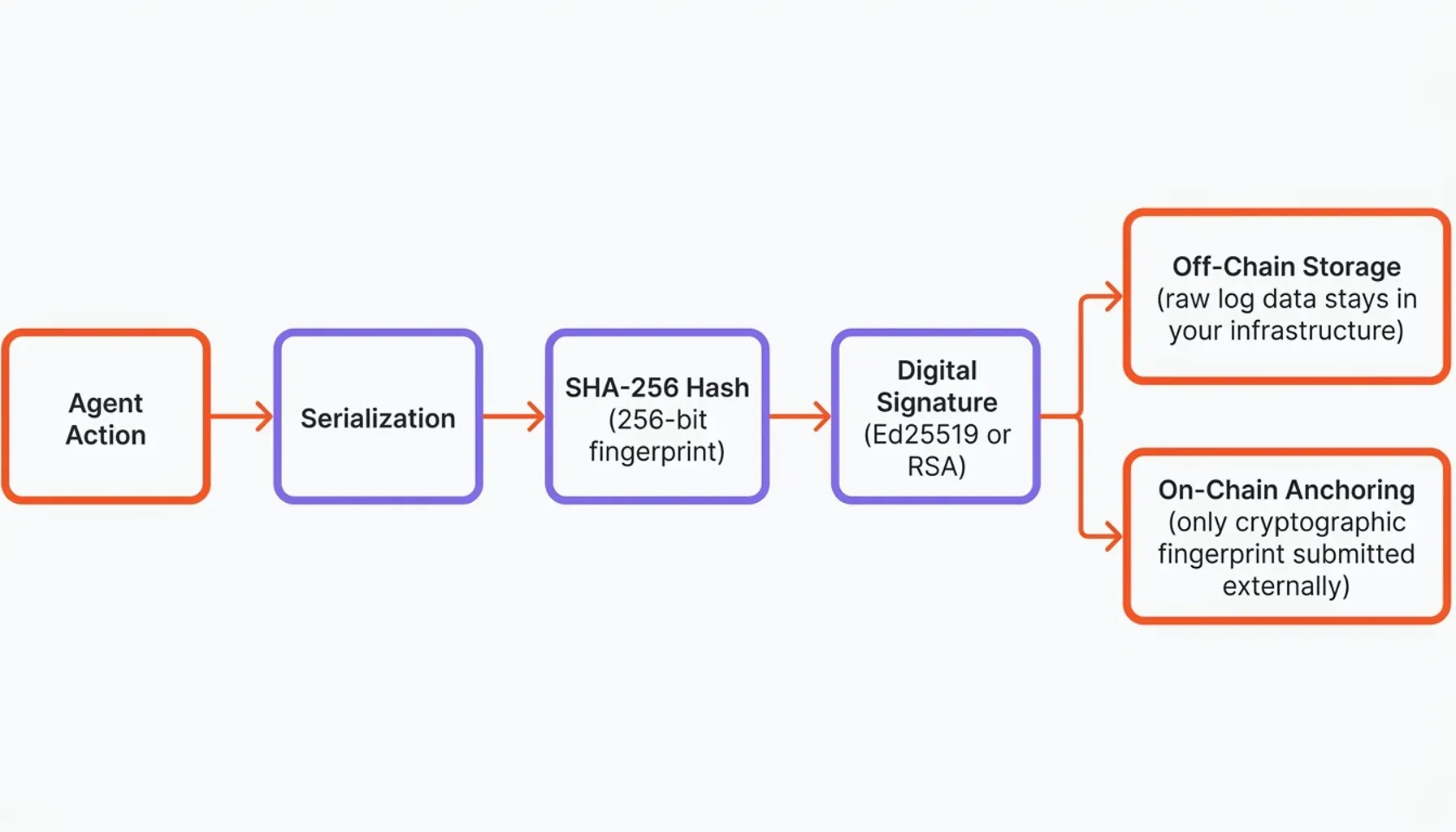
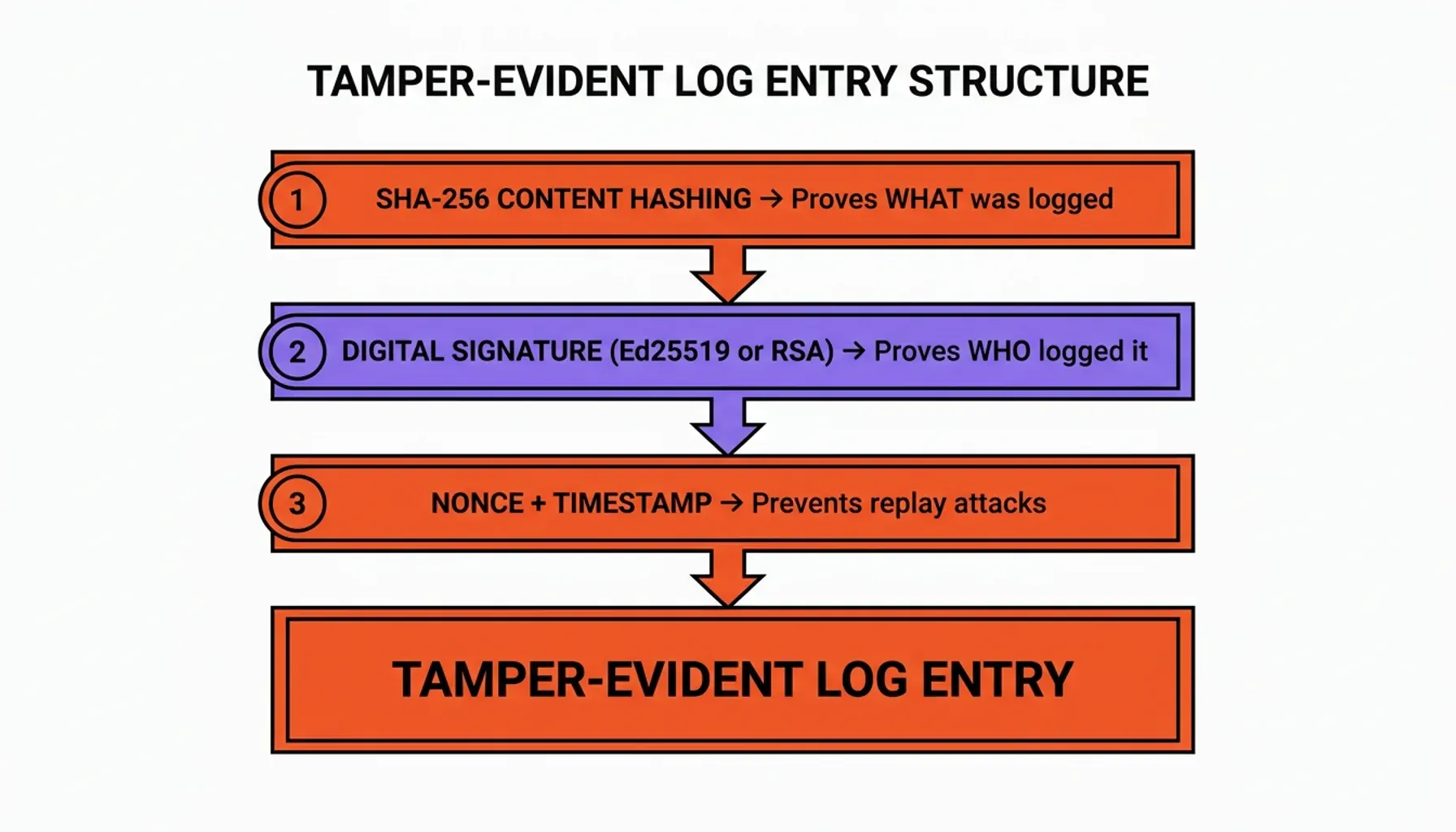
Every agent trace, the input state, the decision parameters, the output action, the timestamp, gets serialized and run through a SHA-256 hash function. The result is a 256-bit fingerprint unique to that exact content. Change a single character in the log entry and the hash changes entirely. That is the core property that makes tamper detection possible: the hash is a commitment to the content.
The raw log data itself does not need to leave your infrastructure. Only the hash gets submitted for external anchoring. Think of this as the "Hash, don't Upload" principle: data sovereignty and cryptographic proof coexist without contradiction.
Digital Signatures for Agent Identity
A hash proves what was logged. A digital signature proves who logged it. Using Ed25519 or RSA signing keys assigned to each agent instance, every log entry carries a cryptographic attestation of the acting agent's identity. This matters in multi-agent systems where one agent may invoke another, because the signature chain creates an unambiguous delegation record.
Nonces and Timestamps Against Replay Attacks
A nonce, a number used once, embedded in each log entry ensures that even identical actions produce distinct records. Pair that with a precise timestamp and you prevent replay attacks where an adversary might resubmit a legitimate log entry in a different context to obscure malicious behavior.
Off-Chain Storage and GDPR Compliance
Raw log data, which may contain personal data, proprietary model outputs, or sensitive business context, stays in your infrastructure. Only cryptographic fingerprints get anchored externally. This architecture is not a compromise; it is the correct design. It satisfies GDPR data minimization requirements while maintaining independent verifiability. The proof travels without the data.
If your agents handle autonomous payment decisions, the identity and sequencing guarantees described here are explored in depth in our breakdown of AI agent authorization in payment workflows.
Hash-Chaining: Securing the Sequence of Agent Actions
A single tamper-evident log entry is useful. A tamper-evident sequence of log entries is forensically powerful. Hash-chaining delivers the sequence guarantee.
The Mechanics of Linking
Each new log entry includes the hash of the previous entry as one of its fields before the new hash is computed. This creates a dependency chain: entry N's hash is a function of entry N-1's hash, which is a function of entry N-2's hash, and so on back to the genesis entry.
The consequence is decisive: you cannot modify, delete, or insert any entry in the chain without invalidating every subsequent hash. Backdating a log entry is not a matter of changing a timestamp field. It requires recomputing every hash from the tampered entry forward. That is computationally detectable and, once the chain is anchored externally, mathematically impossible to conceal.
This is exactly what distinguishes a hash-chain from a conventional database with an audit log column. The database audit log records what the database says happened. The hash-chain is a cryptographic commitment to what did happen. That distinction is everything in a courtroom.
Handling Parallel Execution and Multi-Agent Systems
Most AI workflows are not linear. Agents fork into parallel branches, sub-agents execute concurrently, and results merge. A naive single-chain approach breaks under these conditions.
The solution is a Merkle Mountain Range (MMR), a data structure that lets multiple concurrent chains accumulate into a single root hash for on-chain anchoring. Each branch maintains its own hash-chain integrity, while the MMR root provides a single commitment point capturing the entire execution graph at a given moment. This is the architecture that scales from a single agent to an enterprise-wide multi-agent system without sacrificing verifiability.
Performance in High-Throughput Environments
A common concern is latency. SHA-256 computation on modern hardware runs at several hundred megabytes per second. For a typical agent trace, a few kilobytes of serialized state, hashing adds microseconds, not milliseconds, to the logging path. The anchoring step, which commits the chain head to a public blockchain, is asynchronous and batched: it never sits in the critical path of agent execution.
The practical architecture separates concerns cleanly: hash locally and synchronously, anchor externally and asynchronously. High-throughput environments can anchor on a fixed cadence, hourly, for example, while critical single transactions can trigger an immediate anchor for maximum evidentiary strength.
For organizations building this into SIEM pipelines, immutable blockchain-anchored log integrity for SIEM and forensics provides a direct integration path without requiring changes to the underlying agent architecture.
Public Blockchain Anchoring: Achieving Third-Party Verifiability
Hash-chaining solves the internal integrity problem. It does not solve the independence problem. If the organization that operates the AI also controls the hash-chain database, a sufficiently motivated adversary, including an insider, could reconstruct a fraudulent chain from scratch. The chain would be internally consistent but entirely fabricated.
Public blockchain anchoring eliminates that attack vector.
Internal 'Immutable' Databases Are Not Enough
Most companies get this wrong. Managed ledger services like AWS QLDB are marketed as immutable, and within their operational model they are. Amazon's infrastructure prevents unauthorized writes. But you are delegating trust to Amazon. In a legal dispute involving Amazon as a party, or a regulatory investigation where the cloud provider receives a compelled disclosure, that independence guarantee evaporates. The same applies to any internally controlled ledger, regardless of the technology label.
Public blockchains, Bitcoin and Ethereum specifically, operate under different trust assumptions. No single entity controls them. Transactions anchored to these networks are secured by the cumulative proof-of-work or proof-of-stake of the entire network, making retroactive alteration economically infeasible at any scale.
Periodic Anchoring: Committing the Chain Head
The anchoring process is straightforward. At a defined interval, the current head hash of the log chain gets submitted to the Bitcoin or Ethereum network as a transaction. The blockchain records this hash alongside the block timestamp. From that moment, any auditor, internal, external, regulatory, or judicial, can verify that the hash existed at that time and that all preceding log entries are intact.
This is the mathematical proof of existence. It answers two questions simultaneously: what (the exact state of the log chain) and when (the blockchain timestamp, independent of any party to the dispute).
Independent Verification Without Infrastructure Access
The verification process requires no access to your internal logging infrastructure. An auditor receives the log entries, recomputes the hash chain, computes the chain head, and checks it against the blockchain record. A match means intact. A mismatch means tampering, proven, not alleged. The entire verification is executable by any party with the log data and a blockchain explorer.
This is the same logic behind AI governance frameworks that audit LLM decision trails on-chain. Whether the agent is a trading algorithm, a medical triage model, or a procurement automation system, the proof architecture is identical.
From Agent Traces to Forensic Evidence: Bridging SIEM and SOC
Cryptographically sealed logs are only operationally valuable if they integrate with the tooling your security and compliance teams already use.
SIEM Integration
Security Information and Event Management platforms ingest, correlate, and alert on log data. The tamper-proof layer described here sits beneath the SIEM, not alongside it. Agent traces get hashed and chained at the source before forwarding to the SIEM. The SIEM receives the same structured log data it always has, but now each entry carries a hash that can be independently verified against the chain.
Your SIEM rules, dashboards, and alerting logic need no modification. The forensic guarantee is added at the infrastructure layer, transparently.
Root Cause Analysis for AI Malfunctions
Here is the thing. When an AI agent produces an unexpected or harmful output, the first forensic question is: what was the exact input state and decision context at the moment of the action? Without a tamper-proof record, you answer that question by reconstructing logs that may have been modified, intentionally or through routine log rotation, after the fact. You are already on the back foot.
With a hash-chained, blockchain-anchored record, the answer is definitive. The exact agent state at the moment of the decision is cryptographically committed. Root cause analysis becomes a matter of reading the record, not reconstructing it.
Zero-Trust Logging
Zero-trust architecture extends the principle of never trust, always verify to the logging infrastructure itself. Every log entry is treated as a potential target for a sophisticated adversary, including privileged insiders. The cryptographic architecture described in this article operationalizes zero-trust for logs: no party's claim about the log's integrity is trusted without independent cryptographic verification.
Cryptographically sealed logs also accelerate incident response. When a SOC analyst investigates an AI-related security event, the integrity of the evidence chain is pre-established. There is no preliminary step of validating whether the logs themselves can be trusted. Investigation begins immediately, with evidence that will hold up under adversarial scrutiny, including in court.
Implementation Strategy: Integrating a Timestamping API
The architecture described above is not a research prototype. You can deploy it today using existing API infrastructure.
Where the Hashing and Anchoring Layer Sits
The hashing layer is a lightweight library integrated at the agent runtime level, typically a logging middleware or output handler. It intercepts agent traces before they reach persistent storage, computes the SHA-256 hash, appends the previous entry's hash to form the chain link, and writes both the raw entry and the chain metadata to your log store.
The anchoring layer is an external API call, asynchronous, batched, and operationally separate from the agent execution path. The chain head hash gets submitted to the timestamping API, which anchors it to Bitcoin and Ethereum and returns a verifiable certificate. Store that certificate alongside the log chain and present it during audits.
Automating the Anchoring Cadence
For most enterprise AI workloads, hourly anchoring provides a strong integrity guarantee with minimal overhead. For high-value single transactions, a large autonomous payment, a medical triage decision, a regulatory filing, per-transaction anchoring provides immediate, irrefutable proof. The cadence is configurable and can be tiered by risk classification of the action type.
EU AI Act Readiness
The EU AI Act's transparency and traceability requirements for high-risk AI systems are not aspirational. They are enforceable obligations with significant penalties. The logging architecture described here directly satisfies the traceability mandate: every decision by a high-risk AI system is recorded in a form that is independently verifiable and cannot be retroactively altered.
Organizations that build this infrastructure now are not just managing current risk. They are establishing the evidentiary foundation for operating autonomous AI systems in regulated markets over the next decade. The same principles that underpin AI content provenance and media integrity apply equally to agent decision logs: the value of proof is highest when you establish it before a dispute arises.
For teams ready to move from internal logging to immutable, court-admissible forensic event trails, OriginStamp's tamper-proof log integrity service for SIEM and forensics provides the anchoring infrastructure, Bitcoin and Ethereum anchoring, zero-knowledge by design, with verifiable certificates that satisfy regulatory and legal requirements without modifying your existing log pipeline.
Conclusion
The accountability gap in autonomous AI is a present liability, and it widens with every high-stakes decision an agent makes without a human in the loop. Hash every agent trace, chain the hashes, and anchor the chain head to a public blockchain. That single pipeline transforms a log that says something happened into proof that shows it happened, in a form no administrator can quietly revise. Build that foundation before the audit arrives, because building it during one is already too late.
Thomas Hepp
Co-Founder
Thomas Hepp is the founder of OriginStamp and creator of the OriginStamp timestamp, which has set the standard for tamper-proof blockchain timestamps since 2013. As one of the earliest innovators in the field, he combines deep technical expertise with a pragmatic focus on solving real business problems, and is a recognized voice in blockchain security, AI analytics, and data-driven decision support. His work has earned multiple international awards, including a top Best Project recognition from ETH Zurich and the Swiss Confederation. He publishes regularly on blockchain, AI, and digital innovation.