
EU AI Act Article 12: Defensible Logging for AI Agents
Jun 11, 2026

Thomas Hepp
Jun 11, 2026

The New Blueprint for AI Accountability: Understanding Article 12
A log file that can be edited is not a log file. It is a draft.
This distinction sits at the heart of EU AI Act Article 12, the regulation's binding mandate for automatic event recording across high-risk AI systems. Enacted as Regulation (EU) 2024/1689 and entering full enforcement in August 2026, the AI Act does not treat logging as a technical afterthought. It treats it as a structural requirement for accountability.
Article 12 introduces what regulators frame as traceability by design: the obligation to build AI systems that generate, retain, and protect records of their own operation, not as an audit add-on, but as a core architectural feature. This applies to any high-risk AI system as defined under Annex III, which covers use cases from credit scoring and recruitment tools to medical devices and law enforcement systems. Increasingly, it applies to autonomous AI agents753958_EN.pdf) capable of chained decision-making with limited human oversight.
The enforcement timeline is real. GRC teams waiting for finalized harmonized technical standards, including the still-developing ISO/IEC DIS 24970 and CEN-CENELEC outputs, will find themselves behind the curve. The regulation is law. The standards clarify implementation; they do not delay obligation.
The practical question is not whether your AI systems need defensible logs. They do. The question is whether your current logging infrastructure can withstand regulatory scrutiny, legal discovery, or a post-incident forensic review, and whether you can prove it.
Most organizations cannot. Yet.
Technical Requirements: What Must Your AI Logs Capture?
Article 12 sets a minimum content floor for AI event logs. Understanding what that floor covers, and where it stops, is the first step toward building a compliant architecture.
The Minimum Content Standard
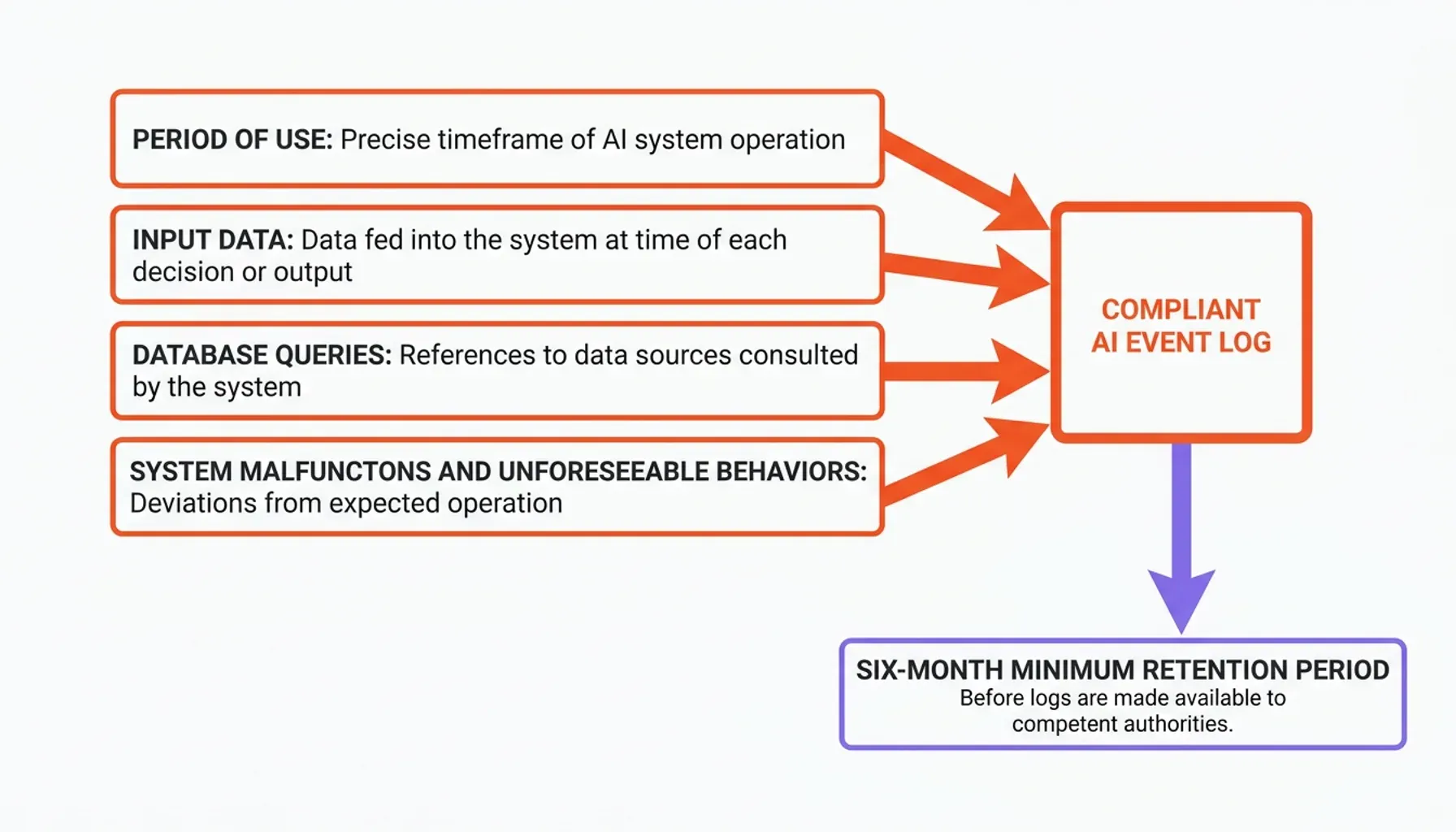
Under Article 12(2), logs must capture, at minimum:
- Period of use: The precise timeframe during which the AI system was operational, enabling regulators to reconstruct the sequence of events.
- Input data: The data fed into the system at the time of each decision or output, where technically feasible and proportionate.
- Database queries: References to the data sources the system consulted, particularly relevant for retrieval-augmented generation (RAG) architectures and AI agents with external tool access.
- System malfunctions and unforeseeable behaviors: Any deviation from expected operation must be captured and flagged for post-market monitoring purposes.
That last category is operationally significant. Regulators are not only interested in what the system did correctly. They want a reliable record of where it failed, behaved unexpectedly, or produced outputs that diverged from its intended function. For AI agents operating in dynamic environments, logging must be continuous and event-driven, not sampled or summarized.
Retention: Six Months, Minimum
The Act establishes a six-month minimum retention period for logs generated by high-risk AI systems. Providers must retain these records and make them available to competent authorities on request.
This creates an immediate tension with GDPR data minimization principles under Article 5(1)(c), which require that personal data not be kept longer than necessary. Organizations operating AI systems that process personal data must resolve this conflict through purpose limitation documentation and, where possible, pseudonymization or hashing of personal data fields within the log itself.
Interplay with Articles 13 and 19
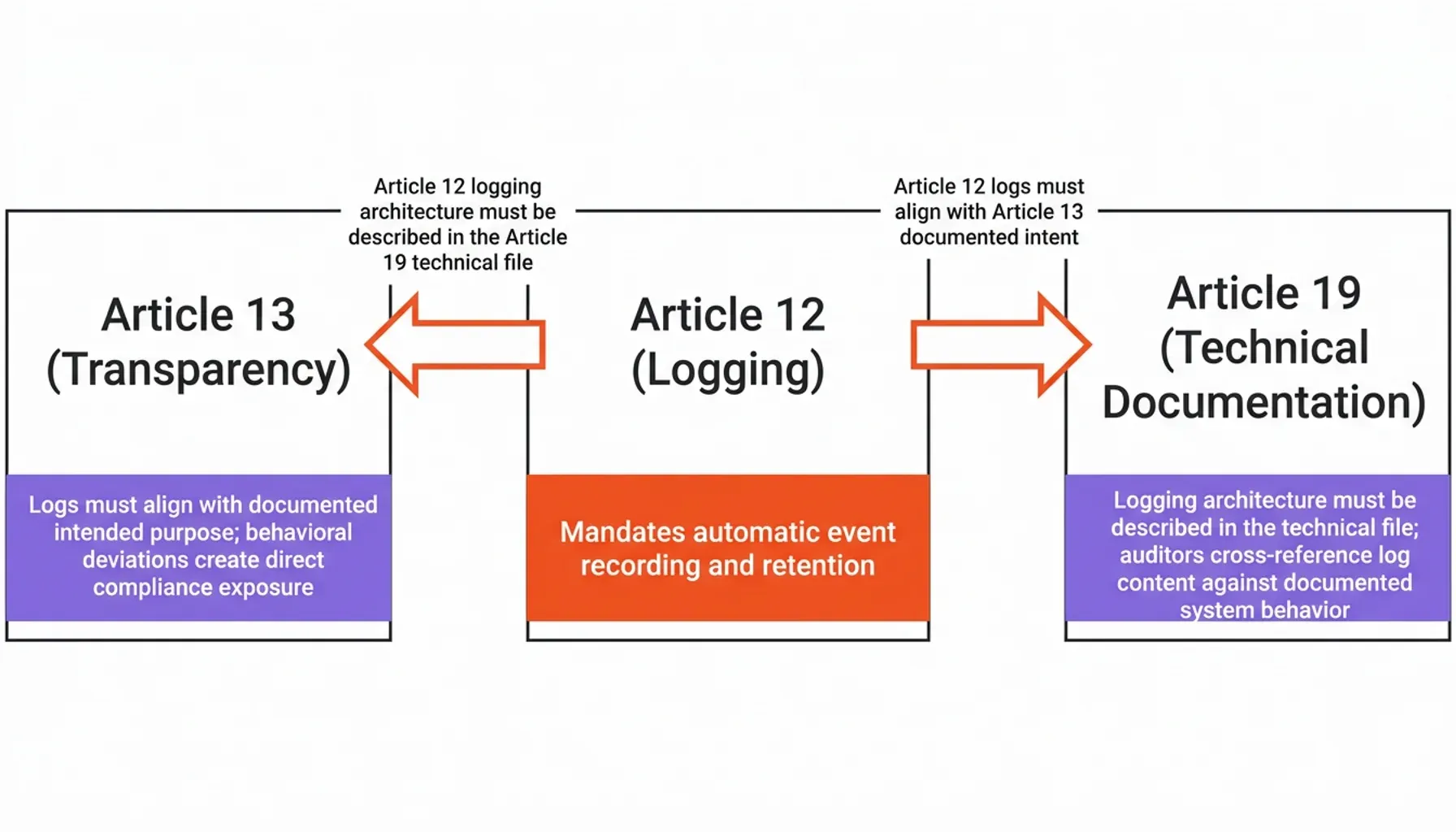
Article 12 does not operate in isolation. It connects directly to:
- Article 13 (Transparency and Instructions for Use): Logs must align with the system's documented intended purpose. Behavioral deviations captured in logs that contradict the Article 13 documentation create direct compliance exposure.
- Article 19 (Technical Documentation): Logging architecture must be described in the technical file. Auditors will cross-reference log content against documented system behavior.
The compliance burden is not just about capturing data. It is about ensuring that what you capture is coherent, consistent, and traceable across your entire documentation ecosystem.
The Regulatory Gap: Mandated Logging vs. Provable Integrity
Here is the problem that Article 12 creates but does not fully solve.
The regulation mandates logging. It does not mandate tamper-proof logging. It requires that records exist. It does not yet prescribe the cryptographic or procedural mechanisms that would make those records forensically defensible.
This is the integrity gap, and it is the most significant unresolved risk in AI Act compliance today.
The Admin Tampering Problem
Standard application logs, whether stored in SIEM platforms, cloud-native logging services, or on-premise databases, share a common vulnerability: they are accessible to privileged users. A system administrator with sufficient access rights can alter, delete, or overwrite log entries without leaving a visible trace in the log itself.
This is not a hypothetical threat. In post-incident forensic investigations, log manipulation by insiders is a documented attack vector. When the logs in question are the primary evidence of an AI system's behavior during a disputed decision, a rejected loan application, a flagged security alert, a medical diagnostic output, the inability to prove those logs have not been altered is a fundamental evidentiary failure.
For AI agents operating with greater autonomy, the problem compounds. As covered in our analysis of AI agent audit trails vs. application logs, the gap between what an AI system records and what actually occurred can be significant, and standard logs provide no mechanism to detect or prove that divergence.
The Standards Landscape: Still Catching Up
Two draft standards are directly relevant here:
- prEN 18229-1 (CEN-CENELEC JTC 21): Security requirements for AI systems, currently in development. Expected to address logging integrity as part of broader AI security architecture.
- ISO/IEC DIS 24970: A dedicated standard for AI system logging. Still in draft status, with publication timelines uncertain.
Neither standard is finalized. Neither provides the technical prescription that compliance teams need today. Organizations that wait for these standards to land before addressing log integrity will face enforcement exposure in the interim.
Why Traceability Without Integrity Is Legally Meaningless
The AI Act's use of the word "traceability" implies that records can be followed backward through time to reconstruct what happened. But traceability is only legally meaningful if the records being traced are authentic.
A log that shows an AI system made a particular decision at a particular time proves nothing if a regulator, opposing counsel, or audit team cannot verify that the log has not been modified since the event occurred. The record exists. Its authenticity cannot be established. In a legal or regulatory context, that is functionally equivalent to no record at all.
This is precisely why AI governance frameworks built on blockchain timestamping are gaining traction among compliance-forward organizations. Cryptographic anchoring converts a mutable log into a mathematically verifiable record, one that can be authenticated independently of the organization that created it.
Closing the Loop: Cryptographic Timestamps for Forensic Readiness
The solution to the integrity gap is not a new logging format. It is a cryptographic seal applied at the moment of log creation.
How Blockchain-Based Hashing Works for AI Logs
The process is straightforward in principle:
- At the moment a log event is generated, a SHA-256 hash, a unique cryptographic fingerprint, is computed from the log entry's content.
- That hash is anchored to a public blockchain (Bitcoin, Ethereum, or both), creating an immutable, timestamped record of the hash's existence at that specific moment.
- The original log entry is stored in your existing infrastructure (SIEM, cloud storage, on-premise archive). The blockchain holds only the hash, so no sensitive data leaves your environment.
- At any future point, the log entry can be re-hashed and compared against the blockchain record. Any modification to the original entry, even a single character, produces a different hash, immediately revealing tampering.
This architecture is what tamper-proof log integrity for SIEM and forensic workflows delivers in practice: a zero-trust audit trail where the authenticity of every event record is independently verifiable, regardless of who has had access to the underlying system.
RFC 3161 and Blockchain Anchors: Court-Admissible Evidence
For AI liability disputes, which the proposed AI Liability Directive makes increasingly likely, the evidentiary standard matters. RFC 3161 defines a trusted timestamping protocol that establishes cryptographic proof of a document's existence at a specific time. Combined with blockchain anchoring, this creates a dual-layer integrity proof that meets the evidentiary requirements of multiple legal jurisdictions.
For SIEM and SOC teams, this has direct operational value. When an AI system produces an anomalous output, a false positive in a threat detection model or an unexpected recommendation in a clinical decision support tool, forensic teams need to determine whether the anomaly originated in the AI's behavior or in an external security breach that manipulated the system's inputs. Tamper-proof event streams make that determination possible. Without them, the investigation starts from an assumption of unreliable evidence.
Zero-Trust Logging as Operational Standard
Most companies get this wrong. The principle of zero-trust security, trust nothing, verify everything, applies directly to logging infrastructure. A log that requires trust in the system administrator's integrity is not a zero-trust log. It is a log that depends on the honesty of a privileged human actor.
Cryptographic timestamping removes that dependency. The integrity of the record is established mathematically, not institutionally. This matters not only for regulatory compliance but for the broader question of AI content provenance and digital truth, ensuring that the record of what an AI system did is as trustworthy as the system itself is required to be.
The Cost of Non-Compliance: Penalties and Liability Exposure
The financial penalties for AI Act violations are substantial. But the fines are not the primary risk.
The Fine Structure
Under Article 71, violations of Article 12's logging requirements, classified as obligations applying to high-risk AI systems, carry penalties of up to EUR 15 million or 3% of total worldwide annual turnover, whichever is higher. For large enterprises, 3% of global turnover will typically exceed the EUR 15 million cap by a significant margin.
The full scope of EU AI Act penalties and their business impact extends well beyond the headline numbers, but the logging-specific exposure is direct: failure to maintain adequate records is a documentable, auditable violation. Either the logs exist and are verifiable, or they do not.
Presumption of Fault: The Liability Directive Dimension
The proposed AI Liability Directive introduces a concept with significant implications for logging: presumption of fault. Under the draft directive, if a high-risk AI system causes damage and the provider or deployer cannot produce adequate logs demonstrating the system's behavior at the time of the incident, courts may presume that the system was at fault.
Think about what that means in practice. Missing or unreliable logs do not simply create a compliance gap. They create a legal presumption of liability that your organization must then disprove, without the evidence that would have enabled that defense.
Article 26: Deployers Are Not Exempt
A common misconception is that logging obligations fall exclusively on AI system providers. Article 26 makes clear that deployers, organizations that put AI systems into operational use, share the burden. Deployers must ensure that logs are generated, retained, and protected in accordance with Article 12, and must cooperate with providers to ensure the logging architecture functions as required.
You cannot outsource your compliance exposure entirely to the vendor. You must verify that the logging infrastructure meets regulatory requirements and that you have access to the records you may need to produce.
Strategic Roadmap: Building a Defensible AI Audit Trail
Compliance with Article 12 is not a single technical fix. It is a cross-functional program. The following roadmap provides a structured path from current-state assessment to defensible logging architecture.
Step 1: Inventory and Gap Analysis
Begin with a systematic inventory of all AI systems in operation that fall within the high-risk categories defined in Annex III. For each system, assess:
- What events are currently logged?
- Where are logs stored, and who has write access?
- What is the current retention period, and does it meet the six-month minimum?
- Can the integrity of existing logs be verified independently?
This gap analysis will typically reveal that most organizations have logging infrastructure that satisfies the existence requirement but fails the integrity requirement entirely.
Step 2: Implement Automated Anchoring at Log Creation
The integrity gap closes when cryptographic sealing is applied at the moment of log creation, not retroactively. Retroactive hashing of log batches provides weaker protection than event-level anchoring, because it leaves a window during which logs can be altered before the hash is computed.
Blockchain-anchored integrity verification for security event logs provides the automated, event-level anchoring that Article 12 compliance demands, with no sensitive data leaving your environment and no dependency on the trustworthiness of internal administrators.
Step 3: Establish Cross-Functional AI Compliance Governance
Defensible logging is not an IT problem. It is a governance problem that requires coordinated ownership across Legal, IT Security, Data Protection, and Compliance functions. Specifically:
- Legal must define the evidentiary standards that logs must meet for the jurisdictions in which the organization operates.
- IT Security must implement and maintain the cryptographic infrastructure.
- Data Protection must resolve the GDPR tension and document the legal basis for retention.
- Compliance must map logging outputs against Article 12, Article 13, and Article 19 requirements and maintain the technical documentation file.
ISO 27001:2022 Annex A Control 8.15 provides a recognized framework for logging governance that integrates naturally with AI Act requirements. Organizations already certified under ISO 27001 have a structural head start, but certification alone does not close the integrity gap.
From Compliance Burden to Competitive Advantage
The organizations treating Article 12 as a minimum threshold to clear are missing the strategic opportunity. Defensible AI audit trails are not just a regulatory requirement. They are a trust signal, to regulators, to customers, and to counterparties in AI-assisted transactions.
As AI systems take on greater roles in contract review, financial decisions, and operational workflows, the ability to produce a mathematically verifiable record of what the system did, when it did it, and on what basis differentiates trustworthy AI deployment from legally exposed AI deployment.
The organizations that build immutable forensic records into their AI infrastructure today will not just be compliant. They will be defensible, in court, in audits, and in the market.
Article 12 sets the floor. Cryptographic integrity raises you above it. Explore how immutable blockchain-anchored logging for AI and SIEM environments can make your AI audit trail forensically defensible from day one.
Thomas Hepp
Co-Founder
Thomas Hepp is the founder of OriginStamp and creator of the OriginStamp timestamp, which has set the standard for tamper-proof blockchain timestamps since 2013. As one of the earliest innovators in the field, he combines deep technical expertise with a pragmatic focus on solving real business problems, and is a recognized voice in blockchain security, AI analytics, and data-driven decision support. His work has earned multiple international awards, including a top Best Project recognition from ETH Zurich and the Swiss Confederation. He publishes regularly on blockchain, AI, and digital innovation.