
How to Timestamp a File on Blockchain: Developer's Guide
Jun 11, 2026

Thomas Hepp
Jun 11, 2026

The Evolution of Digital Trust: Why Blockchain Timestamping Matters
A signed PDF can be forged. Server logs can be edited by any administrator with access. File metadata, creation dates, modification timestamps, is trivially overwritten with a single command. When a legal dispute, an insurance claim, or a regulatory audit hinges on when a document existed and whether it has changed, these conventional methods offer no reliable defense.
That's the core problem blockchain timestamping solves, and it solves it without requiring you to trust any single authority.
Proof of Existence (PoE) is the cryptographic guarantee that a specific piece of data existed in a specific form at a specific point in time. In a digital-first economy where contracts, software builds, medical records, and financial disclosures are all digital artifacts, PoE is no longer a niche legal concept. It is foundational infrastructure.
Traditional Timestamping Authorities (TSAs), as defined in PKI standards, rely on a centralized entity to sign a timestamp. That entity can be compromised, go out of business, or be coerced. Public blockchains, Bitcoin and Ethereum, replace that trust model with mathematics. Once a cryptographic fingerprint is anchored to a block, the proof exists independently of any vendor, any server, and any administrator.
This is not theoretical. Tamper-evident proof of existence can be independently verified by any party with access to the public ledger, a property no centralized TSA can match.
Most developers don't lose sleep over this until they're sitting in a deposition, wondering why their "timestamped" server log carries zero evidentiary weight.
The practical implication for you as a developer: you can build systems where data integrity is not a policy claim. It is a verifiable mathematical fact. The rest of this guide shows you exactly how.
The Privacy-First Workflow: How Timestamping Works Without Sharing Data
One of the most persistent misconceptions about blockchain timestamping is that it requires uploading sensitive files to a third-party service. It does not. The architecture is deliberately privacy-preserving by design.
So how does a public blockchain prove something about a file it has never seen? That's the elegant part.
The Hashing Layer
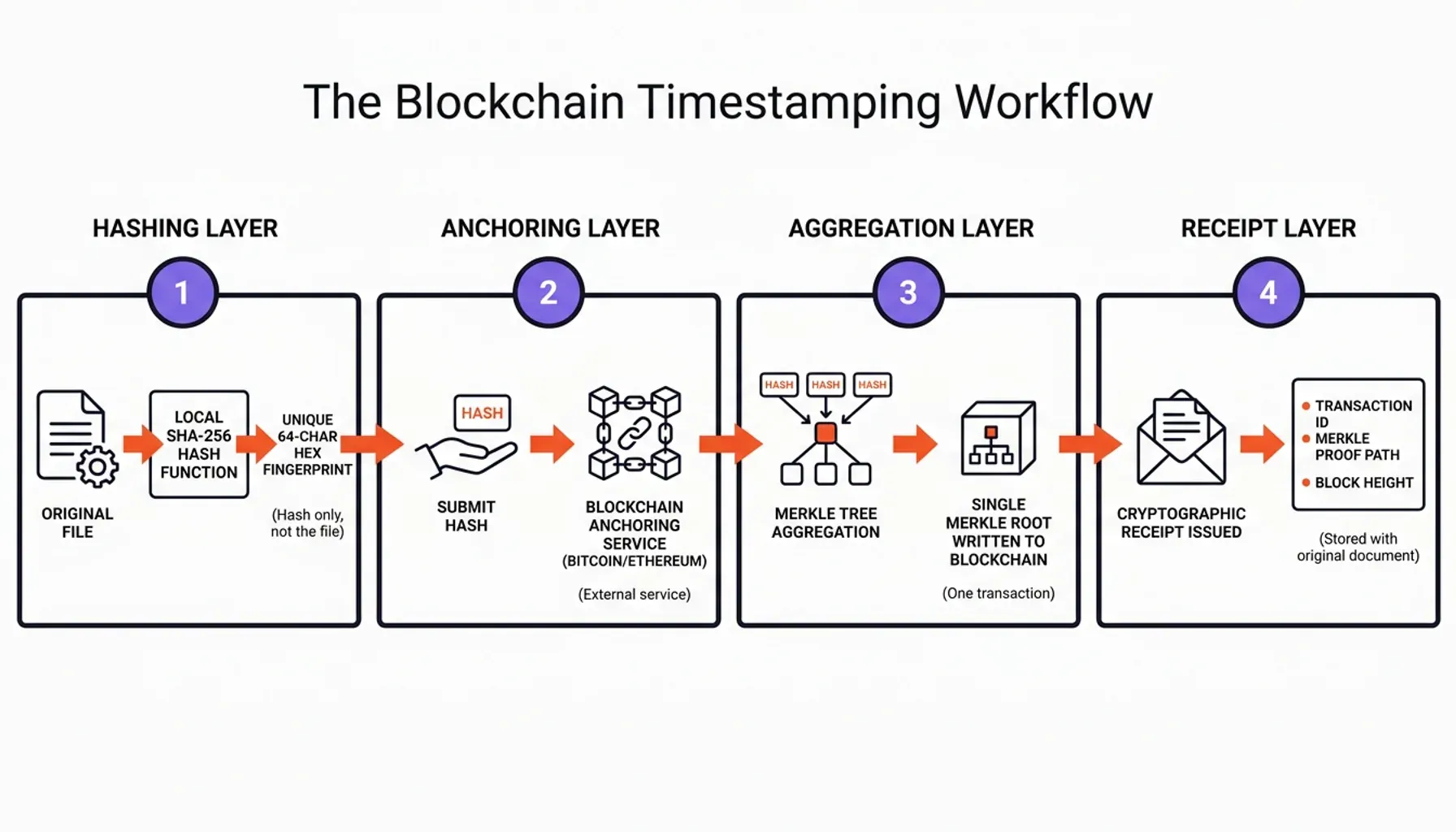
The process begins locally, on your own infrastructure. You run your file through a cryptographic hash function, specifically SHA-256, which produces a fixed-length 64-character hexadecimal string. This string is a unique digital fingerprint of your file's exact contents.
The critical property: the hash is a one-way function. You cannot reconstruct the original file from the hash. This means you never need to share the actual document with anyone. Only the fingerprint leaves your environment.
import hashlib

def generate_sha256(file_path):
    sha256 = hashlib.sha256()
    with open(file_path, "rb") as f:
        for chunk in iter(lambda: f.read(65536), b""):
            sha256.update(chunk)
    return sha256.hexdigest()
The Anchoring Layer
The hash is then submitted to a blockchain anchoring service. The service writes this fingerprint, not your file, to a public blockchain like Bitcoin or Ethereum. The block header contains a timestamp assigned by the network's consensus mechanism, independent of any single party's control.
This is the architecture described in Bitcoin's original timestamp server design: a chain of cryptographic proofs where each block references the previous one, making retroactive alteration computationally infeasible.
The Aggregation Layer: Merkle Trees
Anchoring every individual hash as a separate blockchain transaction would be prohibitively expensive and slow. This is where Merkle tree aggregation becomes essential.
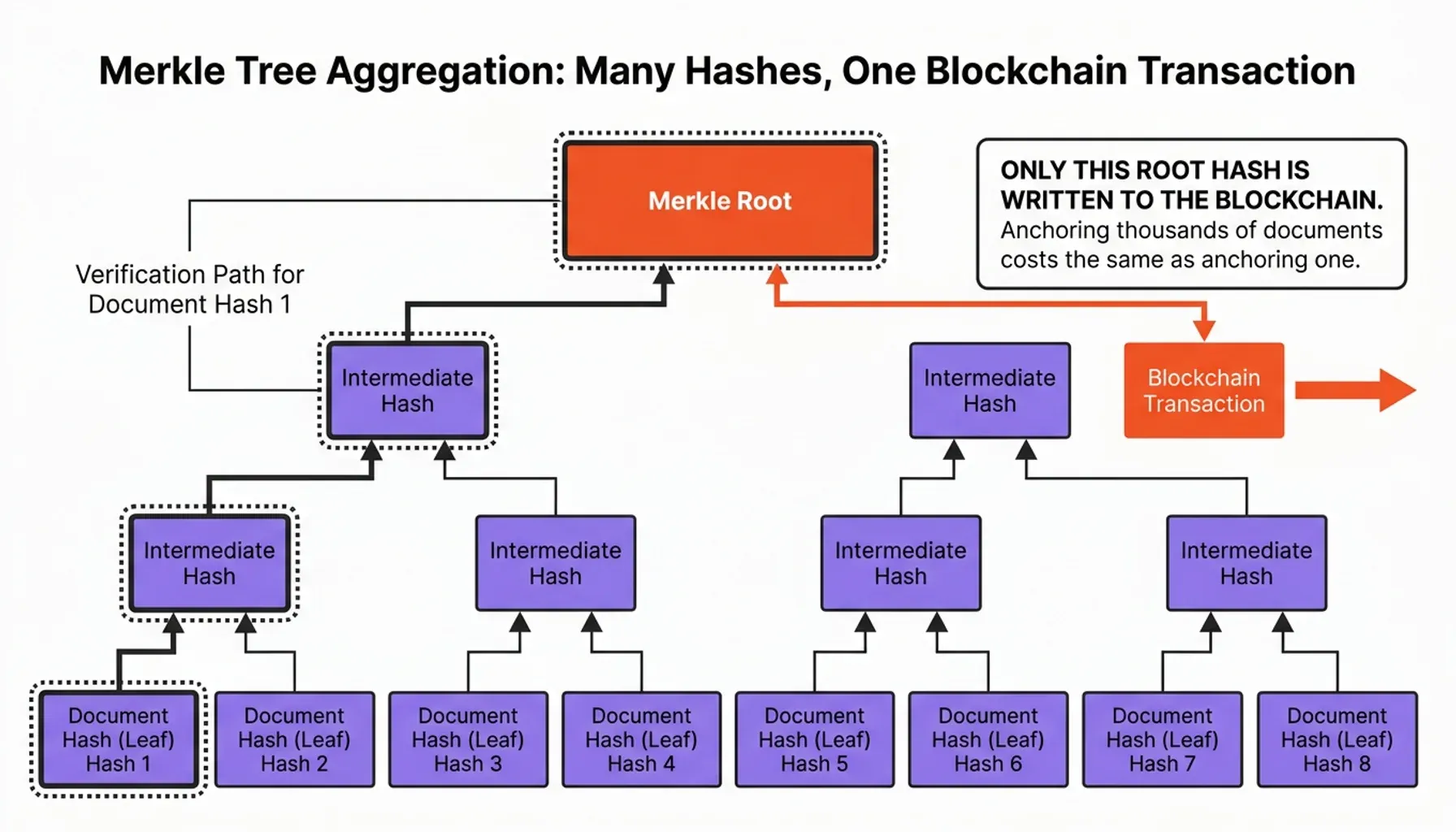
A Merkle tree is a binary tree of hashes. Your document's hash is combined with other hashes submitted during the same time window. These pairs are hashed together repeatedly until a single root hash, the Merkle root, represents the entire batch. Only this root hash is written to the blockchain in a single transaction.
This means anchoring thousands of documents costs the same as anchoring one. Each individual document can still be independently verified by providing its position in the Merkle tree (its "proof path") alongside the blockchain transaction.
The Receipt
After anchoring, you receive a cryptographic receipt: the transaction ID, the Merkle proof path, and the block height. Store this receipt alongside your original document. It is the artifact you will use for future verification, and it contains everything needed to prove integrity without contacting the original service provider.
This zero-knowledge, privacy-first architecture is why timestamping a file on blockchain is viable even for highly sensitive data in regulated industries.
DIY vs. Managed APIs: Evaluating OpenTimestamps, Chainpoint, and Commercial Tools
Once you understand the architecture, the next decision is build vs. buy. Both paths are legitimate. Neither is trivially simple.
Open-Source Standards
OpenTimestamps is the most widely adopted open standard for blockchain timestamping. It uses Bitcoin's blockchain and produces compact .ots proof files. The protocol is well-documented, client libraries exist for Python, JavaScript, Java, and Rust, and the verification process is fully independent.
Chainpoint is a protocol layer that aggregates hashes into a Merkle tree and anchors the root to both Bitcoin and Ethereum. It produces a JSON-LD proof receipt (a "Chainpoint Proof") that is portable and machine-readable.
Both are solid choices for developers who want full control and have no vendor dependency concerns.
The Hidden Complexity of DIY
Most companies get this wrong. Running your own timestamping infrastructure is harder than it looks at the API layer. Ask yourself: do you really want to be debugging Bitcoin node sync issues at 2 a.m. when a client audit is pending?
- Node infrastructure: You need a synchronized Bitcoin or Ethereum node (or a reliable third-party RPC endpoint) to submit and verify transactions. Node maintenance is non-trivial.
- Transaction fees: Bitcoin transaction fees fluctuate significantly. During periods of high network congestion, anchoring costs can spike. You need fee estimation logic and retry mechanisms.
- Re-org protection: Blockchain reorganizations, where a chain temporarily forks, can invalidate recent transactions. Best practice is to wait for 6+ Bitcoin confirmations before treating a timestamp as final. Your implementation must handle this state machine.
- Long-term proof storage: Proof files are only useful if stored reliably alongside the original documents. This is an archiving problem, not a blockchain problem.
Why Developers Choose Managed APIs
A managed blockchain anchoring API abstracts all of the above. You submit a hash via a REST call, receive a transaction ID, and later retrieve a verifiable proof. The provider handles node infrastructure, fee optimization, Merkle aggregation, multi-chain redundancy, and proof storage.
For enterprise-scale projects, the cost-benefit calculation is straightforward: a developer spending 40+ hours building and maintaining DIY infrastructure costs far more than an annual API subscription, and the managed path delivers higher reliability and auditability.
The trade-off is vendor dependency for the anchoring step. Because the proof is anchored to a public blockchain, however, verification is always independent. Even if the API provider shuts down tomorrow, your proofs remain valid and verifiable against the public ledger.
For teams evaluating this decision in depth, understanding what makes digital data truly immutable covers the evidentiary requirements that should inform your architecture choice.
Step-by-Step Implementation: From Local Hash to Blockchain Anchor
Here is a practical implementation walkthrough using a managed REST API. The same logic applies regardless of which anchoring service you use.
Step 1: Select Your Hashing Algorithm
SHA-256 is the current standard and the algorithm used by Bitcoin itself. For new implementations, SHA-256 is the correct default. SHA-3 (Keccak-256) is an alternative with a different internal structure and is the native hash function used by Ethereum. Both are approved for cryptographic applications under FIPS 180-4 and FIPS 202.
Recommendation: Use SHA-256 for maximum ecosystem compatibility. If you are building Ethereum-native tooling, SHA-3/Keccak-256 is a natural fit.
Step 2: Generate the Hash Locally
import hashlib
import json
import requests

def hash_file(path):
    h = hashlib.sha256()
    with open(path, "rb") as f:
        for block in iter(lambda: f.read(65536), b""):
            h.update(block)
    return h.hexdigest()

document_hash = hash_file("contract_v1.pdf")
print(f"SHA-256: {document_hash}")
Step 3: Submit the Hash to the Anchoring API
API_KEY = "your_api_key"
ENDPOINT = "https://api.originstamp.com/v4/timestamp/create"

payload = {
    "comment": "Contract v1 - execution date",
    "hash": document_hash,
    "notifications": []
}

headers = {
    "Authorization": API_KEY,
    "Content-Type": "application/json"
}

response = requests.post(ENDPOINT, json=payload, headers=headers)
result = response.json()
print(result)
Step 4: Handle Asynchronous Confirmation
Blockchain anchoring is not instantaneous. After submission, the hash enters a queue and is included in the next aggregation batch, typically within minutes to hours depending on the provider and chain. Your application must poll for confirmation status or use a webhook callback.
Step 5: Store the Proof Receipt
Once anchoring is confirmed, retrieve the full proof object, including the transaction hash, block height, Merkle proof path, and timestamp, and store it alongside the original file. A common pattern is a sidecar JSON file: contract_v1.pdf.proof.json.
This five-step workflow is the foundation of any production-grade implementation. For teams building automated pipelines, the guide on how to prove a document existed on a specific date covers the architectural patterns for scaling this to high-volume document workflows.
Ensuring Long-Term Data Integrity and Authenticity
A single timestamp proves that a document existed at a point in time. A chain of timestamps proves how a document evolved, and that is a fundamentally more powerful construct for audit trails, software release management, and regulated recordkeeping.
Versioning with Hash Chains
For documents that evolve, contracts under negotiation, software builds, configuration files, the correct pattern is to timestamp every significant version. Each version's proof references a unique hash, creating an immutable audit trail of the document's lifecycle.
For software builds, this means timestamping every commit hash or build artifact. For legal documents, it means timestamping every draft. The result is a tamper-evident audit trail for AI agents and automated systems where the sequence of changes is provable, not just the final state.
The Root of Trust Problem
Any timestamping system is only as durable as the ledger it anchors to. This is why multi-chain anchoring, writing to both Bitcoin and Ethereum simultaneously, is the defensively correct architecture for mission-critical data.
Bitcoin offers the longest track record and the highest cumulative proof-of-work security. Ethereum offers a large, independent validator set and a different cryptographic lineage. An attacker would need to simultaneously compromise both chains to invalidate a dual-anchored proof, a scenario with no realistic threat model.
Both chains are public and permissionless. Your proof does not depend on OriginStamp, or any other provider, remaining operational. The ledger is the root of trust, not the service.
Data Sovereignty Considerations
For European organizations operating under GDPR or Swiss data protection law, the zero-knowledge architecture is essential: hashes are not personal data. The original files never leave your infrastructure. Blockchain timestamping is therefore compatible with data sovereignty requirements in a way that cloud-based document signing services simply are not.
For teams operating across multiple jurisdictions, the international data retention and archiving compliance guide provides a useful framework for understanding where timestamped proof fits within broader archiving obligations.
Verification: Proving the Timestamp Without a Third Party
Here's the thing. The ultimate test of any timestamping system is whether the proof holds up when the original service provider is no longer involved. Independent verification is not a feature, it is the entire point.
What happens if the API provider you relied on disappears five years from now? With blockchain anchoring, the answer is: nothing. Your proof still works.
The Verification Logic
Independent verification follows a deterministic three-step process:
- Re-hash the file: Run the original document through the same SHA-256 function. If the file has been modified in any way, even a single bit, the resulting hash will be completely different.
- Reconstruct the Merkle path: Using the stored proof receipt, recompute the Merkle root from the document's hash and its sibling hashes in the tree.
- Compare against the blockchain record: Look up the transaction ID in a public block explorer (Blockstream for Bitcoin, Etherscan for Ethereum). Confirm that the Merkle root in the proof matches the data embedded in the transaction. Confirm the block timestamp.
If all three steps pass, you have mathematically proven that the document existed in its current form at the recorded time, without trusting any intermediary.
Proof of Non-Existence
A less obvious but equally valuable application: timestamping establishes what did not exist before a certain date. In intellectual property disputes, a timestamp on a design file, source code repository, or creative work proves prior art with mathematical certainty. No court testimony required. No affidavit from a third party. The blockchain record speaks for itself.
Building for Scale
Manual verification works for audits and spot-checks. For automated systems, CI/CD pipelines, document management platforms, compliance workflows, verification should be a programmatic step. Any document retrieved from storage should be re-hashed and verified against its proof receipt before being trusted.
Teams building this infrastructure should explore OriginStamp's blockchain anchoring API to understand how proof retrieval and verification are exposed as API endpoints, enabling fully automated integrity checks at scale.
Strategic Takeaway
The goal is a system where trust is not a policy claim made by an administrator. It is a mathematical property that any stakeholder, a regulator, a counterparty, a court, can verify independently using open-source tools and public ledger data. That is the standard worth building to.
Conclusion
Timestamping a file on blockchain is not a complex operation. The architecture is elegant: hash locally, anchor publicly, verify independently. What makes it powerful is the property it delivers, proof of existence and integrity that is mathematically verifiable by anyone, at any time, without depending on the original service provider.
The implementation path is clear: generate a SHA-256 hash, submit it to a managed anchoring API, store the cryptographic receipt, and build verification into your retrieval workflows. For high-stakes data, anchor to both Bitcoin and Ethereum. For evolving documents, chain your hashes to create an immutable version history.
If you are ready to move from concept to production, OriginStamp's blockchain timestamping service provides the API infrastructure to anchor, retrieve, and verify proofs at enterprise scale, backed by 12 years of development and peer-reviewed research.
Thomas Hepp
Co-Founder
Thomas Hepp is the founder of OriginStamp and creator of the OriginStamp timestamp, which has set the standard for tamper-proof blockchain timestamps since 2013. As one of the earliest innovators in the field, he combines deep technical expertise with a pragmatic focus on solving real business problems, and is a recognized voice in blockchain security, AI analytics, and data-driven decision support. His work has earned multiple international awards, including a top Best Project recognition from ETH Zurich and the Swiss Confederation. He publishes regularly on blockchain, AI, and digital innovation.