
Tamper-Proof MiCA Audit Trails: Blockchain Timestamping Guide
Jun 11, 2026

Thomas Hepp
Jun 11, 2026

The Regulation That Demands Proof, Not Promises
European crypto regulation has crossed a threshold. Markets in Crypto-Assets Regulation (MiCA), Regulation 2023/1114, is no longer a future concern. It is the operating reality for every Crypto-Asset Service Provider (CASP) doing business in the EU. Its auditability expectations are unambiguous: every compliance-relevant event must be documented, preserved, and independently verifiable.
The question is not whether your organization logs events. Every SIEM does. The question is whether those logs constitute evidence, or merely assertions.
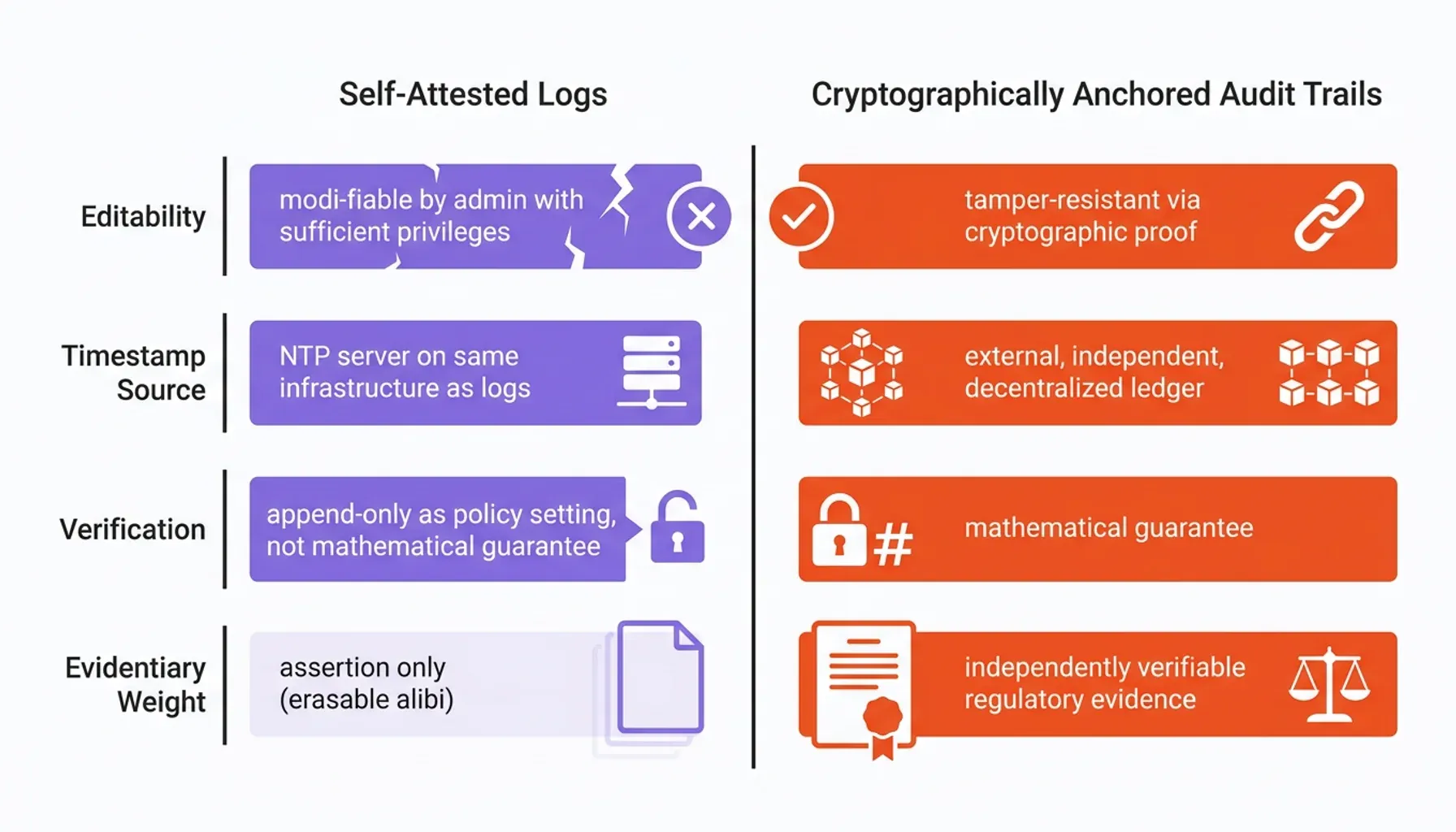
Here is the analogy that frames everything that follows. Imagine a defendant who submits their own alibi, written in erasable ink, witnessed only by their own employees, stored in a filing cabinet they control. A court would not accept it. Neither should a regulator. Self-attested logs, editable by administrators, anchored only to a system clock the organization controls, are the compliance equivalent of that erasable alibi. MiCA audit trails require a fundamentally different architecture. One built on cryptographic proof, not organizational trust.
MiCA Audit Trail Requirements for Crypto-Asset Service Providers
MiCA establishes a sweeping regulatory framework for crypto-asset services across the European Union, with ESMA technical standards defining the operational detail. For CASPs, exchanges, custodians, portfolio managers, and transfer services, the compliance burden is substantial and specific.
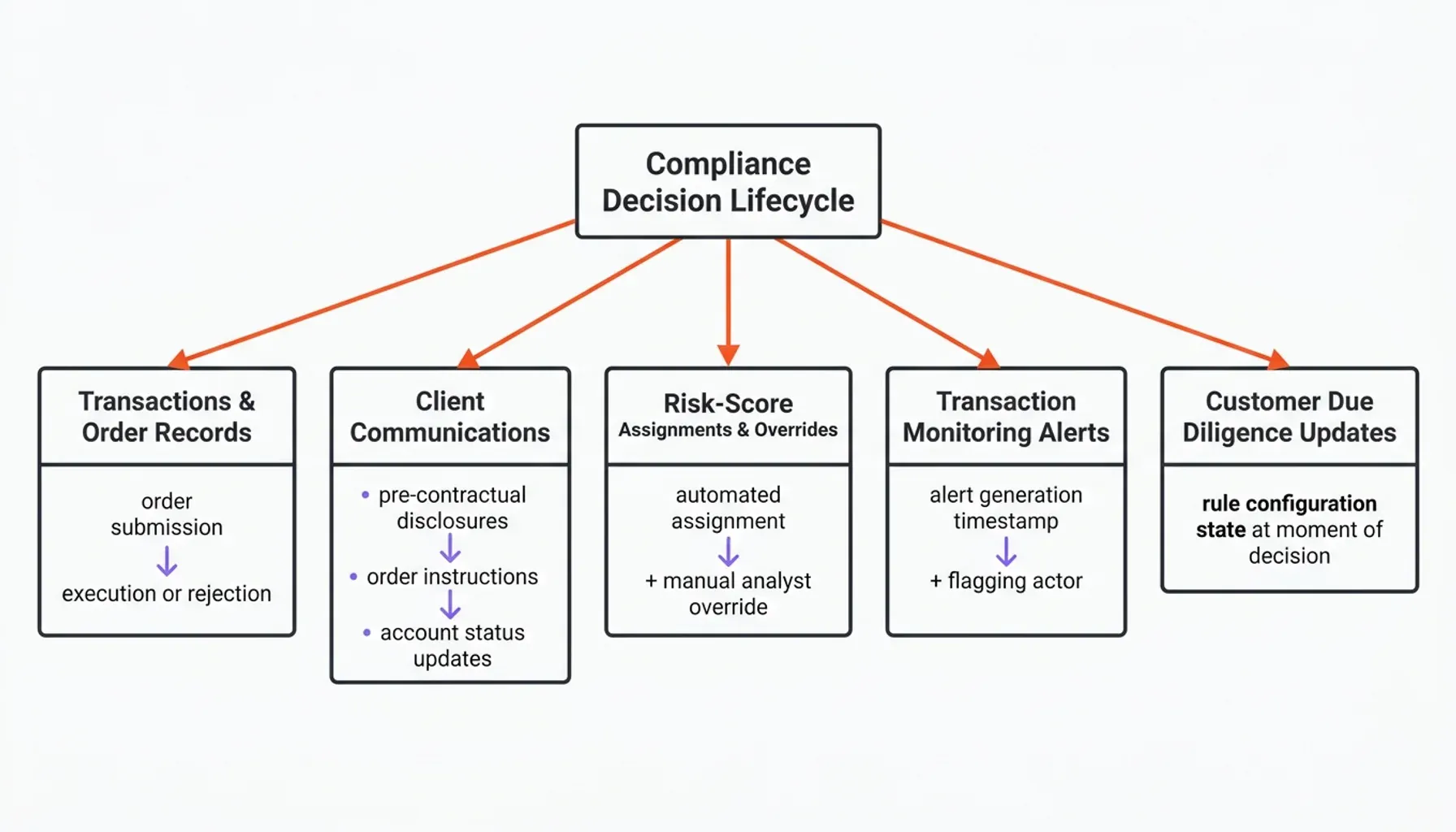
The regulation's auditability expectation extends well beyond transaction records. It covers the full lifecycle of compliance decisions: transaction monitoring alerts, risk-score assignments, manual analyst overrides, customer due diligence updates, and the logic governing automated rule sets. Every action that shapes a compliance outcome is, in principle, a recordable and reviewable event.
This marks a significant departure from how most organizations currently manage compliance logs. Historically, internal audit logs served internal purposes, troubleshooting, operational review, incident response. Under MiCA, those same logs become externally verifiable regulatory evidence. The audience is no longer just the internal compliance team. It is national competent authorities, ESMA, and in enforcement scenarios, courts.
Most companies get this wrong. The phrase "append-only database" appears frequently in compliance architecture discussions. It sounds reassuring. But append-only is a policy setting, not a mathematical guarantee. A database administrator with sufficient privileges can alter that policy. A sophisticated attacker who gains admin access can modify records and reset metadata. Without external, independent verification anchored to a public, decentralized ledger, append-only is a claim, not a proof. Erasable ink, in a different format.
MiCA's scope also captures the timing of compliance events. When was an alert generated? When was a risk score overridden? When was a transaction flagged, and by whom? System timestamps derived from NTP servers are accurate under normal conditions, but they run on the same infrastructure that hosts the logs. They can be manipulated. For MiCA audit trails to carry evidentiary weight, the when must be as tamper-resistant as the what.
Key Records to Capture in MiCA Audit Trails
Before examining the technical architecture, it is worth being precise about what MiCA-compliant audit trails must actually capture. CASPs often focus narrowly on transaction records. The regulatory scope is considerably broader.
Transactions and order records. Every crypto-asset transaction executed on behalf of clients, including the order lifecycle from submission through execution or rejection, must be logged with sufficient granularity to reconstruct the sequence of events. This includes timestamps, counterparty identifiers, asset types, volumes, and the rule state at the time of processing.
Client communications. MiCA requires CASPs to retain records of communications with clients that relate to the provision of services. This covers pre-contractual disclosures, order instructions received via any channel, and material communications about account status or risk classification. The integrity of these records is as important as their existence. A communication log that could be edited after the fact is the erasable alibi problem in a different register.
Risk-score assignments and overrides. Every automated risk-score assignment and every manual analyst override constitutes a compliance decision. The record must capture not only the outcome but the rule configuration in effect at the moment of the decision. If a rule set is later modified, the historical record must still reflect what the system actually did, not what it would do today.
Incidents and escalations. Operational incidents with compliance implications, system outages affecting transaction monitoring, failed KYC checks, suspicious activity escalations, require documented audit trails that capture the sequence of detection, assessment, and response. Regulators reviewing incident handling will ask whether the timeline is verifiable, not just reported.
Approvals and governance decisions. Internal approvals for onboarding high-risk clients, exceptions to standard policy, and governance decisions affecting compliance rule sets all require immutable records. These are precisely the events most vulnerable to retrospective adjustment, and therefore the ones where cryptographic sealing matters most.
Regulatory reporting submissions. Every submission to a national competent authority or ESMA, suspicious transaction reports, periodic compliance reports, breach notifications, must be logged with proof of what was submitted and when. The submission record is itself a compliance artifact.
The common thread across all these record types is non-repudiation. Your organization must be able to demonstrate, to an external party, that a specific record existed in a specific state at a specific point in time. That is a cryptographic problem, not an organizational one.
How MiCA Audit Trails Support CASP Regulatory Compliance and Supervisory Reporting
MiCA audit trails are not merely a defensive measure against enforcement. They are an active enabler of ongoing supervisory reporting obligations, and CASPs that understand this distinction build better compliance infrastructure.
National competent authorities (NCAs) have broad supervisory powers under MiCA, including the right to request records, conduct on-site inspections, and demand evidence of compliance with specific provisions. The quality of a CASP's audit trail infrastructure directly determines how efficiently it can respond to these requests. A CASP with blockchain-anchored records can produce cryptographically verified evidence on demand. A CASP relying on traditional logs faces a manual extraction process, internal integrity attestations, and the inevitable auditor question: how do we know this hasn't been changed?
The erasable alibi problem resurfaces here with particular force. When a supervisory authority requests evidence of how a specific transaction was handled, the CASP's response is only as credible as its audit trail is tamper-proof. An organization that controls its own logs entirely, with no external integrity anchor, is submitting a self-authored account. Regulators are trained to be skeptical of exactly this.
ESMA's ongoing development of regulatory technical standards for MiCA implementation is progressively tightening the specificity of record-keeping requirements. CASPs that build audit trail infrastructure to the minimum current standard risk falling short as those standards evolve. The architectural choice to anchor audit trails to public blockchains is forward-compatible: it satisfies current requirements and exceeds anticipated future ones.
Supervisory reporting also creates a timing dimension that most CASPs underestimate. Periodic reports to NCAs must accurately reflect the state of compliance operations during the reporting period, not a reconstructed account prepared at reporting time. If the underlying event records are mutable, the periodic report is only as reliable as the organization's internal controls at the time of preparation. Blockchain-anchored event records, timestamped at the moment of occurrence, make periodic reports a faithful aggregation of verified facts rather than a narrative constructed after the fact.
For CASPs operating across multiple EU jurisdictions, the supervisory reporting challenge is compounded by the need to demonstrate consistent compliance standards to multiple NCAs. An audit trail architecture that produces mathematically verifiable records, independent of any single jurisdiction's infrastructure, simplifies cross-border supervisory engagement considerably.
The Vulnerability of Analyst-Editable Logs in Compliance
The "Admin Problem" is not a theoretical risk. It is a documented pattern in financial services enforcement. Privileged users, system administrators, database engineers, and in some cases, senior compliance officers, have the technical capability to alter or delete log entries. In a high-stakes regulatory environment, that capability is a liability.
NIST SP 800-92, the foundational guide to computer security log management, explicitly identifies log integrity as a critical control. Logs are only useful as evidence if their integrity can be demonstrated. A log that could have been modified, even if it wasn't, fails this test. Regulators applying MiCA standards will ask the same question auditors always ask: how do you know this log hasn't been changed?
Traditional SIEM platforms and case management systems are designed for operational efficiency, not non-repudiation. They aggregate, correlate, and surface events. They do not, by default, create cryptographic proof that a specific event record existed in a specific state at a specific point in time. That capability requires an additional integrity layer, one that operates independently of the logging infrastructure itself.
The internal fraud risk is particularly acute in compliance contexts. Consider a scenario where an analyst manually overrides a high-risk transaction flag, approving a transaction that should have been blocked. Later, under regulatory scrutiny, the rule set governing that flag is retroactively adjusted to make the override appear consistent with policy. Without an immutable record of the original rule configuration and the override action, timestamped at the moment of occurrence, this manipulation is difficult to detect and nearly impossible to prove. The alibi has been rewritten. In erasable ink.
ENISA guidance on log integrity consistently highlights insider threats to log systems as an underappreciated vector for compliance fraud. The same infrastructure that records non-compliance can be used to conceal it, if that infrastructure is fully under the control of the entity being audited. A "trusted system" that operates as a single point of failure is architecturally incompatible with genuine auditability. Trust, in a regulatory context, must be earned through verifiable proof, not asserted through organizational policy.
This is precisely where immutable audit log infrastructure for SIEM and forensics changes the equation. By anchoring log fingerprints to public blockchains, the integrity of every event becomes independently verifiable, by regulators, auditors, or courts, without relying on the CASP's own infrastructure.
Blockchain Timestamping: A Mathematical Seal for Every Event
The mechanics of blockchain timestamping are straightforward. The implications are profound.
Every compliance event, a transaction monitoring alert, a risk-score override, a KYC status update, is serialized into a structured data record. That record passes through a SHA-256 cryptographic hash function, producing a unique 256-bit fingerprint. This hash is deterministic: the same input always produces the same output. It is also collision-resistant: two different inputs cannot produce the same hash. Any change to the original record, even a single character, produces a completely different hash. One character. Different hash.
That hash is then anchored to the Bitcoin or Ethereum blockchain. The Bitcoin timestamp server mechanism, described in Satoshi Nakamoto's original whitepaper, creates a mathematically ordered chain of proof. Once a hash is included in a confirmed block, its existence at that point in time is permanently recorded on a decentralized ledger maintained by thousands of independent nodes globally. No single entity, including OriginStamp, can alter or remove it.
This distinction matters enormously for MiCA audit trails. System time (NTP-synchronized) tells you what the server's clock showed at the moment of logging. Blockchain-anchored proof of existence tells you what the world's most secure distributed network recorded at that moment. The difference between these two claims is the difference between a defendant's self-written alibi and a notarized affidavit witnessed by thousands of independent parties simultaneously. One is a claim. The other is proof.
The verification process is equally important. An auditor or regulator does not need to trust OriginStamp, the CASP, or any intermediary to verify a blockchain timestamp. They need only the original data record and the publicly accessible blockchain. They hash the record, compare it to the anchored hash, and confirm the block timestamp. The verification is mathematical, not organizational. This is what genuine non-repudiation looks like.
OriginStamp's approach, backed by peer-reviewed academic research and 12+ years of production deployment, anchors hashes to both Bitcoin and Ethereum, providing redundant, cross-chain verification. The result is a compliance integrity layer that operates entirely outside the CASP's own control plane.
Architecting the Immutable Trail: From Alerts to Risk Scores
Building a MiCA-compliant audit trail with blockchain timestamping requires mapping compliance events to the appropriate level of granularity. Not every system event warrants individual timestamping. The architecture should reflect risk and regulatory relevance.
High-priority events for real-time timestamping:
- Transaction monitoring alerts (generated and cleared)
- Manual risk-score overrides by analysts
- User identity association updates (KYC/KYB changes)
- Rule set modifications in automated monitoring systems
- Regulatory reporting submissions
- Suspicious Activity Report (SAR) filings and status changes
- Client communication records with compliance implications
- Internal approvals for high-risk client onboarding or policy exceptions
High-volume telemetry suitable for batch hashing:
- System access logs
- API call records
- Routine transaction metadata
- Periodic compliance system health checks
For high-priority events, the implementation pattern is straightforward. At the moment of event creation, the structured event record is hashed and submitted to the blockchain timestamping API. The returned certificate, containing the hash, blockchain transaction ID, and block timestamp, is stored alongside the original event record. This creates an unbreakable link between the event and its proof of existence. Unbreakable mathematically.
For high-volume telemetry, a daily batch approach is practical and sufficient. All events from a defined period are aggregated into a Merkle tree structure, and the root hash is anchored. This provides integrity verification for the entire batch while minimizing API call volume and cost.
The privacy architecture is worth calling out explicitly. GDPR Article 25 mandates data protection by design. Blockchain timestamping is inherently GDPR-compatible: only the hash is anchored to the public ledger. The underlying data, including any personally identifiable information, never leaves the CASP's controlled environment. The hash is a mathematical fingerprint, not a data container. Regulators get verifiable proof; personal data stays private.
ISO/IEC 27001 Annex A controls for logging and monitoring align directly with this approach. The standard requires that log data be protected against tampering and unauthorized access. Blockchain timestamping operationalizes this requirement at the cryptographic level, moving beyond access controls, which can be circumvented, to mathematical guarantees that cannot.
For CASPs evaluating implementation options, the parallel with compliant document retention is instructive. The same API-first integrity architecture that governs e-invoice archiving and audit trail compliance applies directly to compliance log management: structured records, cryptographic sealing, and independently verifiable retention.
Integrity Layer for SIEM & Forensics: Beyond Simple Logging
Here's the thing. The most important design principle for blockchain timestamping in a CASP environment is that it functions as a non-intrusive integrity layer, not a replacement for existing infrastructure.
Your SIEM keeps running. Your case management system keeps running. Your analysts keep working in the tools they know. Blockchain timestamping operates as a parallel process, intercepting event records at the point of creation, generating and anchoring their cryptographic fingerprints, and returning certificates stored alongside the original records. The operational workflow is unchanged. The evidentiary quality of the logs is transformed.
This architecture dramatically improves forensic readiness. When a regulatory inquiry arrives, or an internal investigation is triggered, demonstrating log integrity is often the difference between a manageable audit and a protracted enforcement action. Forensic analysis of event logs consistently shows that investigators' first question is whether the logs can be trusted. With blockchain-anchored timestamps, the answer is mathematically demonstrable. Not organizationally asserted. The alibi is notarized, not handwritten.
Zero-Trust principles applied to log management follow the same logic: never trust, always verify. In a Zero-Trust architecture, no system, including the logging infrastructure itself, is implicitly trusted. Every claim must be independently verifiable. Blockchain timestamping is the natural implementation of Zero-Trust for compliance logs: every event record can be verified against an immutable external reference, independent of the system that generated it.
The bridge between real-time monitoring and long-term evidence preservation is also addressed. ISO 27037 guidelines for digital evidence identification and preservation require that evidence be collected and maintained in a manner that preserves its integrity and admissibility. Blockchain-anchored timestamps satisfy this requirement: they create a chain of custody that begins at the moment of event creation and extends indefinitely, verifiable at any future point.
For organizations managing AI-driven compliance systems, this integrity layer becomes even more critical. The decisions made by automated monitoring systems must be as auditable as those made by human analysts. The challenge of why application logs are not sufficient evidence for AI agent audit trails applies directly to AI-powered transaction monitoring under MiCA, the same architectural gap, the same cryptographic solution.
OriginStamp's tamper-proof log integrity solution for SIEM and forensics is purpose-built for this use case: blockchain-based integrity verification that integrates with existing SOC infrastructure without disruption.
Strategic Benefits: Efficiency, Trust, and Market Access
The compliance case for MiCA audit trails is clear. The strategic case is equally compelling.
Reduced audit friction. When regulators request evidence of compliance decisions, the current process in most CASPs involves manual log extraction, integrity attestations from internal IT, and often extended back-and-forth with auditors who have legitimate questions about log reliability. Blockchain-anchored audit trails replace this process with a cryptographic verification workflow. The auditor receives the event record and the blockchain certificate. Verification takes minutes, not weeks.
Personal liability protection. MiCA imposes significant personal liability on compliance officers and senior management. An immutable audit trail that captures every decision, including who made it, when, and under what rule configuration, provides a factual record that protects individuals from retrospective blame. When the record shows that a transaction was correctly flagged, reviewed, and processed according to the rules in effect at the time, that record is the compliance officer's defense. Not an erasable alibi. A sealed, verifiable account.
Competitive differentiation. Institutional crypto clients, asset managers, corporate treasury functions, regulated financial institutions, increasingly demand evidence of compliance infrastructure quality from their service providers. A CASP that can demonstrate blockchain-anchored audit trails signals a level of operational maturity that competitors relying on traditional logging cannot match.
AI-readiness. FATF guidance on virtual asset risk-based approaches increasingly anticipates AI-driven transaction monitoring as a standard tool. For AI systems to be auditable under MiCA, their decision trails must be as tamper-proof as those of human analysts. A blockchain integrity layer primes your compliance infrastructure for advanced AI-driven forensics and automated regulatory reporting, capabilities that will define competitive advantage in the next phase of crypto regulation.
For teams building or evaluating AI governance frameworks, the intersection with auditing LLM decision trails using blockchain is directly relevant: the same integrity architecture that secures human compliance decisions secures AI-driven ones.
Conclusion: Proof Is the New Policy
MiCA has set a new baseline for what accountability means in European crypto markets. Self-attested logs, controlled entirely by the entity being audited, are not sufficient. The regulation's auditability mandate, and the enforcement reality that will follow, demands logs that are independently verifiable, cryptographically sealed, and resistant to both insider manipulation and external attack.
Return to the opening analogy one final time. A defendant who submits a self-authored alibi, written in erasable ink, controlled by their own staff, verified by no independent party, that alibi carries no weight. MiCA regulators are applying the same standard to compliance logs. The organization that controls its own audit trail entirely is writing its own alibi. The organization that anchors its audit trail to a public blockchain is submitting notarized evidence.
Blockchain timestamping is not a complex infrastructure overhaul. It is a mathematically rigorous integrity layer that wraps your existing compliance systems in cryptographic proof. Every alert, every override, every risk-score change, every client communication, every approval becomes a sealed, verifiable record, anchored to public blockchains that no administrator can alter.
The CASPs that build this infrastructure now will spend less time in audit rooms, face lower regulatory risk, and offer institutional clients the kind of verifiable compliance assurance that separates serious operators from the rest.
Explore how OriginStamp's blockchain-anchored integrity layer for SIEM and forensics can make your MiCA audit trails mathematically provable, not just organizationally promised.
Thomas Hepp
Co-Founder
Thomas Hepp is the founder of OriginStamp and creator of the OriginStamp timestamp, which has set the standard for tamper-proof blockchain timestamps since 2013. As one of the earliest innovators in the field, he combines deep technical expertise with a pragmatic focus on solving real business problems, and is a recognized voice in blockchain security, AI analytics, and data-driven decision support. His work has earned multiple international awards, including a top Best Project recognition from ETH Zurich and the Swiss Confederation. He publishes regularly on blockchain, AI, and digital innovation.