
Verifiable MiCA Archiving: Beyond Simple Crypto Storage
Jun 11, 2026

Thomas Hepp
Jun 11, 2026

The MiCA Retention Mandate: A High-Stakes Compliance Clock
A regulatory audit does not begin with a warning. For Crypto-Asset Service Providers operating under MiCA, it begins with a data request, and the clock on your defensibility started the moment you onboarded your first client.
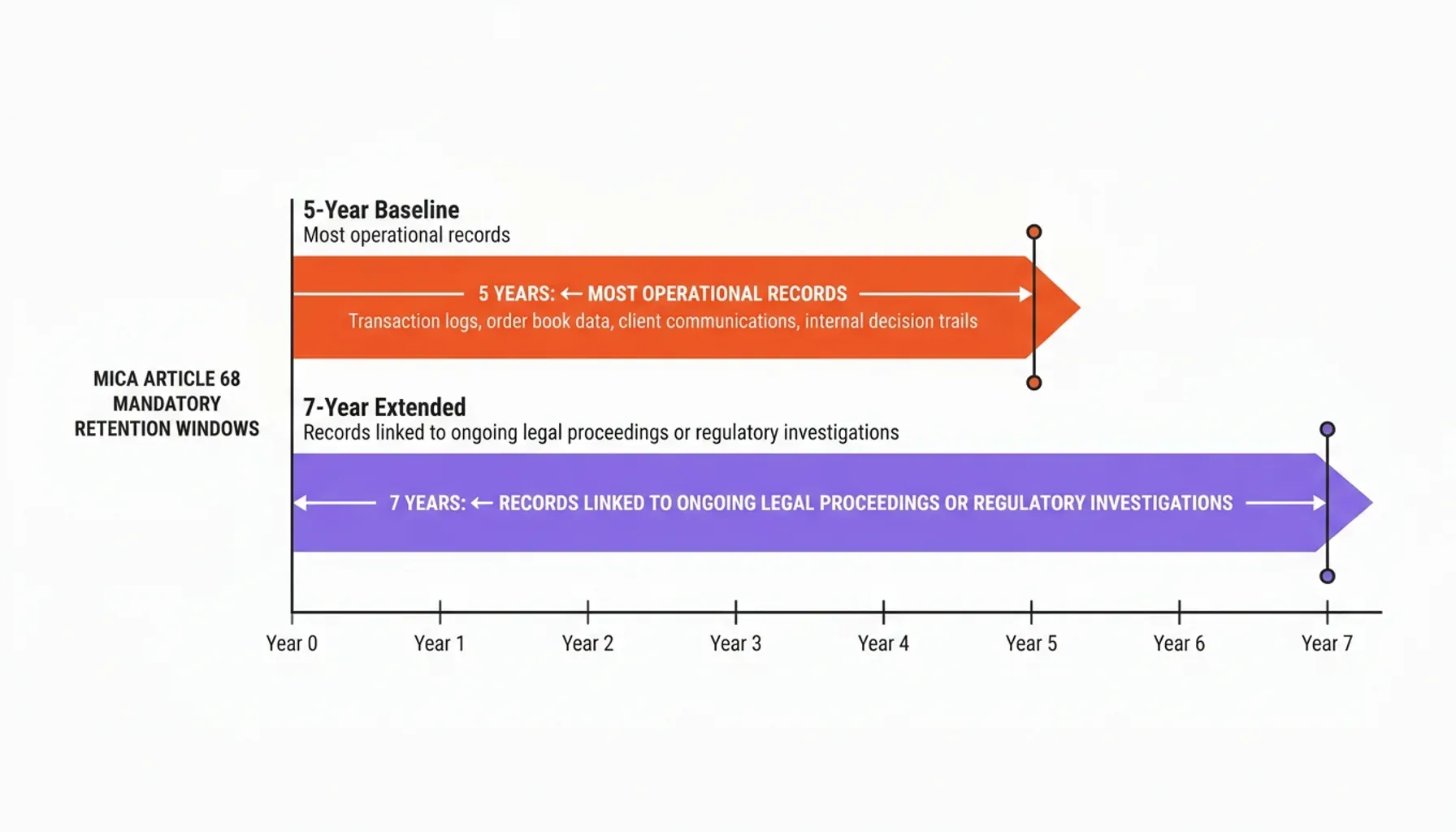
MiCA Article 68 establishes a mandatory retention window of five to seven years for a broad scope of operational records. This includes transaction logs, order book data, client communications, and internal decision trails. The five-year baseline applies to most records; the seven-year horizon kicks in for records linked to ongoing legal proceedings or regulatory investigations. For a CASP operating at scale, this is not a filing problem. It is an infrastructure problem.
Most compliance teams miss the critical distinction: stored data is not the same as defensible data. A record sitting in a database or cloud bucket proves nothing about its state at the time of creation. It proves only that it exists now. National competent authorities and ESMA's technical standards on CASP record-keeping demand more. They require evidence that records have remained unaltered from the moment of their creation.
Here is a scenario worth sitting with. Imagine a CASP that survived a cloud migration in 2022, moved everything cleanly, no data loss, ticked every internal box, only to discover during a 2024 NCA audit that none of its pre-migration transaction records carried an independent integrity proof. The records existed. The hashes did not. Auditors could not confirm that what the CASP exported from its old platform matched what had originally been written. That gap between "we have the records" and "we can prove the records are unchanged" cost the firm six months of forensic reconstruction work and a formal remediation notice. Storage is not proof. That distinction is the whole ballgame.
System obsolescence compounds this challenge. Over a seven-year horizon, the average enterprise will undergo at least one major platform migration, one ERP upgrade, and potentially a full cloud transition. Each migration is a potential break in the chain of custody. Records that survive the migration in terms of bytes may not survive in terms of legal validity, unless their integrity has been mathematically anchored at every stage.
The scope of records subject to MiCA retention is also wider than many CASPs initially assume. It covers not only executed transactions but also rejected orders, amended client instructions, and internal communications that influenced a trading decision. This breadth makes the integrity question even more pressing: you cannot selectively protect records when the regulator can request any of them.
Off-Chain vs. On-Chain Data: The Compliance Archiving Divide
Before diving into how to protect your records, it is worth being precise about which records you are protecting, because the off-chain versus on-chain distinction matters enormously for MiCA compliance archiving, and it trips up more CASPs than you might expect.
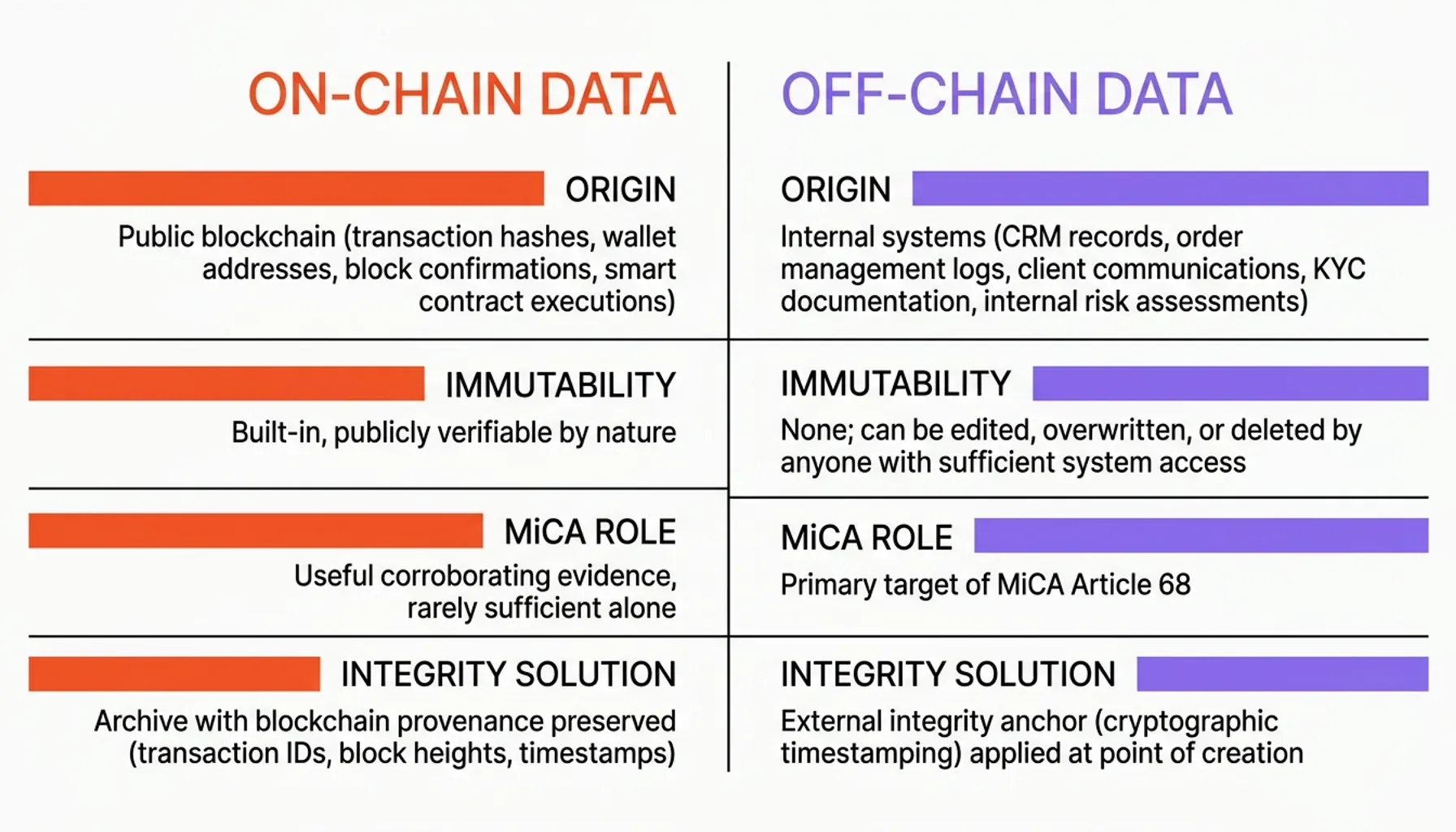
On-chain data refers to records that exist natively on a public blockchain: transaction hashes, wallet addresses, block confirmations, smart contract executions. This data is, by its nature, immutable and publicly verifiable. You did not create it; the blockchain did. For MiCA purposes, on-chain records are useful corroborating evidence, but they are rarely sufficient on their own. They confirm that a transfer occurred, but they do not capture the client instruction that preceded it, the order book state at the time, or the internal approval that authorized it.
Off-chain data is everything else: your CRM records, order management system logs, client communications, KYC documentation, internal risk assessments, and the audit trails generated by your own platform. This is the data that MiCA Article 68 is primarily targeting, and it has no built-in immutability guarantee. Unlike a blockchain transaction, an off-chain database record can be edited, overwritten, or deleted by anyone with sufficient system access.
The practical compliance implication is straightforward. You need a strategy for both. On-chain records should be archived with their blockchain provenance preserved, with transaction IDs, block heights, and timestamps captured and stored in a way that allows independent verification. Off-chain records need an external integrity anchor applied at the point of creation, because the system that generated them cannot credibly vouch for its own integrity. This is precisely where cryptographic timestamping for digital archives closes the gap: it applies the same kind of immutable, independently verifiable proof to off-chain records that the blockchain natively provides for on-chain ones.
A CASP that archives only its on-chain data and treats its internal logs as secondary is leaving the most legally sensitive records in the most legally vulnerable state.

Storage vs. Proof: Why Encryption and Backups Are Not Enough
Most IT teams get this wrong. When confronted with a compliance mandate, the instinct is to provision more storage and implement stronger encryption. Both are necessary. Neither is sufficient.
Encryption protects data in transit and at rest from unauthorized access. It says nothing about whether the data has been altered by someone who already has authorized access. A backup is a copy of data at a specific moment, but a backup without an integrity proof is simply a second copy of potentially compromised data. If the primary record was altered before the backup ran, the backup faithfully replicates the altered version.
This is the Admin Paradox: the people most capable of maintaining a compliant archive are also, technically, the people most capable of undermining it. An internal database administrator with write access can modify a transaction log. An authorized cloud engineer can overwrite a file without leaving a trace in the application layer. Internal audit logs that record these actions are stored in the same system and are therefore subject to the same vulnerability. A regulator who understands this will not accept internal logs as primary evidence of integrity.
The solution does not lie in trusting people less. It lies in building a verification layer that operates independently of the people who manage the storage. This is precisely what cryptographic hashing delivers.
A SHA-256 hash is a 256-bit mathematical fingerprint of a file. Change a single character in a 10,000-page document and the hash changes entirely. The hash is deterministic, meaning the same input always produces the same output, and it is computationally irreversible. You cannot reconstruct the original file from the hash, and you cannot engineer a different file that produces the same hash. This makes it a mathematically reliable integrity check that is completely independent of the storage medium.
The ISO/TC 307 standards on blockchain and distributed ledger technologies formalize the distinction between data availability and data integrity. Availability means you can retrieve the record. Integrity means you can prove it has not changed. MiCA compliance requires both, and the second property demands a verification mechanism that no internal actor can retroactively disable.
The vulnerability of centralized storage becomes acute during vendor lock-in scenarios. When a CASP migrates away from a platform, the outgoing vendor controls the export process. Without an independently anchored integrity proof, the CASP has no way to demonstrate to a regulator that the exported records are identical to what was originally created. The gap between "we exported everything" and "we can prove what we exported" is precisely where regulatory exposure lives.
If you are currently evaluating your storage infrastructure against these requirements, understanding how DMS, ECM, and archive systems differ in their integrity guarantees is a useful place to start. The distinctions matter more under MiCA than most compliance teams realize.
The Legal Leverage of eIDAS: Shifting the Burden of Proof
Cryptographic integrity is a technical property. Compliance is a legal one. The bridge between the two is Regulation (EU) No 910/2014, known as eIDAS, and its provisions on qualified electronic timestamps.
Under eIDAS, a qualified timestamp carries a legal presumption of integrity. This is not a minor procedural convenience. It means that in any legal or regulatory proceeding, the timestamped record is presumed authentic and unaltered from the moment of stamping, unless the contesting party proves otherwise. The burden of proof shifts. Instead of the CASP needing to demonstrate that its records are reliable, the party challenging the records must demonstrate that they are not.
For a CASP facing an NCA investigation or a civil dispute with a client, this is a significant strategic asset. A record without a qualified timestamp requires the CASP to affirmatively prove its integrity through witness testimony, system logs, and forensic analysis, all of which can be challenged. A record with a qualified timestamp starts from a position of legal presumption. That is a fundamentally different posture to walk into an audit with.
The technical requirements for a timestamp to achieve this legal standing under eIDAS are specific. The timestamp must be issued by a Qualified Trust Service Provider (QTSP) listed in an EU member state's trusted list. It must bind the hash of the document to a precise time value using a cryptographic signature. And it must be verifiable by any party without access to the original issuing system.
The European Commission's Digital Identity and Trust Services framework makes clear that qualified timestamps are the appropriate mechanism for establishing the legal integrity of electronic records in regulated contexts. For CASPs managing high-value transaction records, particularly those that could become evidence in market manipulation investigations or client disputes, eIDAS-aligned timestamping is not an optional enhancement. It is the difference between a record that holds up in proceedings and one that does not.
Map your record categories against eIDAS qualification requirements now, before an investigation begins. The cost of implementing qualified timestamping at the point of record creation is orders of magnitude lower than the cost of reconstructing provenance after the fact. I have yet to meet a compliance officer who disagreed with that arithmetic after going through a remediation exercise.
Blockchain Timestamping: Creating an Immutable Audit Trail
The practical implementation of verifiable integrity at scale requires a mechanism that is simultaneously cryptographically sound, vendor-independent, and cost-effective. Blockchain timestamping satisfies all three requirements, anchoring SHA-256 hashes to public blockchains like Bitcoin and Ethereum.
The mechanism is straightforward. A SHA-256 fingerprint of the record is generated at the point of creation or archival. That hash is then submitted to a public blockchain, where it is permanently recorded in a block alongside a timestamp derived from the blockchain's consensus mechanism. The blockchain itself, distributed across thousands of independent nodes globally, becomes the verification layer. No single party controls it. No administrator can alter a historical block. The record of the hash's existence at that precise moment is permanent.
This is what makes public blockchains function as a universal, vendor-independent integrity clock. The Bitcoin blockchain has been producing blocks continuously since 2009, Ethereum since 2015. Any hash anchored to either chain can be verified by any party, at any time, using only the original document and publicly available blockchain data. No dependency on the original timestamping provider, no reliance on a vendor's continued operation.
For CASPs, this has a direct implication for audit readiness. When an NCA requests evidence of record integrity, you can provide the original document, its SHA-256 hash, and a blockchain transaction ID. Any auditor, or any court, can independently verify the match. The audit trail is not a report generated by your own system. It is a mathematical proof anchored in public infrastructure that neither party controls.
The W3C Verifiable Credentials Data Model provides a complementary framework for expressing this kind of cryptographic provenance in a standardized, machine-readable format, which is relevant for CASPs building interoperable compliance infrastructure across jurisdictions.
Practical integration follows a clear path. At the point of record creation, whether a transaction log entry, an order book snapshot, or a client communication, the record management system calls a timestamping API. The hash is generated and submitted. The blockchain anchor is returned and stored alongside the record metadata. The entire process adds milliseconds to the archival workflow and requires no changes to the underlying storage architecture.
This is precisely how OriginStamp's blockchain timestamping for archiving operates: as an integrity layer that sits above any storage system, making every sealed record independently verifiable without touching the data itself.
Scalable Integrity: Managing High-Volume Crypto Transaction Logs
A CASP processing retail trading volume can generate millions of transaction records per day. Anchoring each record individually to a public blockchain would be prohibitively expensive and technically impractical. The solution is Merkle Tree aggregation.
A Merkle Tree is a cryptographic data structure that aggregates thousands of individual hashes into a single root hash. Each leaf of the tree represents one record's hash. Each branch combines pairs of hashes until a single root hash represents the entire set. That single root hash is anchored to the blockchain in one transaction, providing integrity proof for every record in the batch at the cost of a single blockchain write.
Verification stays lightweight. To verify any individual record, an auditor needs only the record itself, its hash, and the Merkle path, which is a small set of sibling hashes that allow reconstruction of the root and confirmation of the blockchain anchor. The computational overhead is minimal, and any party with standard cryptographic tools can run the verification independently.
For API-based integration with existing CASP architectures, the timestamping layer operates as a background service, batching records at configurable intervals, whether hourly, daily, or per transaction threshold, without impacting front-end performance. The integrity sealing is asynchronous, invisible to end users, and fully auditable.
The practical result: a CASP can maintain mathematically verifiable integrity across its entire transaction history at a cost and performance profile that scales with volume rather than against it. The strategic case for digital archiving as a competitive asset covers the architectural considerations for building this kind of integrity layer into enterprise archiving systems in more detail.
Future-Proofing the Archive: Format Shifts and System Migrations
A seven-year retention horizon is long enough to make today's standard file formats obsolete. The risk of bit rot, the gradual degradation of data due to hardware failures, media decay, or format obsolescence, is real and well-documented. More practically, the software environments that generated today's records may not exist in their current form by 2031.
The OAIS (Open Archival Information System) reference model, formalized in ISO 14721, defines the requirements for a trustworthy digital archive. One of its core requirements is the ability to demonstrate that records have remained intact through migrations and format conversions. A blockchain timestamp satisfies this requirement in a specific and powerful way: the mathematical proof outlives the software that generated the original file.
When a CASP migrates records from an on-premise system to a cloud-agnostic environment, the migration process should include a re-verification step. Confirm that the hash of each migrated record matches the hash anchored at the time of creation. If the hashes match, integrity is confirmed. The new storage environment can then receive a fresh timestamp, not replacing the original, but extending the chain of custody with a documented migration event.
This approach, verify, migrate, re-anchor, maintains a continuous chain of custody that any auditor can follow. The original blockchain anchor proves the record's state at creation. Each subsequent anchor documents the migration event. The chain is unbroken, and each link is independently verifiable.
This is not a theoretical concern for CASPs planning cloud migrations or infrastructure consolidations within their retention window. The integrity and migration resilience requirements that a well-designed ERP archive must satisfy map directly onto the CASP archiving challenge: chain-of-custody preservation principles apply equally across regulated industries.
Here is the strategic point. Mathematical proof is format-agnostic. A SHA-256 hash computed in 2025 can be verified in 2032 using any standard cryptographic library. The blockchain record does not age. Verification does not require the original software environment. This is the only archival property that genuinely survives a seven-year horizon with zero degradation.
Conclusion: Building a Defensible MiCA Compliance Strategy
The transition from passive storage to active, verifiable integrity is not a technical upgrade. It is a strategic repositioning. A CASP that can produce mathematically provable, independently verifiable records at any point in a seven-year window is not just compliant. It is audit-ready by default.
Here is what that transition looks like in practice. Before implementing a verifiable archiving layer, a typical CASP holds records in encrypted cloud storage with access logs as the primary integrity evidence, a posture that depends entirely on internal actors and collapses under forensic scrutiny. After implementing blockchain-anchored timestamping, every record carries an independently verifiable integrity proof from the moment of creation, migration events are documented with re-anchored hashes, and an NCA audit request becomes a retrieval exercise rather than a reconstruction crisis. The difference is not in how much data you store. It is in whether that data can defend itself.
To get there, the path runs through five concrete steps. First, scope your records: confirm that transaction logs, order books, client communications, and internal decision trails are all captured within the MiCA retention framework, including off-chain data that has no native immutability guarantee. Second, assess your integrity layer: determine whether your current archival system can produce independent proof of record integrity, not just access logs, but cryptographic verification that no internal actor can retroactively disable. Third, map against eIDAS: identify which record categories warrant qualified timestamp protection based on their potential role in regulatory or legal proceedings. Fourth, audit your migration history: for records already in the archive, verify that any past migrations preserved hash integrity and document the chain of custody. Fifth, automate at the point of creation: implement API-based timestamping that seals records the moment they enter the archive, not retroactively.
The compliance architecture for SaaS vendors and regulated platforms shows how organizations that build verifiable integrity into their archiving infrastructure convert compliance from a cost center into a competitive differentiator. For CASPs, the same logic applies: the ability to demonstrate audit-readiness with mathematical certainty is a credibility asset in a market where trust is the primary product.
Regulatory scrutiny of crypto-asset markets is intensifying, not abating. ESMA's final report on MiCA technical standards signals that record-keeping requirements will be enforced with increasing precision. The CASPs that will navigate this environment most effectively are those that have already moved beyond storage and built verifiable, blockchain-anchored integrity into their operational infrastructure.
Explore how OriginStamp's tamper-proof timestamping for digital archives can form the integrity backbone of your MiCA compliance strategy.
Thomas Hepp
Co-Founder
Thomas Hepp is the founder of OriginStamp and creator of the OriginStamp timestamp, which has set the standard for tamper-proof blockchain timestamps since 2013. As one of the earliest innovators in the field, he combines deep technical expertise with a pragmatic focus on solving real business problems, and is a recognized voice in blockchain security, AI analytics, and data-driven decision support. His work has earned multiple international awards, including a top Best Project recognition from ETH Zurich and the Swiss Confederation. He publishes regularly on blockchain, AI, and digital innovation.