
MiCA White Paper Integrity: Proving Published Versions
Jun 11, 2026

Thomas Hepp
Jun 11, 2026

The Legal Ticking Clock on Your Crypto-Asset White Paper
A crypto-asset issuer files their white paper with a National Competent Authority. Months later, a dispute arises. A regulator asks a simple question: Is this the exact document you originally submitted?
If your answer relies on server logs, email timestamps, or an internal version control system, you are standing on sand. Under the Markets in Crypto-Assets regulation, MiCA white paper integrity is not a technical preference. It is a legal obligation with direct liability consequences for issuers, offerors, and persons seeking admission to trading.
This piece breaks down why standard document management fails under MiCA's disclosure requirements, what the technical standards actually demand, and how cryptographic proof transforms your compliance posture from defensible to unassailable.
The New Era of Crypto-Asset Disclosure Under MiCA
MiCA, Regulation (EU) 2023/1114, is the most far-reaching regulatory framework ever applied to crypto-assets in the European Union. It replaces a fragmented patchwork of national rules with a single, enforceable standard governing everything from token issuance to exchange licensing.
At the center of this framework sits the crypto-asset white paper: a mandatory disclosure document that must be complete, fair, clear, and not misleading. Article 6(2) of MiCA is explicit, white papers must contain all information necessary for investors to make an informed decision. That is not a soft guideline. It is a strict liability standard.
What makes this era fundamentally different from previous crypto disclosure norms is the shift toward machine-readable, structured formats. ESMA's technical standards mandate iXBRL as the filing format for certain categories of white papers, moving disclosures away from marketing-heavy PDFs toward auditable, structured data. Regulators took this same direction with financial reporting after the 2008 crisis, and it carries the same implication: every field, every figure, every statement is now traceable.
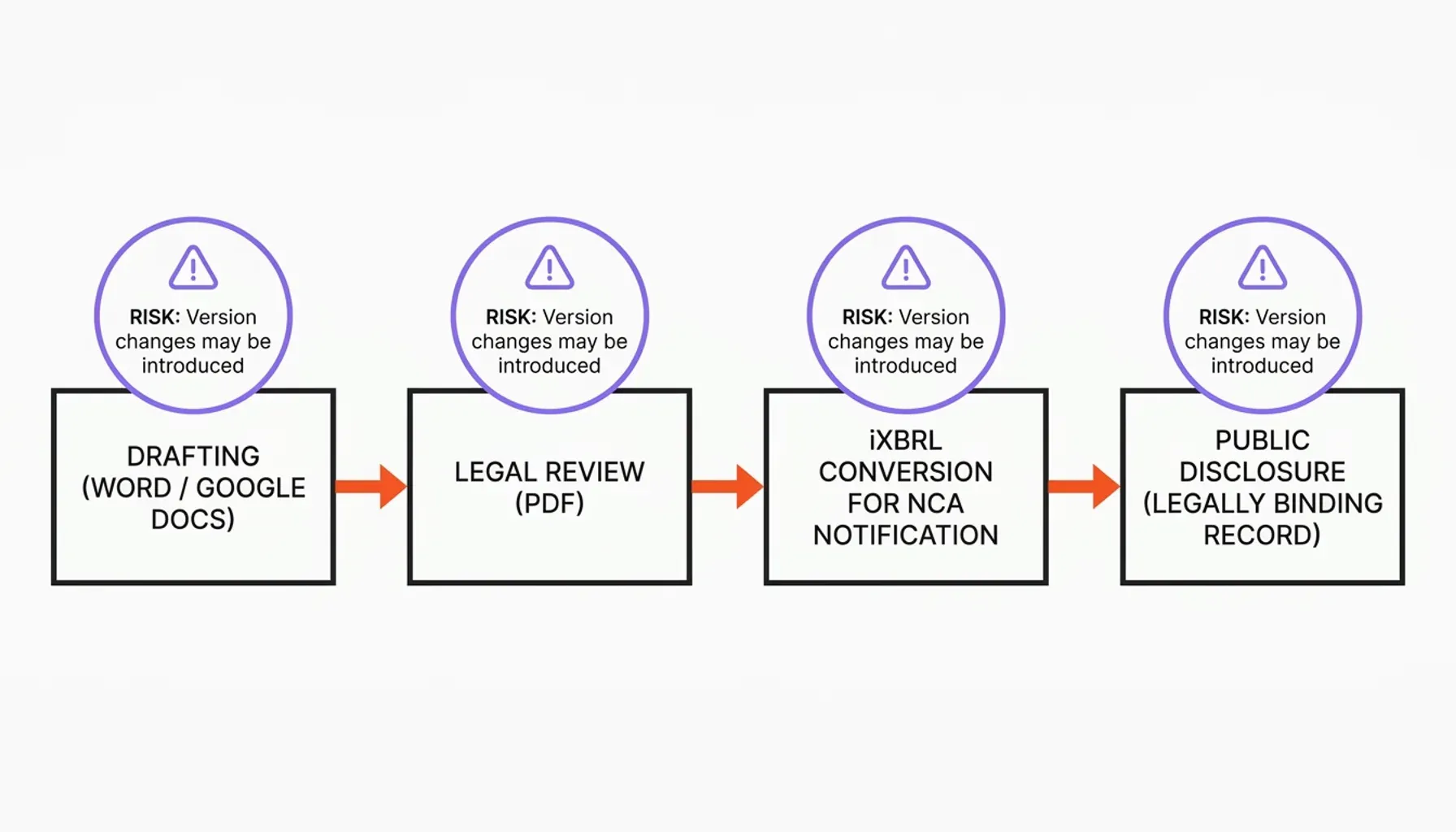
Version control is no longer just a developer's concern. When your white paper moves through drafting, legal review, NCA notification, and public disclosure, each stage potentially introducing changes, the question of which version constitutes the legally binding disclosure becomes operationally critical.
The regulatory intent is clear: investors must be able to rely on the published document as an accurate, unaltered record. Issuers who cannot prove that record with mathematical certainty face material legal exposure. Understanding how blockchain-based proof of existence works is the first step toward building that certainty into your workflow.
Technical Standards: iXBRL, XHTML, and the Data Integrity Gap
The Implementing Technical Standards developed under MiCA introduce iXBRL (Inline eXtensible Business Reporting Language) as the structured format for white paper submissions. iXBRL embeds machine-readable XBRL tags directly within a human-readable XHTML document, letting regulators extract and analyze structured data without requiring a separate filing.
Technically elegant. Also a source of significant integrity risk that most issuers have not yet confronted.
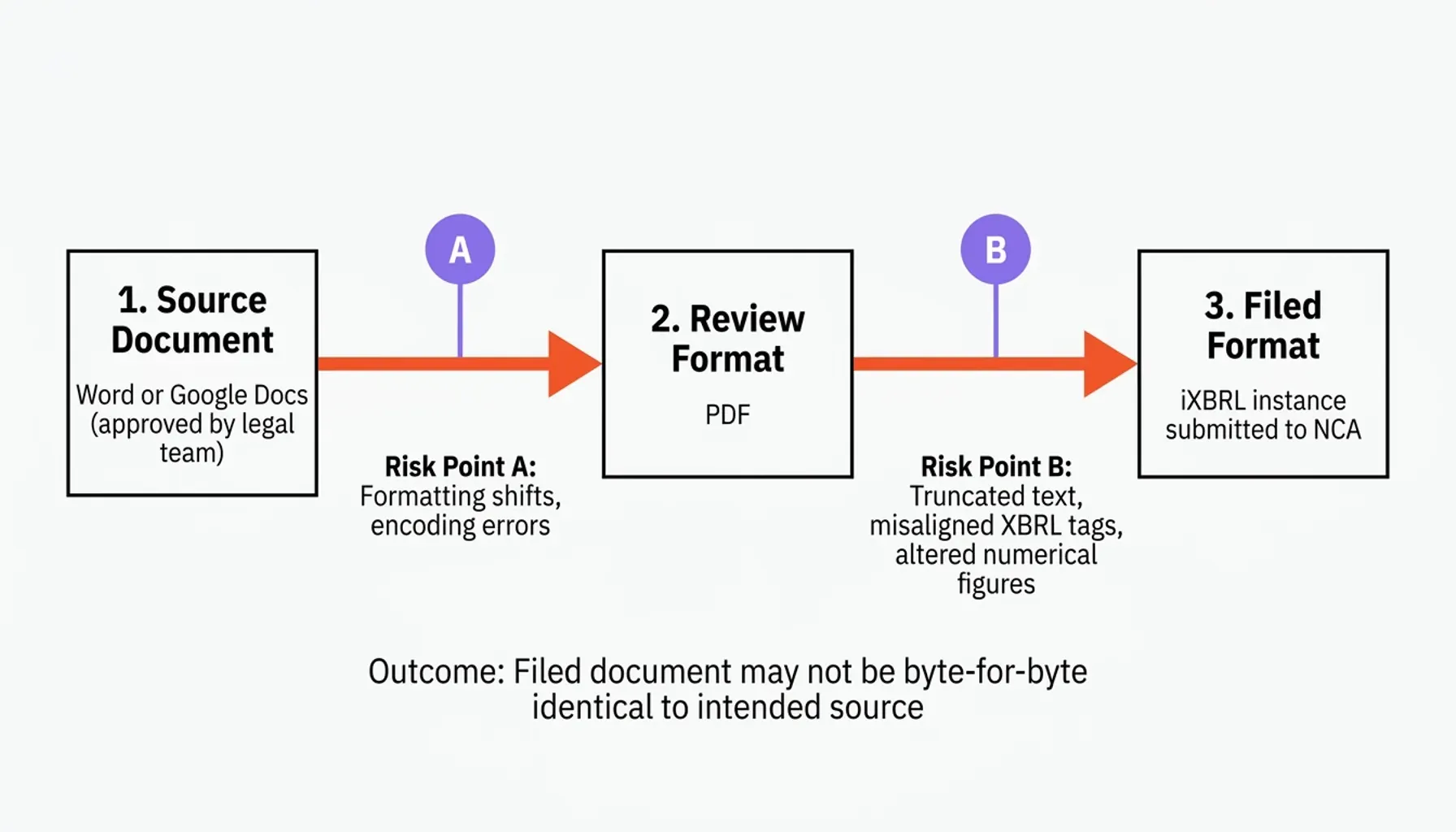
The conversion problem is real. White papers are typically drafted in Word or Google Docs, reviewed in PDF, and then converted to iXBRL for final submission. Each conversion step introduces the possibility of unintentional changes: formatting shifts, encoding errors, truncated text, or misaligned XBRL tags. The document your legal team approved may not be byte-for-byte identical to the iXBRL instance filed with the NCA.
XBRL International's iXBRL conformance guidance acknowledges this challenge explicitly. Conformance testing covers structural validity, but it does not prove that the content of a filed iXBRL document matches the source document the issuer intended to file.
That gap between filed and mathematically provable is where regulatory disputes are born.
Consider the practical implications:
- A material omission in the iXBRL conversion, say a risk factor that appeared in the Word draft but was dropped during tagging, could expose the issuer to Article 6(2) liability even if the omission was unintentional.
- An error introduced during XHTML rendering could alter a numerical figure, changing the meaning of a disclosure without any human actor making a deliberate change.
- Without a cryptographic baseline established at each stage of the workflow, there is no objective way to prove when a specific version existed or whether it was altered afterward.
The EBA's Regulatory Technical Standards under MiCA set the structural requirements for filings. They do not, and cannot, address the provenance of the content within those filings. That responsibility falls entirely on the issuer.
This is precisely where OriginStamp's tamper-proof timestamping for iXBRL and PDF files fills a critical gap in the compliance workflow. Anchor a cryptographic hash of the iXBRL instance at the point of conversion and you create an objective, verifiable record that the file existed in that exact state at that exact moment, before it ever reaches a regulator.
The Provenance Problem: Which Version Was Notified?
MiCA Article 17 establishes a formal notification process. Before a crypto-asset white paper can be published, the issuer must notify the relevant NCA, typically 20 working days before the intended publication date. The NCA does not approve the white paper; it receives notification and may raise objections. The issuer retains full legal responsibility for the content.
This creates a critical provenance gap: the document notified to the NCA and the document ultimately published to investors may not be identical. Amendments made during the notification period, even minor ones, must be tracked. If you cannot demonstrate exactly what was notified versus what was published, the regulatory exposure is significant.
Scenario analysis: the retroactive amendment problem
Imagine an investor files a complaint six months after a token launch, claiming the published white paper omitted a material risk factor present in an earlier draft. The issuer maintains the published version is complete and unchanged. Without an immutable audit trail, this dispute becomes a battle of competing assertions: server logs against email chains, internal version histories against regulatory filings.
Here's the problem: standard server logs are administratively controlled. System administrators can modify them. Internal document management systems record user actions, but those records live on infrastructure controlled by the same party whose conduct is in question. In high-stakes litigation under European administrative law, the burden of proof lies with the issuer to demonstrate compliance, not with the regulator to prove non-compliance.
You cannot discharge that burden with evidence a sophisticated adversary could argue is self-serving.
The solution is a timestamp that no party controls. A cryptographic hash anchored to a public blockchain, Bitcoin, Ethereum, or both, exists outside the administrative reach of the issuer, the NCA, and any third-party service provider. Any party, anywhere, can verify it without trusting a central institution.
For MiCA compliance specifically, understanding the mechanics of trusted timestamping is essential reading for legal and compliance teams building their white paper workflows.
Securing the Audit Trail with Blockchain Timestamps
The mechanics are straightforward. The security properties are profound.
When you run a white paper, whether an iXBRL instance, a PDF, or a source document, through a cryptographic hash function such as SHA-256, the output is a fixed-length string: the hash. This hash is a unique digital fingerprint of that exact file. Change a single character anywhere in the document, and the hash changes entirely. The relationship between document and hash is deterministic and collision-resistant.
That hash is then anchored to a public blockchain. In Bitcoin's case, the hash is embedded in a transaction that becomes part of an immutable block, one of millions of blocks maintained by tens of thousands of independent nodes worldwide. Ethereum applies the same principle with additional programmability. NIST Special Publication 800-102 establishes the theoretical foundation for this approach in the context of digital timestamping for long-term document retention.
Why decentralized timestamping outperforms Certificate Authorities
Traditional PKI-based timestamping relies on a Trusted Third Party, a Certificate Authority (CA), to issue a signed timestamp token. The security of that timestamp depends entirely on the continued trustworthiness, operational continuity, and cryptographic key integrity of the CA. If the CA is compromised, goes out of business, or revokes its certificate chain, the timestamp's verifiability is at risk.
Blockchain timestamping eliminates this single point of failure. The proof lives on a public ledger maintained by a global network of independent participants. No single entity, including OriginStamp itself, can alter or revoke it. This is a qualitatively different security guarantee, and it matters enormously for documents that may need to be verified years or decades after issuance.
OriginStamp's blockchain timestamping service anchors document hashes to both Bitcoin and Ethereum simultaneously, creating a redundant, cross-chain proof of existence. The resulting certificate is globally verifiable without requiring access to any proprietary system.
For MiCA issuers, this means establishing a source of truth that remains verifiable even if the issuing company is acquired, wound down, or the NCA's filing portal migrates to a new system. The proof is sovereign. It belongs to the document, not to any institution.
For a deeper look at how this infrastructure operates at scale, the article on MiCA record-keeping obligations for CASPs covers the full regulatory context.
Implementing Tamper-Proof Data for Regulatory Defensibility
Most companies get this wrong. Building MiCA white paper integrity into your workflow does not require restructuring your entire document management system. It requires inserting a cryptographic sealing step at each material stage of the white paper lifecycle.
The four-stage sealing model
-
Draft finalization: When the legal team approves the final draft, whether in Word, PDF, or another format, generate and anchor a hash of that file. This establishes the baseline content before any conversion occurs.
-
iXBRL conversion: After converting the document to iXBRL/XHTML format, generate and anchor a second hash. This creates a verifiable record of the exact iXBRL instance that will be submitted, allowing direct comparison against the approved draft.
-
NCA notification: At the moment of formal notification under Article 17, anchor a hash of the notified document. This timestamp becomes the objective record of what was notified and when, independent of the NCA's own receipt records.
-
Public disclosure: At publication, anchor a final hash of the publicly available document. This seals the record of what investors were shown, creating the baseline for any future dispute about omissions or amendments.
Automation eliminates human error
Manual hashing processes introduce the same risks they are designed to prevent: human actors can make mistakes, skip steps, or in adversarial scenarios, selectively apply timestamps to favorable versions. Automating SHA-256 hashing within the document workflow eliminates this risk entirely. When the sealing step triggers automatically at each stage transition, the audit trail is complete and consistent without relying on human discipline.
The strategic value extends beyond litigation defense. Cross-border MiCA compliance, where an issuer operates across multiple EU jurisdictions with different NCAs, requires demonstrating consistent disclosure across markets. A globally verifiable, immutable timestamp certificate delivers that consistency in a format any regulator in any jurisdiction can independently verify, without contacting the issuer.
This is what blockchain technology as a foundation for data integrity delivers at the institutional level: proof that is portable, permanent, and politically neutral.
Building Investor Trust with Proof, Not Promises
MiCA has raised the evidentiary bar for crypto-asset disclosure. The question is no longer whether your white paper contains the required information. It is whether you can prove, at any point in the future, that the document investors read was identical to the document you filed, and that neither was altered after the fact.
Blockchain timestamping resolves this challenge with mathematical certainty. By anchoring cryptographic hashes of each material version of your white paper to public blockchains, you create an audit trail that is:
- Immutable: No party, including your own administrators, can alter the record after the fact.
- Independently verifiable: Any regulator, investor, or court can verify the proof without contacting the issuer.
- Jurisdiction-neutral: The blockchain does not recognize borders. Your proof is equally valid before a German BaFin examiner or a Luxembourg CSSF panel.
- Permanent: The proof survives company restructurings, platform migrations, and CA key revocations.
A practical checklist for MiCA-compliant white paper publication:
- Hash and anchor the final approved draft before iXBRL conversion
- Hash and anchor the iXBRL instance before NCA notification
- Hash and anchor the notified document at the moment of submission
- Hash and anchor the publicly disclosed document at the moment of publication
- Store timestamp certificates alongside each document version in your compliance archive
- Ensure your compliance team can explain the verification process to non-technical stakeholders
The EU crypto ecosystem will be built on investor trust. That trust is not established by marketing language or legal disclaimers. It is established by proof. Issuers who embed cryptographic integrity into their disclosure workflows from day one are not just protecting themselves from liability. They are demonstrating, in a verifiable and permanent way, that their commitment to transparency is real.
Explore how OriginStamp's blockchain timestamping infrastructure for document integrity can be integrated into your MiCA white paper workflow, and turn your compliance documentation into an asset that works for you, not just a liability shield.
Thomas Hepp
Co-Founder
Thomas Hepp is the founder of OriginStamp and creator of the OriginStamp timestamp, which has set the standard for tamper-proof blockchain timestamps since 2013. As one of the earliest innovators in the field, he combines deep technical expertise with a pragmatic focus on solving real business problems, and is a recognized voice in blockchain security, AI analytics, and data-driven decision support. His work has earned multiple international awards, including a top Best Project recognition from ETH Zurich and the Swiss Confederation. He publishes regularly on blockchain, AI, and digital innovation.