
Is Your Digital Evidence Admissible? The Integrity Standard
May 21, 2026

Thomas Hepp
May 21, 2026

A digital file is not evidence. It is a claim. The moment it enters litigation, opposing counsel's first move is to question not what the file says, but whether you can prove it is what you say it is. Courts have dismissed terabytes of digital records on exactly this basis. The question is no longer whether you have the data. It is whether your data can prove its own integrity.
The Admissibility Crisis: Why Digital Evidence Often Fails
Litigation has shifted decisively to digital. Emails, log files, dashcam footage, database exports, and application records now form the evidentiary backbone of corporate disputes, regulatory investigations, and criminal proceedings. Yet the legal bar for admitting this evidence has not relaxed. It has risen.
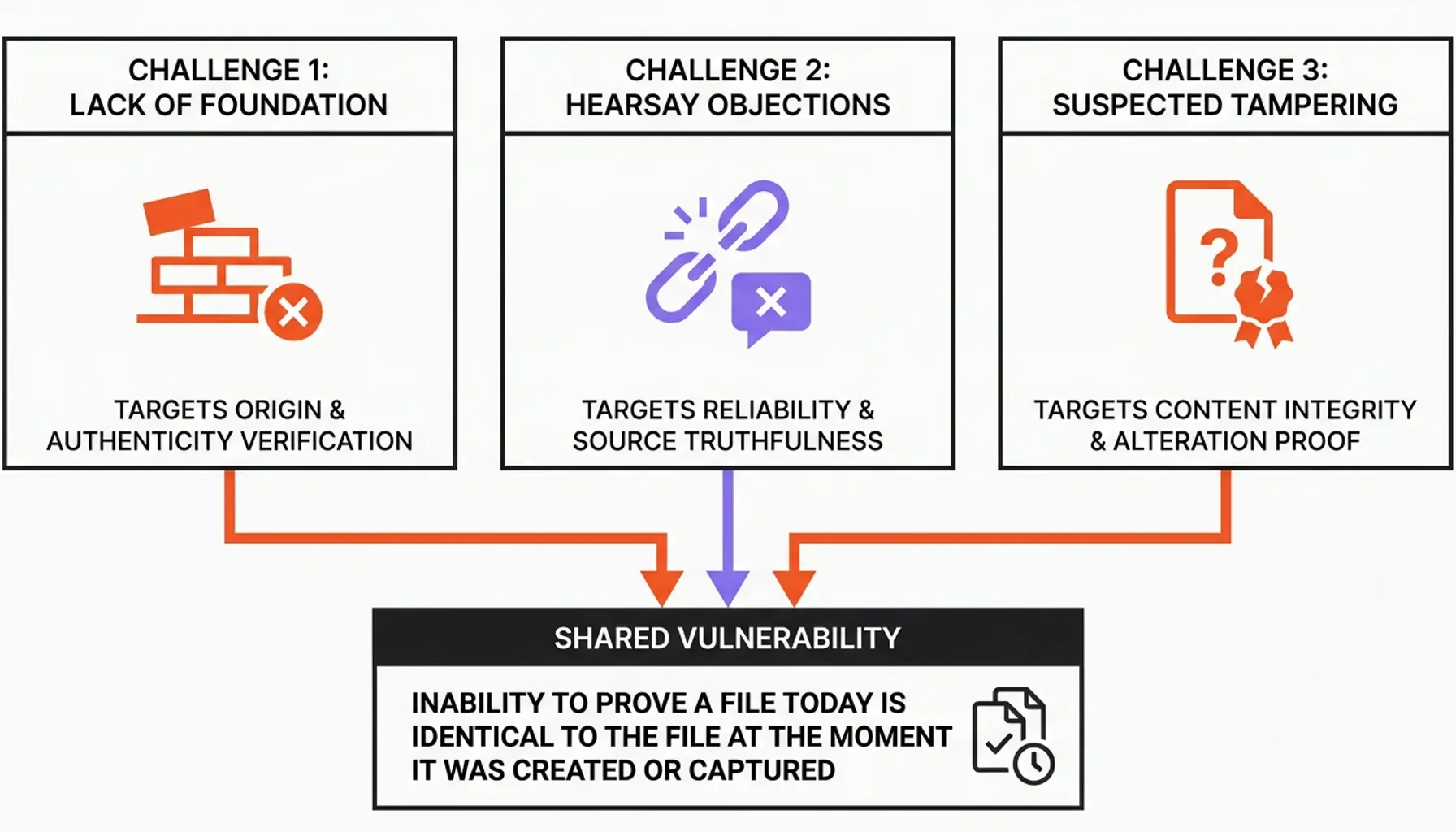
When digital evidence gets challenged or excluded, the reasons cluster into three buckets:
- Lack of foundation — the proponent cannot establish where the file came from or how it was produced.
- Hearsay objections — the record is treated as an out-of-court statement offered for its truth.
- Suspected tampering — opposing counsel argues the file could have been altered after the fact.
Each attack targets the same vulnerability: the inability to prove that a file today is identical to the file at the moment it was created or captured.
This is the distinction courts draw between digital existence and digital integrity. You can prove a file exists on a server. Proving it has not been altered since a specific date is an entirely different evidentiary burden. The Federal Rules of Evidence require that any piece of evidence be authenticated before admission, and for digital files, authentication means demonstrating that the data is what it purports to be.
The problem compounds because of the nature of digital infrastructure itself. Self-generated logs and system metadata, including file creation dates, "Date Modified" fields, and access timestamps, are increasingly dismissed by opposing counsel as unreliable. These values are controlled by the same systems and administrators whose conduct may be under scrutiny. A server clock can be changed. A privileged user can edit a log file. Metadata alone proves nothing.
The result is an admissibility crisis that most organizations only discover when it is too late to fix. By the time a complaint lands, the evidence that decides the case has already been created, stored, and, possibly, quietly modified. Nobody was watching the integrity question when it actually mattered.
Authentication Under FRE 901: Proving the File Is What You Claim
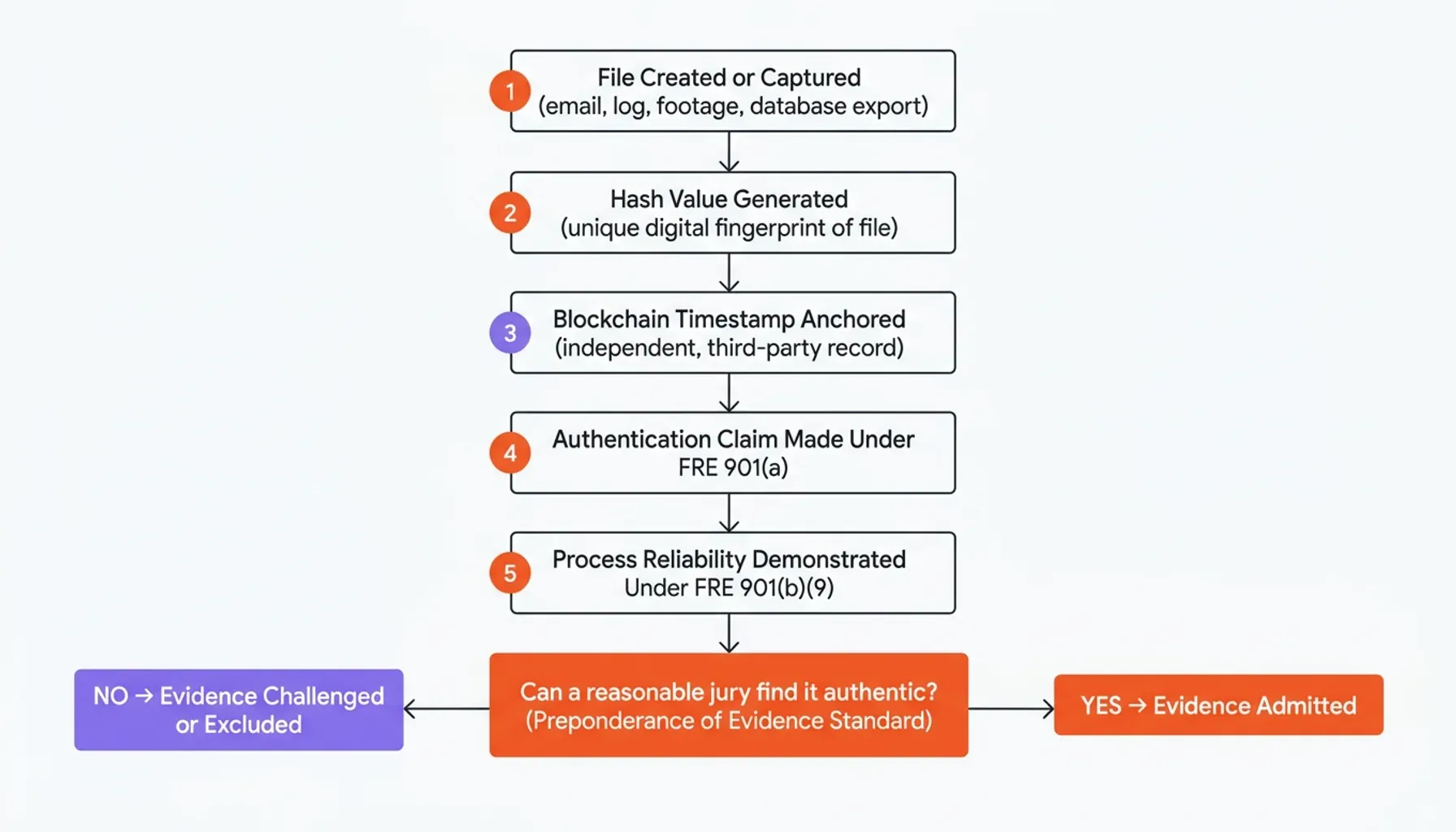
Federal Rule of Evidence 901 establishes the foundation for authenticating evidence. Under Rule 901(a), the proponent must produce evidence sufficient to support a finding that the item is what the proponent claims it to be. For digital evidence, this is rarely straightforward.
Rule 901(b)(9) is the provision that matters most for machine-generated records. It permits authentication by "evidence describing a process or system and showing that it produces an accurate result." This was designed with automated data capture in mind, covering surveillance systems, application logs, network packet captures, and similar outputs. But it places the burden squarely on the party seeking admission to demonstrate that the underlying process was reliable, properly configured, and tamper-resistant. You are not just authenticating a file. You are authenticating the machine that produced it.
Courts apply a preponderance of evidence standard at the authentication stage. The question is not whether the evidence is definitively authentic, since that goes to the jury, but whether a reasonable jury could find it authentic. That sounds like a low bar. In practice, the moment opposing counsel introduces a credible technical argument about the mutability of digital files, even the preponderance standard becomes hard to clear without objective, third-party verifiable proof.
Witness testimony has real limits here. A system administrator can testify that logs were not altered. An IT manager can affirm that backup procedures are sound. But the Department of Justice's own forensic guidance reflects a principle courts apply consistently: lay testimony describing complex automated processes is insufficient on its own when technical authenticity is genuinely contested. The witness cannot speak to what they did not observe, and no human observer watches every write operation to a log file.
Most companies get this wrong. When opposing counsel challenges your log files, they are not attacking the data. They are attacking your process. Organizations that lean on internal attestation, "our team confirms this data is unaltered," are building their case on the weakest possible foundation, because the people offering the attestation are the same people who could have changed the file. What authentication actually requires is an independent, verifiable record that the data existed in a specific form at a specific point in time, created by a process that no internal actor could retroactively influence.
That is precisely what blockchain timestamping for IT security and forensic readiness is designed to provide.
The Integrity Standard in Case Law: From Hash to Admissible
The cryptographic hash is the technical anchor of digital evidence integrity. A SHA-256 hash turns any file into a unique fingerprint, and changing a single character anywhere in the file changes that fingerprint completely. That property is what lets a hash stand in for a file's exact content at a precise moment. The deeper mechanics of why hashing makes data effectively immutable are covered in our explainer on what makes digital records tamper-proof; here, the relevant question is narrower and more legal: how do courts treat that fingerprint as proof?
The landmark answer is Lorraine v. Markel American Insurance Co. (D. Md. 2007). Judge Paul Grimm's exhaustive opinion established a five-part framework for admitting electronic evidence, working through authentication, hearsay, the Best Evidence Rule, relevance, and the risk of unfair prejudice. Nearly two decades later it remains the most comprehensive judicial treatment of digital evidence admissibility in US federal courts, and it is still the reference point practitioners reach for when navigating electronic discovery disputes.
The court's treatment of the Best Evidence Rule is especially instructive. Federal Rule of Evidence 1002 requires the original of a document to prove its content, which raises an immediate question for digital files: what counts as the "original"? Courts have answered by holding that a digital file whose integrity can be verified through hash matching is treated as equivalent to the original. If you can show that the SHA-256 hash of the file you present in court matches the hash recorded at the time of capture, you have satisfied the functional purpose of the Best Evidence Rule. The hash, in effect, becomes the original.
This is exactly where metadata fails as a substitute. The "Date Modified" field is written and rewritten by the operating system; it reflects the last time the file system touched a file, not when the content was created and not whether it has changed since. NIST's guidance on integrating forensic techniques warns explicitly against treating file-system timestamps as sole integrity indicators, precisely because anyone with file-system access can alter them in seconds. A hash, computed from the content itself, cannot be quietly edited to match a modified file. If the hash was independently anchored at creation time, any later regeneration produces a mismatch that anyone can see.
The practical implication is direct. Compute and independently anchor SHA-256 hashes at the moment a file is created or a log is written, and you hold a technically and legally defensible record. Skip that step, and you are relying on the goodwill of opposing counsel not to challenge your metadata. I would not count on that goodwill.
Securing the Chain of Custody for IT Forensics and DevOps
Authentication does not end at the moment of capture. The proponent also has to account for everything that happened to the evidence afterward, which is the role of the digital chain of custody: a documented record that the file in court is the same file that was collected. Every gap in that record is an opening for opposing counsel to argue the data could have been altered in transit. Rather than re-explain how a hash-and-timestamp custody trail is constructed, the focus here is the threat model that makes it indispensable inside an IT organization.
For IT security teams and DevOps organizations, the danger is internal as much as external. Privileged account abuse, where administrators with legitimate access modify log files, alter pipeline outputs, or delete audit records, is one of the hardest threats to detect and prove. An administrator who edits a log file leaves no trace in that same log file. This is not hypothetical: SANS research on insider threats documents how often trusted accounts are the source of incidents, and the evidentiary damage extends well past the breach itself into any investigation or litigation that follows.
When your own infrastructure is the subject of scrutiny, you cannot use that same infrastructure to prove its own integrity. That is a circular argument, and courts see through it quickly.
Automated timestamping breaks the circle by inserting a neutral, tamper-evident observer at every critical point in the data lifecycle. When a log entry is generated, a CI/CD pipeline produces an artifact, or a security event is recorded, the hash of that output is anchored immediately to an external, immutable record. No later administrative action can change the original hash, and any modification after anchoring produces a detectable mismatch.
This architecture maps directly onto ISO/IEC 27037:2012, the standard for identification, collection, acquisition, and preservation of digital evidence. The standard requires that evidence be handled in a way that preserves its integrity and that a complete audit trail document every action taken. Automated hash anchoring satisfies both at once: the hash is the integrity record, and the anchoring event is the audit-trail entry.
For organizations pursuing SOC 2 Type II or ISO 27001, this matters operationally as well as legally. Auditors increasingly expect demonstrable technical controls for log integrity, not just policy statements. An immutable audit trail backed by blockchain timestamps is a control any auditor can verify independently, without access to your internal systems. The same hash-anchoring logic extends to video: blockchain timestamping defends dashcam and video records against tampering and deepfakes, turning the moment of capture into the moment of proof.
Tamper-proof blockchain timestamps for IT security logs and DevOps pipelines provide exactly this kind of independently verifiable, forensic-grade evidence record, built into the workflow rather than assembled after the fact.
Blockchain Timestamping: The Third-Party Verifiable Advantage
The fundamental weakness of any internally managed integrity system is that it is controlled by the same party whose data is under scrutiny. Even technically rigorous internal controls hit a credibility wall in adversarial proceedings: the custodian of the evidence is also the custodian of the integrity proof. Courts and opposing counsel are entitled to be skeptical, and they will be.
Blockchain timestamping resolves this structural conflict by moving the integrity proof outside any single party's control. When a SHA-256 hash is anchored to the Bitcoin or Ethereum blockchain, it is embedded in a public, decentralized ledger that no administrator, no vendor, and no court order can retroactively rewrite. The proof exists outside your organization, permanently and publicly.
That is the legal difference between a tamper-evident and a tamper-proof record: the former detects changes after the fact, while the latter makes concealment mathematically impossible. If a file has been altered since anchoring, the hash mismatch is provable by anyone with access to the public blockchain, including opposing counsel, a court-appointed expert, or a regulatory auditor.
The procedural advantage in litigation is significant. Instead of granting opposing counsel access to your internal servers, databases, and administrative logs for their own integrity audit, an expensive, slow, and invasive process, you hand over a blockchain transaction ID and a hash value. Any technically competent party can verify the proof in minutes, with no requirement to trust your organization, your vendor, or any intermediary. The burden of proof effectively shifts: the doubter, not the custodian, now has to explain away mathematics.
Peer-reviewed research on blockchain timestamping shows the approach is technically sound and reproducible. The Bitcoin and Ethereum networks provide timestamps with precision sufficient for most legal purposes, anchored to a global consensus mechanism that has run continuously for more than a decade. As proof of originality and digital provenance become baseline expectations in both litigation and regulation, the organizations that already hold blockchain-anchored integrity records will have a decisive head start over those reconstructing provenance from mutable system logs.
Practical Implementation: Preparing for Future Litigation
Forensic readiness is not a response to litigation. It is a precondition for surviving it. Organizations that implement integrity controls after a dispute arises are, by definition, too late. The evidence that matters most was created before anyone knew it would matter.
The governing principle is integrity-by-design: every critical digital asset, including security logs, transaction records, contractual communications, and pipeline artifacts, is hashed and anchored at the moment of creation, automatically, without human intervention. This closes the single largest source of evidentiary vulnerability, the gap between when data is created and when someone decides it might be important.
Automation is not optional, and the reason is arithmetic. A log file hashed three hours after generation carries three hours of unverified exposure, a window in which the integrity claim quietly evaporates. An automated process that hashes and anchors at write time carries zero. That gap is exactly where cases are lost.
Jurisdiction matters for multinational organizations. The eIDAS Regulation (EU No 910/2014) establishes a legal framework for electronic seals and timestamps across EU member states, granting qualified electronic timestamps a legal presumption of integrity. FRE and eIDAS operate under different legal traditions, but they converge on the same technical requirement: an independently verifiable, time-bound record of data integrity created by a trustworthy process. Blockchain timestamping satisfies both at once.
It is worth widening the lens beyond courtrooms. Regulatory investigations, internal audits, insurance claims, and contractual disputes all turn on the same question: can you prove what your data said, and when? The organizations that build integrity-by-design into their infrastructure answer that question before anyone asks it, and that quietly reshapes the dynamic of any proceeding. A defensible record is leverage long before it is exhibit A.
The strategic takeaway is straightforward. Any organization that handles digital evidence, in litigation, regulatory investigation, or internal audit, needs an architecture where critical data is independently verifiable from the moment it is created. Not when a dispute arises. Not when an auditor asks. From the moment it exists.
Conclusion: Integrity Is Not Assumed, It Must Be Proven
Courts do not assume digital evidence is authentic. They require proof. And that standard keeps rising as technical challenges to digital integrity grow more sophisticated and more routine.
The organizations that fare best in future digital litigation are those that have already answered the authentication question at the infrastructure level, not with policy documents and witness testimony, but with cryptographic hashes anchored to immutable public blockchains, verifiable by any party, at any time, without access to internal systems.
Here is the question worth sitting with: if opposing counsel demanded independent cryptographic proof of your most critical log files tomorrow, could you produce it, or would you be walking into court with nothing but your own word?
Thomas Hepp
Co-Founder
Thomas Hepp is the founder of OriginStamp and creator of the OriginStamp timestamp, which has set the standard for tamper-proof blockchain timestamps since 2013. As one of the earliest innovators in the field, he combines deep technical expertise with a pragmatic focus on solving real business problems, and is a recognized voice in blockchain security, AI analytics, and data-driven decision support. His work has earned multiple international awards, including a top Best Project recognition from ETH Zurich and the Swiss Confederation. He publishes regularly on blockchain, AI, and digital innovation.